 Skip to content

Why CAN Bus Is Widely Used in Mobile Machinery
Table of Contents
Why Communication Matters in Modern Mobile Machinery
Modern mobile and off-highway equipment is no longer defined by a single function or isolated subsystem. Construction machinery, agricultural equipment, mining vehicles, and sanitation trucks now integrate controllers, sensors, actuators, displays, and operator interfaces into one coordinated system.
As this complexity increases, reliable communication between subsystems becomes essential. Traditional point-to-point wiring and relay-based logic struggle to support this level of integration. This is why communication networks have become a core part of mobile machinery control systems.
Among various options, CAN Bus has emerged as the most widely used communication backbone in mobile machinery.
What Is CAN Bus ?
CAN Bus, short for Controller Area Network, is a communication protocol originally developed for automotive applications. Instead of relying on direct point-to-point wiring, CAN allows multiple electronic control units (ECUs) to communicate over a shared network.
In mobile machinery, CAN Bus acts as a common communication layer that enables controllers, I/O modules, displays, and keypads to exchange data efficiently and reliably—without a central master controlling every message.
At a system level, CAN Bus is not just a cable or a protocol. It is the foundation that allows distributed control architectures to function as a coherent system.
Communication Challenges in Mobile and Off-Highway Equipment
Mobile machinery operates in conditions that are fundamentally different from factory automation environments.
Typical challenges include:
Constant vibration and shock
Wide temperature variations
Dust, moisture, and electromagnetic interference
Long cable runs across large machines
Frequent configuration changes across models
In traditional relay-based systems, each function requires dedicated wiring. As machines grow more complex, wiring becomes heavier, harder to maintain, and more prone to failure.
These challenges help explain why intelligent control is replacing relay-based systems in mobile machinery, and why a robust communication network is required to support that transition.
Why CAN Bus Is Ideal for Mobile Machinery
Reduced Wiring Complexity and Cost
One of the most immediate advantages of CAN Bus is wiring simplification. Instead of running separate wires for each signal, CAN allows multiple devices to communicate over a single pair of cables.
This significantly reduces:
Wiring length and weight
Installation time
Failure points caused by connectors and harnesses
For OEMs, fewer wires mean lower production cost and easier platform standardization.
Reliable Communication in Harsh Environments
Mobile machinery demands communication that remains stable under vibration, electrical noise, and environmental stress.
CAN Bus uses differential signaling and built-in error detection mechanisms to maintain reliable communication even in harsh conditions. If a node encounters an error, it can detect and isolate the problem without disrupting the entire network.
This robustness is a key reason CAN Bus has become the default choice in off-highway equipment.
Deterministic and Real-Time Behavior
Control systems in mobile machinery often require predictable response times. CAN Bus supports message prioritization, ensuring that critical control messages are transmitted with minimal delay.
This deterministic behavior is essential for:
Coordinated motion control
Safety-related functions
Real-time operator feedback
Unlike best-effort communication methods, CAN provides the consistency required for control applications.
Scalability and Flexibility
Modern mobile equipment platforms are rarely one-off designs. OEMs expect to reuse control architectures across multiple machine sizes and configurations.
CAN Bus supports this by allowing new nodes to be added or removed without redesigning the entire wiring system. This flexibility aligns well with modular and scalable system design.
At an architectural level, CAN Bus enables centralized and distributed control architectures to coexist within the same platform.
How CAN Bus Enables Smarter Control Systems
As mobile machinery evolves from manual operation to smart control, communication becomes the system’s nervous system.
CAN Bus enables:
Distributed control across multiple modules
Coordination between controllers, I/O modules, and HMIs
Real-time diagnostics and system monitoring
This capability directly supports the shift described in From Manual Operation to Smart Control in Mobile Equipment, where operators move from executing every action to supervising intelligent systems.
CAN Bus as the Backbone of Distributed Control
Environmental Exposure
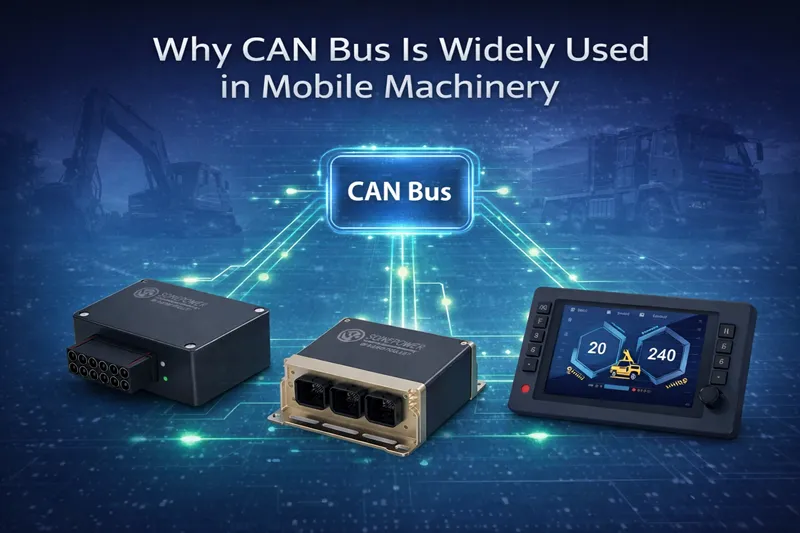
In a modern mobile control system, CAN Bus connects multiple functional modules:
Vehicle controllers handle centralized logic and decision-making
Distributed I/O modules manage sensors and actuators closer to the field, reducing wiring complexity
Rugged displays provide real-time system status and diagnostics to operators
Control keypads offer reliable tactile input for critical functions
Together, these components form a coordinated system rather than isolated devices. CAN Bus allows them to operate as a unified control network.
CAN Bus Compared to Other Communication Approaches
From a system-level perspective, CAN Bus strikes a balance that fits mobile machinery requirements:
More robust and scalable than point-to-point wiring
More deterministic and cost-effective than high-speed Ethernet for control tasks
Widely supported by standards and ecosystems
Rather than being the fastest or most complex option, CAN Bus succeeds because it aligns with real-world operational needs.
Limitations and Practical Considerations
While CAN Bus is well suited for control communication, it is not designed for high-bandwidth data such as video streams or large data transfers.
In advanced systems, CAN may coexist with other communication technologies. However, for core control logic and real-time coordination, CAN remains the preferred backbone.
Recognizing these boundaries helps OEMs design balanced and future-ready architectures.
Conclusion – Why CAN Bus Remains the Standard in Mobile Machinery
CAN Bus is widely used in mobile machinery not because it is new, but because it solves fundamental system challenges.
Its reliability in harsh environments, predictable real-time behavior, reduced wiring complexity, and scalability make it a natural fit for modern mobile and off-highway equipment.
As mobile machinery continues to evolve toward smarter, more integrated control systems, CAN Bus remains the communication foundation that makes this evolution possible.