Skip to content

Marlin vs SonnePower: Mobile Machinery Control Systems
Table of Contents
Electronic control systems are vital in mobile machinery equipment, ensuring reliable communication and precise control. OEMs and system integrators often compare suppliers to match technical standards.
This article compares Marlin Technologies and SonnePower across four product categories: controllers, displays, I/O modules, and keypads.
Company Overview
Marlin Technologies
- Location: Headquartered in Wisconsin, USA
- Expertise: Rugged electronic control systems for demanding environments
- Industries Served: Off-highway, industrial, agricultural, construction, and marine
- Core Products:
- Embedded CANbus modules
- Digital switching solutions
- HMI (Human-Machine Interface) displays
- Customers: OEMs (Original Equipment Manufacturers) and system integrators
- Engineering Services:
- Custom firmware development
- Rapid prototyping
- Lifecycle support

SonnePower
- Headquarters: Hunan, China
- Founded: 2007
- Expertise: Mobile machinery controllers, I/O modules, HMI displays, CAN keypads, integrated motor systems
- Industries Served: Sanitation, construction, mining, agriculture, firefighting, port logistics
- Core Products: Programmable CAN bus controllers, rugged HMI displays (4.3–12.1″), distributed I/O modules (8–32 channels), CAN keypads (8–20 keys, optional rotary knob), HV motor systems (250–450V)
- Engineering Services: Hardware & software customization, programming with CODESYS 3.5

Product Features
Marlin Technologies
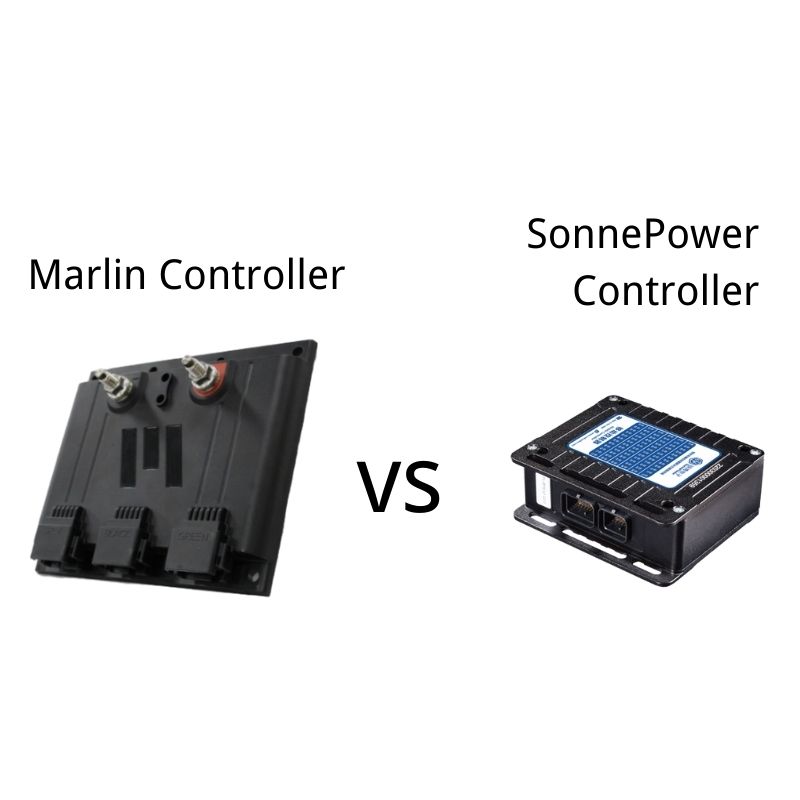
- Controllers: XML-configured, 4–27 I/O, IP67/IP69K, CAN bus up to 1 Mbps
- Keypads: 5–12 keys, relegendable, RGB/amber LEDs, optional Bluetooth
- Displays: 4.3″, 480×272, 800 cd/m² brightness, TouchGFX programmable
- CAN Bridges: Isolated bridge, MFD gateway, protocol bridging
SonnePower
- Controllers: 4–66 I/O channels, DI/DO/AI/PWM/H-Bridge, up to 5 CAN, RS232/Ethernet optional
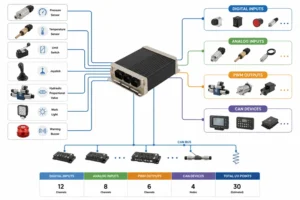
- I/O Modules: 8–32 channels, 5–35A load, CANopen/user-defined, extended functions (amplifier, video, power out)
- Displays: 4.3–12.1″, resolutions 480×272/800×480/1024×600, brightness 400–1000 cd/m², CODESYS 3.5, capacitive touch, video input, quick start 5s
- Keypads: 8–20 keys, white backlight with RGB indicators, customizable icons, optional knob, wireless remote, reversing/water-level/music support
Applications
Marlin Technologies
- Industries: Agriculture, construction, marine, refuse, turf care
- Use Cases: Digital switchers in construction, joystick CAN controllers in marine, valve controllers in utility, refuse truck power distribution
SonnePower
- Industries: Sanitation, construction, mining, agriculture, firefighting, port logistics
- Use Cases: Integrated control in sanitation trucks, mining vehicle automation, excavator/loaders, fire truck monitoring, agricultural CAN control
Controller Parameter Comparison
| Specification | Marlin (M-Flex M05-04) | SonnePower (SPC-SFMC Example) |
|---|---|---|
| Power Supply | 12V / 24V | 8–32V |
| I/O Channels | 4 inputs, 5 outputs | 4–66 channels depending on model |
| Communication | 1–2 × CAN (125–1000 kbps) | Up to 5 × CAN, RS232, Ethernet |
| Protocols | J1939, CANopen, NMEA2000 | J1939, CANopen, User-defined |
| Programming Environment | XML-based configuration | CODESYS 3.5 |
| Protection Grade | IP67/IP69K | IP65/IP67 |
| Operating Temperature | –40°C to +85°C | –40°C to +85°C |
Need a CAN Bus Controller Solution?
SonnePower provides programmable controllers and integrated systems for construction, agriculture, sanitation, mining, and special-purpose machinery.
Display Parameter Comparison
| Specification | Marlin (M-Flex 4.3″) | SonnePower (Displays 4.3–12.1″) |
|---|---|---|
| Sizes | 4.3″ only | 4.3″, 5″, 7″, 8″, 10″, 12.1″ |
| Resolution | 480×272 | 480×272, 800×480, 1024×600 |
| Brightness | 800 cd/m² | 400–1000 cd/m² |
| Programming | XML, TouchGFX | CODESYS 3.5 |
| Interfaces/Protocols | 1–2 × CAN, J1939, CANopen, NMEA2000 | 2–5 × CAN, J1939, CANopen, User-defined, RS232, Ethernet, USB, 4G/GPS/Bluetooth |
| Special Features | Sunlight-readable | Capacitive touch, programmable keys, video input, quick start (≈5s) |
I/O Module Parameter Comparison
| Specification | Marlin (Custom I/O) | SonnePower (SPC-SDIO series) |
|---|---|---|
| I/O Range | Limited, 4/4, 8/8 | 8, 9, 11, 12, 16, 17, 26, 32 channels |
| Protocols | J1939, CANopen | J1939, CANopen, User-defined |
| Load Capacity | Not disclosed | 5–35A (model dependent) |
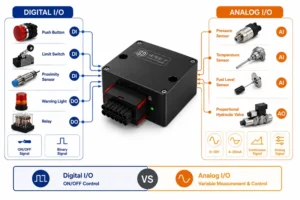
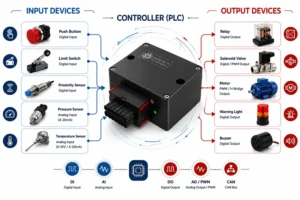
| Functions | DI/DO, limited analog | DI/DO, AI, PWM, PI, H-Bridge |
| Special Features | Rugged encapsulation | Voice amplifier, video input, auxiliary power (5–10V/250mA) |
Keypad Parameter Comparison
| Specification | Marlin (Legend & Classic) | SonnePower (SPM/SPQ series) |
|---|---|---|
| Keys | 5–12 keys | 8, 12, 16, 17, 20 keys, optional knob |
| Backlight | RGB/Amber LEDs | White backlight (adjustable), RGB indicator LEDs |
| Customization | Relegendable icons | Custom key graphics, programmable layouts |
| Connectivity | CAN, optional Bluetooth | CAN, optional Bluetooth or wireless remote |
| Special Features | Tactile buttons | Reversing aid, water-level detection, music playback |
Customer Fit for Mobile Machinery Control Systems
Marlin Technologies
- OEMs and system integrators in North America, especially in marine, turf care, and refuse industries
- Projects requiring rugged digital switching and CAN protocol bridging
- Customers preferring XML configuration with small to medium I/O controllers
SonnePower
- OEMs and integrators in construction, sanitation, mining, agriculture, and firefighting vehicles
- Projects requiring high-channel controllers (up to 66 I/O), large HMI displays (up to 12.1″), or multifunctional CAN keypads
- Customers using CODESYS 3.5 and seeking custom hardware/software integration
Conclusion
Both Marlin Technologies and SonnePower provide CAN bus solutions designed for demanding environments, but their focus differs. Marlin emphasizes rugged digital switchers, relegendable keypads, and CAN bridges, with strong presence in North American marine and turf care markets. SonnePower offers broader coverage with high-channel controllers, larger HMI displays, distributed I/O modules, and multifunctional keypads, serving industries like sanitation, mining, and firefighting.
Decision-making should consider technical specifications, integration requirements, and industry focus to ensure compatibility and long-term reliability.