 Skip to content

Is CAN Bus Outdated?
Table of Contents
Short Answer
No — CAN bus is not outdated.
Classic CAN (CAN 2.0) is still widely used because it is robust, cost-effective, and predictable for real-time control. What is changing is the surrounding system architecture: as machines handle more data, the industry is extending CAN through CAN FD and CAN XL, while selectively introducing Automotive Ethernet where high bandwidth is required.
In other words, CAN is not being replaced — it is being repositioned.
Why People Think CAN Is “Outdated”
The perception that CAN is outdated usually comes from three converging trends.
First, data volume has increased. Modern machines integrate more sensors, diagnostics, and software features. Compared with newer networks, classic CAN’s limited payload and bandwidth can appear restrictive.
Second, connectivity and cybersecurity concerns have changed how engineers evaluate in-vehicle and in-machine networks. As remote access and cloud integration grow, legacy buses are sometimes blamed for risks that actually originate at higher architectural layers.
Third, new electrical architectures — such as domain-based or zonal control — often use Ethernet as a backbone. When people see Ethernet entering the system, they assume CAN must be on its way out.
In practice, none of these pressures mean CAN has stopped being useful.
Where CAN Still Makes Sense — and Why It Persists
Despite newer technologies, CAN remains a default choice in many real machines because it delivers exactly what control systems need:
Proven reliability in electrically noisy environments
Simple wiring and predictable timing
Low implementation and maintenance cost
A massive, well-understood ecosystem
For functions such as body control, power distribution, actuation, and safety-related logic, CAN continues to meet requirements efficiently.
This becomes especially clear when CAN is viewed as part of a broader mobile machine control architecture rather than in isolation, where multiple controllers, I/O modules, and networks work together to perform coordinated functions.

CAN Is Evolving, Not Disappearing
When engineers say “CAN is old,” they usually mean classic CAN no longer fits every use case. The industry response has been evolution, not abandonment.
CAN FD: Extending the Life of CAN
CAN FD increases payload size and allows higher data rates during the data phase, making it suitable for diagnostics, firmware updates, and more data-intensive communication — without abandoning CAN’s core principles.
For many systems, CAN FD represents a practical middle ground: more capability without a full architectural overhaul.
CAN XL: Preparing for the Next Generation
CAN XL, standardized in ISO 11898-1:2024, pushes CAN further into higher-performance territory. It is designed to coexist with CAN and CAN FD, reinforcing the idea that CAN technology is being actively extended, not retired.
The existence of CAN XL alone is strong evidence that the CAN ecosystem has a long future ahead.
Will Automotive Ethernet Replace CAN?
A more accurate question is how these technologies work together.
Ethernet excels at moving large amounts of data — cameras, high-resolution sensors, centralized computing. CAN excels at deterministic, real-time control with minimal overhead.
Future-proofing a machine does not mean choosing one over the other.
In practice, many high-end machines use Ethernet as the backbone for high-bandwidth data, while CAN continues to act as the nervous system for real-time control. Each technology plays a distinct role in a layered architecture.
This hybrid approach is already common in modern vehicle and machinery designs.
When Should You Move Beyond Classic CAN?
Instead of asking whether CAN is outdated, decision-makers should ask what their system actually needs.
Classic CAN is still appropriate when:
Messages are small and periodic
Deterministic control is the priority
Cost and serviceability matter
CAN FD becomes attractive when:
Payload size or update rates increase
Diagnostics and data exchange grow
Ethernet or hybrid architectures make sense when:
Large data streams are unavoidable
The system is moving toward centralized compute
From a system design perspective, flexibility matters. Many modern controllers are designed to support Classic CAN today while remaining ready for CAN FD or hybrid architectures tomorrow, helping protect long-term platform investments.
This approach reduces the risk of choosing a technology that becomes a dead end.
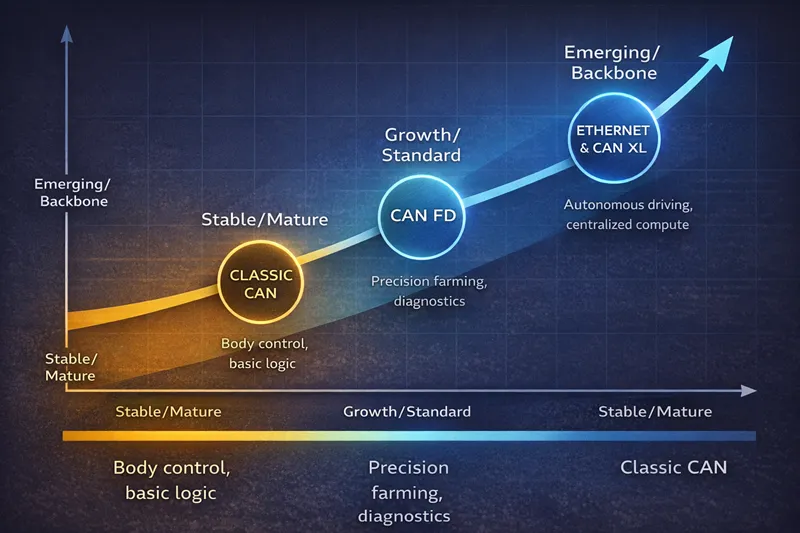
“Outdated” vs “Mature”: A Crucial Distinction
CAN is a mature technology — not an obsolete one.
Maturity means:
Known behavior
Predictable performance
Clear design boundaries
In industrial and mobile machinery, these traits are often more valuable than novelty. Mislabeling maturity as obsolescence is a common source of unnecessary redesign and project delays.
If you are still building intuition around CAN’s electrical behavior, this foundational clarification can help:
Is CAN Bus AC or DC?
Final Takeaway
CAN bus is not outdated
It remains essential for reliable real-time control
CAN FD and CAN XL extend its relevance
Ethernet complements CAN rather than eliminating it
The real question is not whether CAN will disappear, but how it fits into a layered, future-ready architecture.
For many machines, CAN is not the past — it is still part of the plan.