Skip to content

HED vs SonnePower : CAN Bus Controller Supplier
Table of Contents
CAN bus controllers are a core component of modern mobile machinery, ensuring communication between sensors, actuators, and control units. They are widely used in construction, agriculture, sanitation, mining, and special vehicles. Selecting the right supplier involves comparing technology, programming tools, communication capabilities, and application focus. This article provides an overview of HED and SonnePower, highlighting their differences in controllers and applications.
Company Overview
HED
Founded: 1986
Headquarters: Hartford, Wisconsin, USA
Main Business: Rugged electronic control systems for mobile equipment.
Key Products: Controllers, CAN bus displays, keypads, telematics, cameras, and software tools.
Industries Served: Construction, agriculture, forestry, rescue, and utility vehicles.
Positioning: Focus on multiplexed wiring and intelligent controls to improve machine performance and reduce system cost.
SonnePower
Founded: 2007
Headquarters: Changsha, China
Main Business: Electronic control solutions for mobile machinery and special equipment.
Key Products: Controllers, CAN bus displays, I/O modules, keypads, and intelligent motor systems.
Industries Served: Construction, agriculture, sanitation, firefighting, mining, ports, and logistics.
Positioning: Provides integrated control platforms with programmable hardware and flexible communication interfaces.
HED vs SonnePower:CAN Bus Controller
HED Electronic I/O Controllers
Experience & Positioning
Over 35 years in mobile machinery controls.
Widely used in heavy-duty and specialized vehicles.
Communication & Programming
Supports J1939 and CANopen protocols.
Offers programming tools and Board Support Packages (BSP) for OEM customization.
Module Types
Master Control Module – runs application software and manages vehicle functions.
Client I/O Module – communicates with the master module via CAN.
Power Distribution Module – high-power unit integrating control and distribution.

SonnePower Controllers
Experience & Positioning
Focused on mobile machinery since 2007.
Applied in diverse fields such as construction, sanitation, mining, ports, and aerial work platforms.
Communication & Programming
Interfaces: 2–3 × CAN, RS232, RS485, Ethernet (on some models).
Protocols: J1939, CANopen, and custom options.
Programming: CoDeSys 3.5 (some models 2.3).
I/O & Features
I/O range: 18–66 channels, including DI, DO, AI, AO, PWM.
Functions: Fast boot (<5s), built-in diagnostics, port protection.
Options: Wireless connectivity (WiFi, 4G, BeiDou) and data storage up to 64GB.
Need a CAN Bus Controller Solution?
SonnePower provides programmable controllers and integrated systems for construction, agriculture, sanitation, mining, and special-purpose machinery.
Controller Comparison: WIKA vs SonnePower
| Feature / Aspect | HED Controllers | SonnePower Controllers |
|---|---|---|
| Power Supply | 12V, 24V, or 12/24V dual | 8–32VDC wide range across all models |
| Communication Interfaces | 1–4 × CAN | 2–3 × CAN, plus RS232, RS485, Ethernet (on some models) |
| Supported Protocols | J1939, CANopen | J1939, CANopen, Custom Protocols |
| Total Inputs | From 1+ up to 32+ | From 18 to 36 on standard models, up to 66 on high-end |
| Total Outputs | From 1+ up to 32+ | From 12 to 20 on standard models, up to 32 on high-end |
| I/O Capability | Modular: master module, client I/O module, power distribution module | Compact to high-end models with fixed I/O ranges |
| Special Features | Rugged design, BSP support, widely adopted by global OEMs | Fast boot (<5s), customizable UI, IoT-ready (WiFi, 4G, BeiDou, storage) |
Application Comparison
HED Controllers
Construction machinery (excavators, loaders, cranes)
Defense and military vehicles
Rescue and emergency vehicles
Utility and municipal equipment
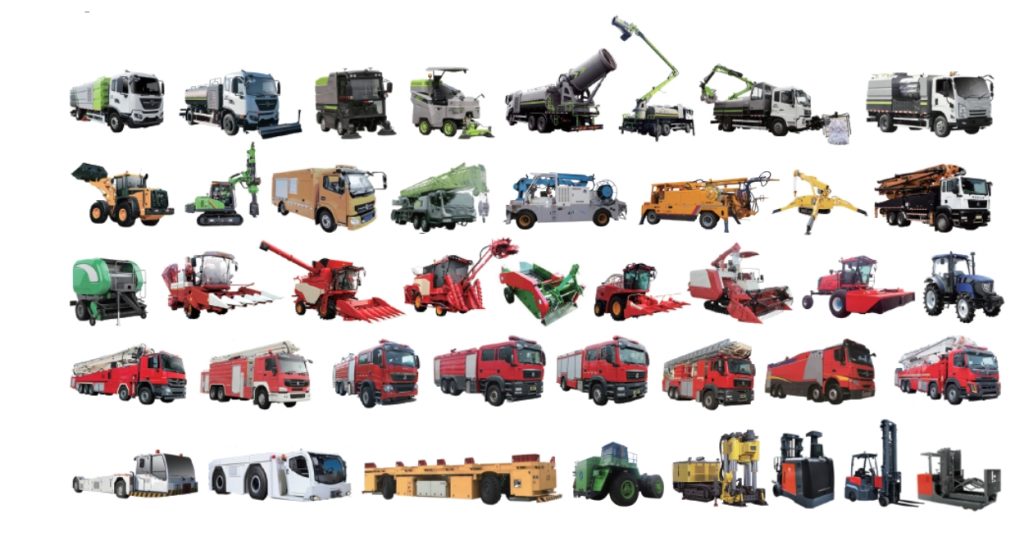
SonnePower Controllers – Main Applications
- Construction machinery
- Agricultural equipment
- Sanitation vehicles
- Firefighting and rescue vehicles
- Mining machinery
- Port equipment
- Airport ground support equipment
- Aerial work platforms
- Logistics machinery
- Road machinery
- Oilfield equipment
- Cranes
- AGVs (Automated Guided Vehicles)
- Hydrogen energy systems
Key Differences Between HED and SonnePower
Industry Focus
HED: strong presence in North America, widely adopted in defense, rescue, and utility vehicles.
SonnePower: broader application coverage in construction, sanitation, and industrial vehicles.
Design Approach
HED: modular system with separate master, client, and distribution modules.
SonnePower: integrated controllers with multiple I/O configurations.
Communication Options
HED: CAN-based with BSP support.
SonnePower: CAN plus extended interfaces (RS232, RS485, Ethernet).
Geographic Market
HED: established mainly in the US and global OEMs with defense and rescue focus.
SonnePower: partnerships with Chinese and Asian OEMs, expanding internationally.
FAQs
Q1. What are the main differences between HED and SonnePower controllers?
HED uses a modular design with a master and client I/O, while SonnePower offers integrated controllers with higher I/O counts and broader communication options.
Q2. Do SonnePower controllers support custom protocols?
Yes, SonnePower controllers support J1939, CANopen, and custom protocols.
Q3. Are HED controllers more focused on North America?
Yes, HED has its strongest presence in the North American market, while SonnePower covers broader Asian and international sectors.
Conclusion
HED and SonnePower both provide CAN bus controllers for mobile machinery, but their focus and design strategies differ.
HED emphasizes rugged modular systems, often used in defense and rescue vehicles.
SonnePower offers integrated, multi-interface controllers applied across a wider range of industries.
Both companies address the core needs of mobile machinery, and the choice depends on application requirements, market region, and desired system flexibility.