Skip to content
CAN Bus Controllers vs. PLC — What’s the Difference?
Table of Contents
In modern industrial automation and mobile machinery, CAN Bus Controllers and Programmable Logic Controllers (PLCs) are two fundamental technologies. They frequently appear in discussions about control systems, yet they serve distinct purposes. This article provides a detailed comparison, covering definitions, features, applications, standards, performance considerations, and guidance for selecting the appropriate solution.
What is a CAN Bus Controller?
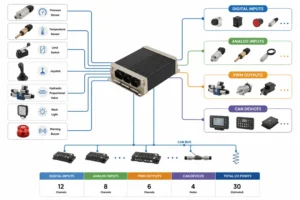
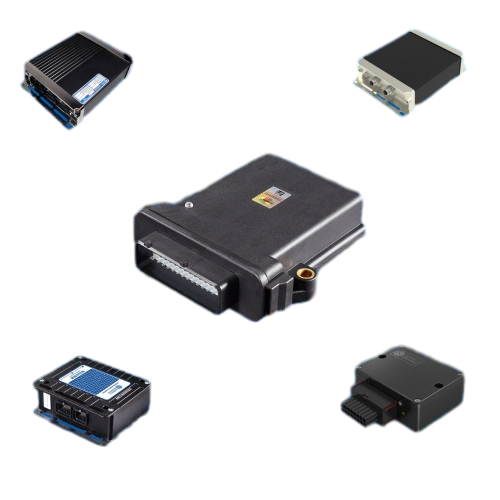
A CAN Bus Controller is a hardware module or embedded component that manages communication over a Controller Area Network (CAN), as defined by ISO 11898. It handles message framing, error detection, arbitration, and buffering, allowing multiple devices (nodes) to exchange information in real time without a central host.
Key Applications
Automotive systems (engine management, transmission control, ABS, airbags)
Mobile machinery (construction, agricultural, mining equipment)
Industrial automation and distributed I/O systems
Medical devices and smart sensors
Key Features
Multi-master capability: Any node can initiate communication
Arbitration & priority: Critical messages transmitted first
Error handling: Automatic error detection and retransmission
Physical layer: Two-wire differential signaling (CAN High/CAN Low) with EMI resistance
Protocol support: CANopen, SAE J1939, DeviceNet
What is a PLC (Programmable Logic Controller)?
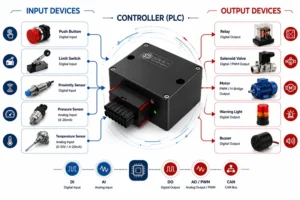
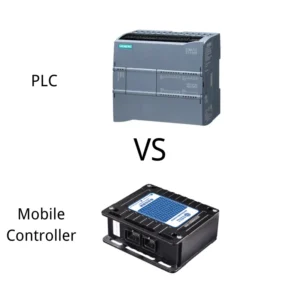
A PLC is an industrial-grade digital computer designed to control machinery and processes. It continuously reads inputs, executes pre-programmed logic, and drives outputs in a deterministic scan cycle.
Key Features
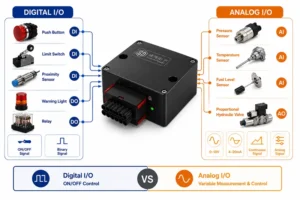
Modular I/O architecture for analog and digital sensors and actuators
Programming standards compliant with IEC 61131-3: Ladder Logic, Function Block Diagram (FBD), Structured Text (ST), Sequential Function Chart (SFC)
Durable against industrial conditions: vibration, dust, temperature, humidity
Expandable with additional I/O modules, communication buses, and safety devices
Typical Applications
Factory automation: assembly lines, robotics, packaging
Process industries: chemical plants, oil & gas, water treatment, metallurgy
Building automation: HVAC, elevators, energy management systems
Advantages and Limitations
CAN Bus Controllers
Advantages:
High real-time communication performance
Simple two-wire cabling, cost-effective for distributed systems
Strong resistance to electromagnetic interference
Flexible node-based architecture for scalable deployment
Limitations:
Limited data rate: 1 Mbps standard, up to 8 Mbps with CAN FD
Requires external logic processing for complex control
Bus topology requires careful termination and planning
PLCs
Advantages:
Capable of handling complex logic, sequencing, and PID control
Reliable and durable in industrial environments
Standardized programming facilitates integration with SCADA/HMI systems
Limitations:
Higher initial investment
Scan cycle latency limits ultra-fast response
Physical expansion may be constrained by chassis size
Typical Application Scenarios
CAN Bus Controllers
Automotive electronics: engine, transmission, ABS, airbags
Mobile machinery: construction, agricultural, mining equipment
Distributed I/O systems, smart sensors, and monitoring networks
PLCs
Factory automation: assembly lines, robotics, packaging
Process industries: chemical plants, water treatment, metallurgy
Building automation: HVAC, elevators, energy management
Industry Standards and Ecosystem
CAN Bus: ISO 11898, CANopen, SAE J1939, DeviceNet
PLC: IEC 61131-3, PROFINET, Modbus, EtherCAT, Ethernet/IP
Hybrid Systems: Many modern PLCs include CAN interfaces for combined centralized logic and distributed communication
Performance & Design Considerations
Communication speed: CAN (1 Mbps / 8 Mbps CAN FD) vs Ethernet-based PLC (100 Mbps+)
Node count & topology: CAN supports linear bus; PLC networks often use star or modular Ethernet topologies
Real-time requirements: CAN excels in deterministic messaging; PLC excels in logic execution
Cost and maintenance: CAN nodes are low-cost but require protocol analyzers for debugging; PLC systems are more expensive but easier to monitor and maintain
Environmental tolerance: PLCs are industrial-grade; CAN nodes must be ruggedized for harsh mobile conditions
Architecture and Functional Comparison
Architecture & Operating Principles
CAN Bus Controllers: Act as the communication interface, connecting distributed nodes, managing message arbitration, and ensuring real-time data delivery
PLCs: Act as the central controller, executing logic, performing calculations, and driving outputs based on input signals
Functional Comparison Table
| Feature | CAN Bus Controller | PLC |
|---|---|---|
| Primary Role | Real-time node communication | Execute control logic |
| Real-Time Capability | Sub-millisecond message arbitration | Scan cycle (10–50 ms typical) |
| Scalability | Flexible addition/removal of nodes | Modular expansion limited by chassis |
| Environment | Mobile machinery, automotive | Fixed industrial environments |
| Logic Handling | Requires external MCU/ECU | Built-in logic execution |
| Cost | Low per node | Higher initial investment |
Choosing Between CAN Bus and PLC
Use CAN Bus Controllers
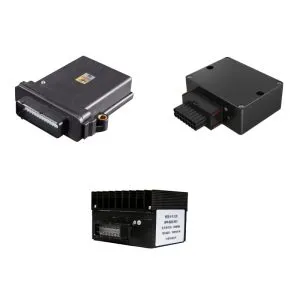
when distributed real-time communication is critical — for example, SonnePower’s rugged CAN-bus controllers and intelligent distributed I/O modules are designed for mobile machinery and harsh outdoor environments, delivering reliable node-to-node data exchange.
Use PLCs
when centralized logic, complex sequencing, or industrial process control is required — SonnePower controllers can also integrate with existing PLC systems via CANopen or SAE J1939 for seamless communication.
Call to Action (CTA)
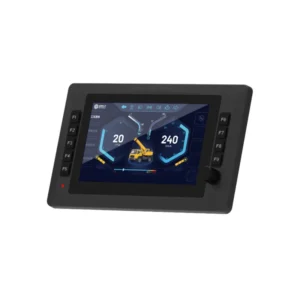
Looking for a reliable solution that combines real-time communication and centralized control? SonnePower provides rugged CAN-bus controllers, intelligent I/O modules, programmable HMI displays, and electric motor systems tailored for your mobile machinery and industrial automation needs.
Looking for a reliable solution that combines real-time communication and centralized control? SonnePower provides rugged CAN-bus controllers, intelligent I/O modules, programmable HMI displays, and electric motor systems tailored for your mobile machinery and industrial automation needs.
Get Your Custom Control Solution