Skip to content
CAN Bus Hydraulic Control: Components, Benefits & Applications
Table of Contents
What Is a CAN Bus Hydraulic Control System?
In modern mobile machinery—from excavators and pavers to loaders and agricultural equipment—hydraulic systems provide the force required to move cylinders, booms, buckets, and other actuators. A programmable controller coordinates these movements by processing operator commands, monitoring sensor feedback, and controlling hydraulic valves in real time.
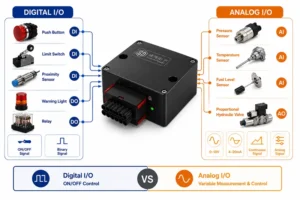
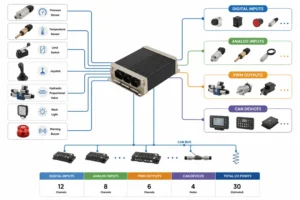
In a CAN bus hydraulic control system, joysticks, pressure sensors, displays, and electronic controllers exchange data through protocols such as SAE J1939 or CANopen. The controller converts these CAN messages into PWM, current-controlled, or on/off output signals for proportional and solenoid valves. This allows the machine to regulate hydraulic flow, pressure, direction, and actuator movement with greater precision and diagnostic capability.
Key Components of a CAN Bus Hydraulic Control System
| Component | Function | Typical Signal/Interface |
|---|---|---|
| Joystick/HMI | Sends operator commands and displays system parameters, alerts, and diagnostic information. | SAE J1939, CANopen, analog |
| Sensors (Pressure, Position, Temperature) | Measure operating conditions and provide real-time feedback for closed-loop control and diagnostics. | CAN, analog, digital |
| Electronic Controller (ECU) | Reads input signals, processes control logic, and commands outputs to valves and actuators. | CAN, PWM, current, digital |
| Proportional Valves | Regulate hydraulic flow and pressure to provide precise control of actuator speed, position, or force. | PWM or current-controlled output |
| Solenoid Valves | Switch hydraulic functions on or off based on commands from the controller. | Digital output |
| CAN Bus Network | Provides the communication backbone connecting controllers, joysticks, sensors, and HMIs. | SAE J1939, CANopen |
How CAN Bus Controllers Communicate with Hydraulic Valves
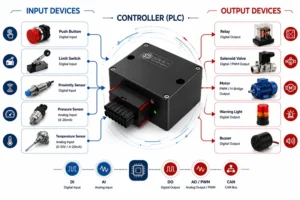
A CAN network carries commands and diagnostic data between electronic devices, but it does not normally supply the electrical power needed to drive a hydraulic valve directly. Instead, a CAN bus joystick, sensor, or HMI sends a message to the machine controller. The controller interprets that message according to the programmed control logic and generates the appropriate output for the valve.
For a proportional hydraulic valve, the controller typically uses a PWM or current-controlled output to regulate the valve spool position. Changing the output changes hydraulic flow or pressure, allowing precise control of cylinder speed, motor speed, or actuator force. On/off solenoid valves use digital outputs for simpler switching functions.
Sensor feedback can also be returned to the controller through analog inputs or the CAN network. This creates a closed-loop system in which the controller continuously compares the requested movement with pressure, position, speed, or temperature data and adjusts the valve output accordingly.
A typical signal path is:
Joystick or sensor → CAN message → programmable controller → PWM/current output → proportional valve → hydraulic actuator
Benefits of CAN-Based Hydraulic Control
-
Precise Motion Control – Smooth cylinder movement, accurate positioning, and coordinated multi-axis operation.
-
Energy Efficiency – Supports load-sensing strategies, variable pump control, and optimized flow distribution.
-
Diagnostics & Safety – Supports diagnostic functions, fault handling, event logging, and application-specific safety strategies when properly designed and programmed.
-
Simplified Wiring – CAN bus reduces wiring harness complexity compared to point-to-point analog connections.
-
Flexibility & Scalability – Easily reprogrammed or expanded to add new functions without redesigning hardware.
Best Practices for Implementation
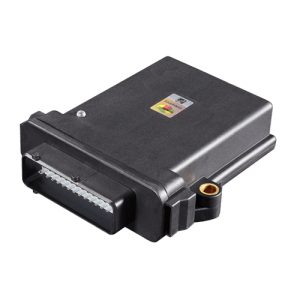
Match I/O to Machine Needs: Select a controller with the right number of digital/analog inputs and outputs.
Ensure Environmental Robustness: Look for IP67 protection, EMC compliance, and -40°C to +85°C operating range.
Use Standard Protocols: SAE J1939 or CANopen ensures interoperability with sensors, displays, and actuators.
Plan for Diagnostics: Integrate pressure/temperature sensors and log data for preventive maintenance.
Software Configuration: Use parameterizable and programmable logic for flexibility in different machine models.
Trends in Mobile Hydraulic Control Electrification and Hybrid Systems
Mobile machines increasingly combine hydraulic actuators with electric motors and battery-powered subsystems. Controllers must coordinate hydraulic and electric functions while managing energy consumption and machine performance.
Telematics and Remote Diagnostics
CAN-based controllers can share operating data, fault codes, pressure readings, and temperature information with telematics systems. This supports remote troubleshooting, preventive maintenance, and improved equipment availability.
Advanced Closed-Loop Control
Pressure, position, speed, and temperature sensors provide continuous feedback to the controller. The control software uses this data to adjust proportional-valve outputs in real time, improving motion accuracy, stability, and efficiency.
More Integrated Control Architectures
Modern controllers are increasingly expected to connect joysticks, sensors, HMIs, I/O modules, valves, and other machine subsystems through standardized CAN networks such as SAE J1939 and CANopen.
Applications
Pavers & Road Machinery: Control screed lift cylinders and material feed precisely.
Excavators & Loaders: Smooth multi-function operation, boom/bucket synchronization, flow sharing.
Sanitation & Utility Vehicles: Control lifting arms, compaction units, and hydraulic winches.
Agricultural Equipment: Precision spraying, seeding, and boom height control.
SonnePower Controllers for Mobile Hydraulic Systems
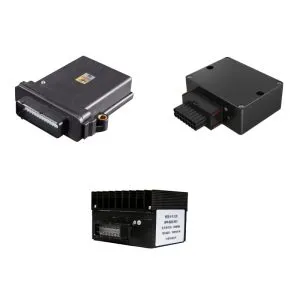
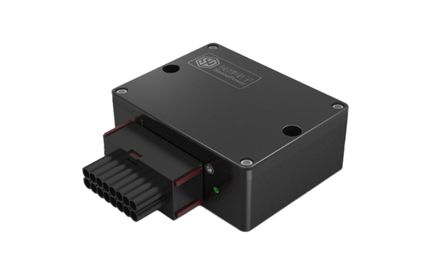
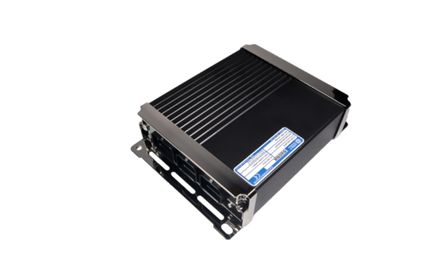
SonnePower programmable mobile machinery controllers can be integrated into CAN-based hydraulic systems to process joystick and sensor signals, communicate over J1939 or CANopen networks, and control valves and actuators through configurable I/O.
Controller selection should be based on the required input and output types, CAN interfaces, valve-driving requirements, environmental conditions, and control software. Explore our complete mobile machinery controller range or contact our engineers to discuss your hydraulic control architecture.