Skip to content
Construction Equipment Displays : Rugged CAN-Bus HMI Guide
Table of Contents
Why Construction Equipment Needs Rugged HMIs
In construction equipment, the Human-Machine Interface (HMI) is the operator’s primary control and monitoring tool. It displays key parameters and alerts in real time.
Construction sites are harsh — dust, rain, vibration, and extreme temperatures demand displays that remain reliable. The global rugged display market topped USD 10B in 2023 and is growing ~6% annually, with rising demand for larger 10–15″ screens for data-rich applications.
CAN-Bus and HMI Technology Basics
The Controller Area Network (CAN bus) is the most widely used communication network in construction machinery, electric vehicles, and off-highway equipment. It allows multiple electronic control units to exchange data reliably and in real time over a shared bus.
Common protocols include:
SAE J1939 – the dominant protocol for heavy-duty vehicles and construction machinery, supporting diagnostics and control.
CANopen – popular in industrial automation, enabling modular expansion.
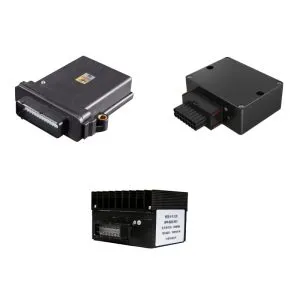
For HMIs, supporting multiple CAN channels and multiple protocols allows integration with engine ECUs, hydraulic controllers, sensor nodes, and I/O modules, resulting in higher system integration and more effective data visualization.

Key Design Considerations for Rugged HMIs
Display Performance
Brightness and Readability: High-brightness screens (700–1000 nits) with sunlight readability and anti-glare coating are essential.
Resolution and Size: From compact 4–7″ displays to larger 10–15″ screens, selected based on cabin space and data complexity.
Durability
Ingress Protection: IP65, IP67, or even IP69K ensures dustproof and waterproof performance under heavy washdown conditions.
Environmental Robustness: Wide temperature operation (-40°C to +70°C), vibration and shock resistance for continuous uptime.
Interfaces and Protocols
Multiple CAN channels with J1939 and CANopen compatibility
Additional interfaces such as USB, Ethernet, or video input for diagnostics, firmware updates, and camera integration
Input Methods
Touchscreen: Intuitive navigation and customization
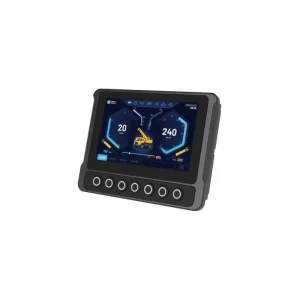
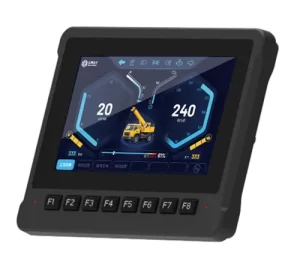
Physical Buttons or Hybrid Input: Reliable operation with gloves, in wet or bumpy conditions
Software and UI
Programmable interface for OEM-specific layouts and workflows
Remote diagnostics and OTA (over-the-air) updates to reduce downtime and maintenance costs
Industry Challenges and Design Trade-Offs
Cost vs. Reliability: Higher IP ratings and high-brightness displays increase manufacturing costs, requiring OEMs to balance budgets and lifecycle costs.
Power Consumption and Thermal Management: Bright backlighting raises power draw and thermal load, demanding efficient design.
Operator Experience: The interface should be clear and intuitive, avoiding information overload that distracts operators.
Maintainability: Modular construction reduces downtime and makes field replacement easier.
Application Scenarios
Asphalt Pavers: Display paving thickness, speed, and material level to ensure consistent quality.
Loaders and Excavators: Monitor engine RPM, hydraulic pressure, fuel consumption, and boost productivity.
Mining Trucks & Sanitation Vehicles: Centralize subsystem monitoring, support remote alarms and dispatch.
Agricultural Machinery: Show navigation paths, spraying or seeding parameters for precision agriculture.
Recommended Solution
Choosing the right rugged CAN-bus HMI is key to reliable operation and operator safety.
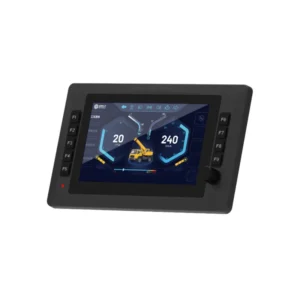
SonnePower Rugged CAN-Bus Displays (4.3″, 5″, 7″, 8″, 10.1″, 12.1″) feature high-brightness, anti-glare screens, IP65 aluminum housing, multiple CAN channels (J1939, CANopen), and customizable software with remote updates — ideal for construction, mining, and agricultural machines.
📩 Learn more: Contact us for specs, support, or a demo unit.