...
🇮🇹 Meet SonnePower at REAS 2026 in Italy   |   Oct. 8–10, 2026   |   Centro Fiera Montichiari   |   Pavilion 2 – Stand C9 🇮🇹 Meet SonnePower at REAS 2026 in Italy   |   Oct. 8–10, 2026   |   Centro Fiera Montichiari   |   Pavilion 2 – Stand C9

Agricultural Display Integration Guide (2025)

Table of Contents

Agriculture is becoming increasingly connected, automated, and data-driven. Precision guidance, automated implement control, and IoT-based sensors have become part of everyday farm operations. At the heart of this transformation is the agricultural display — the operator’s primary interface for machine control and real-time data visualization.

An integrated display merges navigation, implement control, and performance monitoring into a single hub, reducing in-cab clutter and simplifying the operator’s workflow.

The Challenge of System Fragmentation

Traditionally, operators used separate monitors for GPS guidance, implement control, and machine diagnostics. This approach often results in:

  • Complex cab layouts with multiple screens and cables

  • Fragmented data, making it difficult to generate a complete record of field operations

  • Compatibility issues between equipment from different manufacturers

Such fragmentation not only increases setup time but also raises the risk of operational errors.

Key Technologies Enabling Display Integration

ISOBUS and Standardization

Standards such as ISOBUS (ISO 11783) enable a single Universal Terminal (UT) display to control multiple implements, regardless of manufacturer. Task Controller (TC) functions manage prescription maps and record as-applied data, while the File Server (FS) function ensures seamless data transfer between devices.

Communication Networks

Most modern agricultural displays support CAN bus and SAE J1939 communication for machine diagnostics and control. This allows reliable, real-time data exchange between ECUs and the display, forming the backbone of precision farming operations.

Multi-Function Operator Interface

A well-designed agricultural display enables operators to:

  • Define guidance lines and field boundaries with high precision

  • Control variable-rate seeding, spraying, and fertilizing for optimized input usage

  • Continuously monitor engine parameters and machine health

  • Automatically log field operations for regulatory compliance and post-season analysis

SonnePower’s Integrated Display Solution

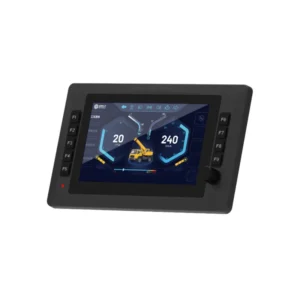
Integrated displays are no longer just a concept — they are a proven way to simplify operations and boost productivity. SonnePower’s SDIS Series displays are built with these principles at their core:

  • Hardware Durability: Rugged design with IP65/IP67 protection and sunlight-readable touchscreens in 4.3″, 7″, 10.1″, and 12.1″ sizes.

  • Protocol Support: Full ISOBUS UT/TC compatibility, plus CAN bus and SAE J1939 support for seamless integration with tractors, sprayers, harvesters, and other implements.

  • Data Handling: Onboard data logging with local storage and optional wireless synchronization to farm management systems for real-time data access.

  • User Experience: Intuitive, customizable UI layouts and multi-language support to suit global operators.

This solution represents where the industry is heading — combining rugged hardware, open communication standards, and software flexibility into one integrated platform for agricultural operations.

Key Benefits for Farmers and Operators

  • Simpler Cab Environment: One integrated display replaces multiple monitors, reducing in-cab clutter and operator confusion.

  • Time & Input Savings: Section control and variable-rate application minimize overlaps and skips, maximizing efficiency and reducing input costs.

  • Better Record-Keeping: Centralized task data supports compliance reporting and enhances traceability for audits and decision-making.

  • Future-Proof Investment: Software upgrades add new features without hardware replacement, protecting long-term ROI.

Challenges and Considerations

Even with integrated displays, several challenges remain:

  • Upfront Cost: Retrofitting older machines for ISOBUS compatibility may require new controllers and wiring, increasing initial investment.

  • Training: Operators need time and support to learn the interface and take full advantage of its capabilities.

  • Connectivity Gaps: Limited network coverage in rural areas can restrict real-time cloud features and remote support.

Conclusion & Call to Action

Integrated agricultural displays bring together guidance, implement control, and data management into one operator-friendly platform — improving efficiency, reducing complexity, and preparing farms for the future of precision agriculture.

📩 Looking for a rugged integrated display solution?
Explore SonnePower’s SDIS Series and discover how our displays can upgrade your farm operations.
👉 Contact our experts to get datasheets, request a demo, or receive tailored recommendations for your farm equipment.
Scroll to Top

Contact information

Write for us