Skip to content
How to Choose a J1939 Keypad for Mobile Machinery
Table of Contents
Modern mobile machinery — including fire trucks, garbage compactors, agricultural harvesters, and port logistics vehicles — typically requires rugged and reliable operator interfaces that can withstand vibration, shock, extreme temperatures, and dust or water ingress.
J1939 CAN-bus keypads are widely adopted by OEMs and system integrators because they simplify wiring harnesses, enable software-configurable button functions, provide visual feedback through status LEDs, and can improve system uptime through easier diagnostics and maintenance.
In this guide, we’ll cover the essentials: J1939 protocol requirements (baud rate, addressing, PGNs), key environmental and EMC standards (IP65/67, IEC 60068, ISO 16750), relevant safety considerations (e.g., ISO 13849), and practical integration tips — helping you confidently choose the right J1939 keypad for your vehicles or fleet.
What Is a J1939 Keypad?
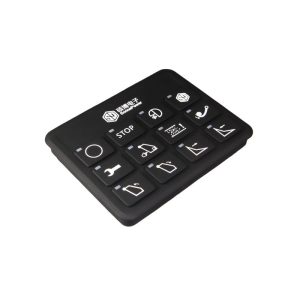
A J1939 keypad is a programmable multi-button switch panel that uses the SAE J1939 higher-layer protocol over CAN (29-bit extended frames), widely adopted in heavy-duty and off-highway vehicles. Instead of individual hardwired circuits, the keypad publishes J1939 messages (PGNs—often vendor-proprietary) to the controller, which interprets the embedded fields.
Key Advantages
- Reduced wiring harness — fewer cables, lower weight, faster installation.
- Software-configurable — reassign functions without rewiring (via vendor tools or CAN parameters).
- Integrated feedback — status LEDs/backlighting (optionally buzzer/dimming) for real-time indication.
- Scalable — add more keypads on the same CAN bus with unique source addresses and controlled bus load.
Key Factors to Consider When Selecting a J1939 Keypad

1.Protocol Compatibility & CAN Parameters
Before shortlisting any J1939 keypad, confirm that it fully meets your network’s protocol and communication requirements.
Baud Rate
Check whether the keypad supports 250 kbps (J1939-11) or 500 kbps (J1939-14) as required by your system. Some OEMs also use J1939-15 (unshielded 250 kbps). Using the wrong baud rate can prevent the keypad from communicating with the rest of the network.
Source Addressing
Each device on a J1939 network needs a unique source address (SA). Choose a keypad that supports configurable or dynamic address claiming so it can coexist with other ECUs without conflicts.
PGN / SPN Mapping
Keypads typically transmit button states using proprietary PGNs. Make sure your controller can parse these messages, or that the keypad allows remapping to match your application’s PGN/SPN structure.
Diagnostics & Heartbeat
Look for devices that provide heartbeat messages or error status PGNs to monitor network health. Full DM1/DM2 diagnostic messages are optional—commonly implemented only on more advanced or safety-critical models.
Pro Tip
If your system combines multiple CAN protocols (e.g., J1939 + CANopen), pick keypads with multi-protocol firmware or field-upgradeable options. This ensures you can adapt to mixed networks without swapping hardware later.
2.Environmental Protection & Durability
Mobile machinery keypads must survive dust, water, vibration, and chemicals.
Standards: Look for testing to ISO 16750 (mechanical, climate, chemical) and IEC 60068 (vibration -2-64, shock -2-27).
Ingress Protection: Minimum IP67, or IPX9/IP69K for high-pressure washdown (ISO 20653).
Temperature: −40 °C to +85 °C operation to handle all weather.
Vibration & Shock: Validated to match machine mounting location.
UV & Chemicals: UV-stable overlays and chemical-resistant materials to prevent fading or cracking.
3. Mechanical Design & Materials
Good keypads combine ergonomics and durability — glove-friendly operation, consistent tactile feel, and robust construction.
Button Overlay: UV-stable silicone or hard-coated PC; laser-etched or under-printed legends with scratch and chemical resistance.
Actuation Life: ≥1 million cycles per key (prefer 2–5 M) with minimal force drift over life.
Mounting: Front- or rear-panel mount with proper cut-out, thickness, torque, and gasket specs to maintain IP rating.
Connector: Sealed Deutsch DT/DTM/DTP, TE AMP Superseal/AMPSEAL 16, or Molex MX150/ML-XT; match pin count, current rating, and keep CAN stub lengths short.
4.Visual Feedback & Backlighting
LED indicators: single-color or RGB with PWM dimming; define color/blink patterns for each state.
Backlighting: wide-range, low-flicker dimming (night mode) for low-light operation.
Glove-friendly: large keys with distinct travel and tactile/audible feedback; high-contrast legends.
5. Safety & Compliance
Functional safety: Keypads in E-stop circuits should support the target ISO 13849-1 PL level; system design must ensure dual-channel or monitored input paths.
EMC: Compliance with ISO 7637-2, CISPR 25 (and ISO 11452 if possible) for immunity and emissions.
Redundancy: Dual contacts or redundant CAN frames with heartbeat for fail-safe operation.
6. Integration & Network Considerations
- Bus termination: Verify 120 Ω end-of-line termination or switchable internal resistor.
- Addressing: Support static or dynamic address claiming to avoid conflicts.
- PGN docs: Request a DBC or message table for faster controller integration.
- Firmware: Prefer OTA or field-update capability with secure rollback.
7. Cost vs. Total Value
Look beyond unit price—factor in downtime risk, replacement ease, spare part availability, and customization (icons, LEDs, firmware). A higher-quality keypad can save hours in wiring, validation, and future service calls.
8. Supplier Checklist
Before ordering, request:
Datasheets & drawings with pinout and cut-out dimensions
Environmental test reports (IP, vibration, chemical resistance)
PGN/DBC documentation for controller integration
Sample units for real-world cab testing
Conclusion
Choosing a J1939 keypad isn’t just about button count — it’s about ensuring protocol compatibility, ruggedness, operator ergonomics, and long-term reliability.
✅ Quick Selection Checklist:
J1939 baud rate & PGN/SPN mapping confirmed
IP67/IP69K protection & vibration/shock tested
Backlit, glove-friendly buttons
Supplier provides documentation, test reports, and support
Looking for a reliable keypad solution?
SonnePower offers IP67-rated J1939 CAN keypads with customizable icons, RGB LED feedback, and proven durability for mobile machinery.📩 Request a Sample and test it in your next project.