Skip to content
What Are I/O Modules in Mobile Machinery?
Table of Contents
Modern mobile machinery—from construction excavators to agricultural harvesters—relies on electronic control systems to operate safely and efficiently. One of the most important building blocks in these systems is the I/O module (Input/Output module).
This article explains what an I/O module is, the main types available, how it differs from a PLC or controller, and why it plays a critical role in distributed control systems for mobile equipment.
What Is an I/O Module?
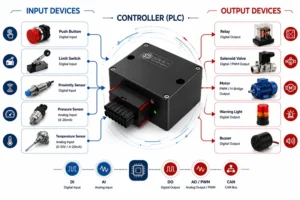
An I/O module connects sensors, switches, and actuators to the machine’s controller or PLC. It acts as the interface between the physical world and the control system:
Input side – Collects data such as hydraulic pressure, temperature, joystick position, or limit switch status.
Output side – Sends control signals to proportional valves, relays, solenoids, or work lights.
In mobile machinery, rugged I/O modules are essential because they must operate reliably in harsh outdoor conditions, withstanding vibration, moisture, and extreme temperatures.
Three Main Types of I/O Modules
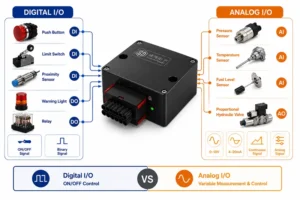
Digital I/O (DI/DO) – Detects ON/OFF signals (switches, buttons) or controls discrete outputs like relays.
Analog I/O (AI/AO) – Processes continuous signals (e.g., 4–20 mA transmitters, voltage/current outputs).
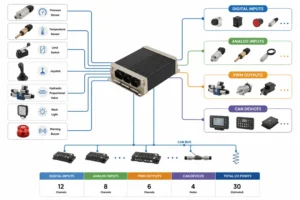
Communication / Mixed Modules – Combine multiple I/O types and include CAN bus (SAE J1939, CANopen) for easy integration in distributed architectures.
I/O Module vs. PLC/Controller
| Aspect | I/O Module | PLC / Controller |
|---|---|---|
| Main Function | Extends I/O points, interfaces with field devices | Executes control logic and decision-making |
| Programmable? | Usually fixed, not programmable | Fully programmable (IEC 61131 languages) |
| Location | Distributed near sensors/actuators | Often installed centrally in control box |
Think of the controller as the “brain” and the I/O modules as the “senses and muscles” of the system.
Why I/O Modules Are Important?
Expand system capacity when built-in I/O is not enough
Reduce wiring complexity by mounting near sensors and actuators
Improve reliability with electrical isolation and built-in diagnostics
Support modular design for scalable and serviceable systems
Looking for Rugged I/O Modules?
SonnePower’s SDIO Series I/O modules feature IP67 protection, wide temperature range (-40°C to +85°C), and CAN bus communication (SAE J1939 / CANopen) for reliable distributed control in mobile machinery.
Functions of I/O Modules
Signal acquisition & conversion – Read voltages, currents, temperatures
Signal output & actuation – Control motors, relays, proportional valves
Conditioning & protection – Filter noise, provide isolation, prevent damage
Diagnostics – Detect open circuits, shorts, or faults for easier maintenance
Examples and Applications
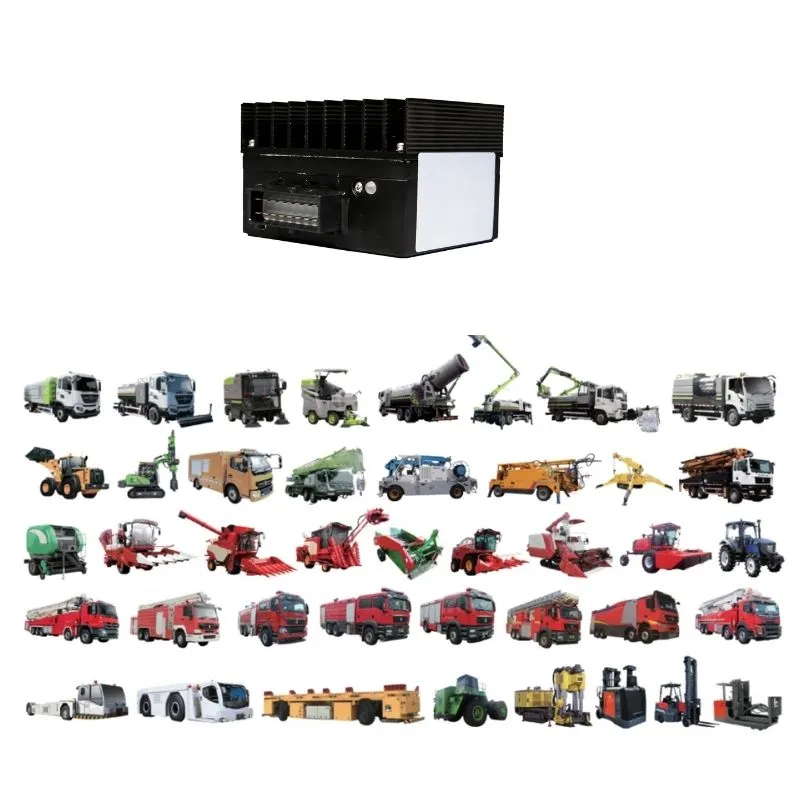
I/O modules are widely used in off-highway equipment, including excavators, sanitation trucks, harvesters, and mining vehicles. Brands such as IFM, STW, and TTControl offer rugged solutions designed for these demanding applications.
Conclusion
I/O modules are a cornerstone of distributed control systems in mobile machinery. They help machines gather accurate data, respond quickly to commands, and maintain reliability even in extreme conditions.
If you are looking for technical details, datasheets, or integration examples of IP67-rated CAN bus I/O modules, you can explore solutions by contacting SonnePower.