...
🇮🇹 Meet SonnePower at REAS 2026 in Italy   |   Oct. 8–10, 2026   |   Centro Fiera Montichiari   |   Pavilion 2 – Stand C9 🇮🇹 Meet SonnePower at REAS 2026 in Italy   |   Oct. 8–10, 2026   |   Centro Fiera Montichiari   |   Pavilion 2 – Stand C9

How to Choose Rugged CAN-Bus HMl for Mobile Machinery?

Table of Contents

Why Rugged HMIs Matter in Mobile Machinery

Mobile and off-road machinery—such as tractors, harvesters, excavators, bulldozers, loaders, mining equipment, snow groomers, cranes, forklifts, telehandlers, and forestry vehicles—operate in some of the harshest conditions. These machines must endure rain, mud, dust, extreme temperatures, mechanical shocks, and continuous vibration. Any weak link in the operator interface can lead to downtime, safety risks, and higher maintenance costs.

A rugged CAN-bus HMI (Human-Machine Interface) ensures reliable communication between operators and vehicle systems, providing real-time monitoring, control, and diagnostics. Choosing the right HMI is therefore critical for efficiency and long-term reliability.

Key Factors to Consider in Mobile Machinery HMIs

1. Installation Environment

Will the HMI be mounted inside the cabin, or fully exposed outdoors? Sunlight readability, glare reduction, and IP-rated protection (e.g., IP65 / IP67 as defined by IEC 60529) are crucial for outdoor installations.

2.Display Size & Information Density

The required display size depends on the type and amount of information shown. For simple Tier IV engine data, a compact display may suffice, whereas advanced control systems may require larger, high-resolution screens to visualize complex machine parameters and diagnostic data.

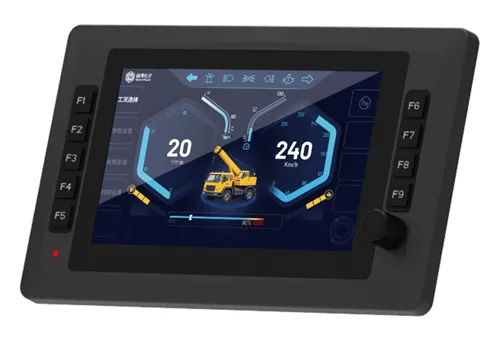
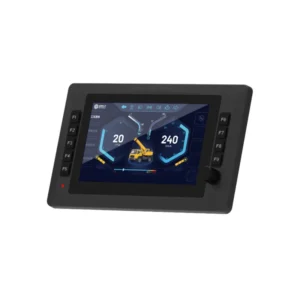
SPD-070-Bx

3.Input Methods: Touch vs. Physical Buttons

While capacitive touchscreens offer intuitive operation, physical buttons remain essential in scenarios where operators wear gloves or work in muddy, wet environments. Many rugged HMIs combine both input types for maximum flexibility.

4. Programming & Integration

Compatibility with standard programming environments such as IEC 61131-3 (ladder, structured text, function block) ensures that the HMI can be easily integrated with controllers and I/O modules. Support for CAN bus (ISO 11898) and other communication protocols (RS232, RS485, Ethernet) expands connectivity.

5.Durability & Lifecycle Testing

To withstand extreme duty cycles, rugged HMIs undergo comprehensive environmental qualification, including:

  • Temperature range: –40°C to +85°C

  • Resistance to hydrocarbons, greases, and lubricants

  • Shock and vibration testing in compliance with off-highway vehicle standards

  • Electromagnetic compatibility (EMC) to avoid signal interference

These measures ensure years of continuous operation without efficiency loss.

6.Material Selection & Reliability

Housing materials and elastomers must be carefully chosen to handle wide temperature fluctuations and resist chemical exposure. Poor material selection can lead to cracks, leaks, or premature failure. Leading manufacturers of rugged HMIs adopt vertically integrated development—covering hardware, software, and electronics—to maintain strict quality control and maximize product reliability.

SonnePower Rugged CAN-Bus HMI Solutions in Mobile Machinery

Compact 4.3-Inch Series (SPD-043)

CommunicationUp to 2×CAN, optional RS232, Ethernet
Resolution480×272 / 800×480
Brightness≥400 cd/m², up to 1000 cd/m²
Programming EnvironmentCoDeSys 3.5
I/O Capacity8 to 34 channels (model dependent)
Other FeaturesDDR3/DDR4 memory, Flash 4–64 Gbit, FRAM 256 Kbit, WiFi & USB (optional)
ApplicationCompact vehicles requiring reliable CAN communication

Mid-Size 5-Inch Series (SPD-050)

Communication2×CAN, RS232, Ethernet
Resolution800×480
Brightness≥800 cd/m²
Programming EnvironmentCoDeSys 3.5
I/O Capacity14 channels (10 inputs / 4 outputs)
Other Features7 programmable keys, WiFi & USB support
ApplicationMid-size machinery dashboards

Versatile 7-Inch Series (SPD-070 / SPC-WT-A01)

Communication1–5×CAN, RS232, Ethernet
Resolution800×480 / 1024×600
Brightness≥600 cd/m²
Programming EnvironmentCoDeSys 3.5 or C Language
I/O Capacity6 to 20 channels
Other FeaturesCapacitive touch, programmable keys, rotary knob (optional), AHD/CVBS video input, GPS/4G/Bluetooth, voice amplifier
ApplicationConstruction, mining, and sanitation vehicles

Large 8-Inch Series (SPD-080)

Communication5×CAN, RS232, Ethernet
Resolution1024×600
Brightness≥500 cd/m²
Programming EnvironmentCoDeSys 3.5
I/O Capacity20 channels (12 inputs / 8 outputs)
Other FeaturesCapacitive touch, video inputs, GPS/4G/Bluetooth, extended SD storage
ApplicationAdvanced diagnostics and multi-function control

Extra-Large 12.1-Inch Series (SPD-121)

CommunicationUp to 3×CAN, Ethernet
Resolution1024×768
Brightness≥480 cd/m² (typical 600 cd/m²)
Programming EnvironmentCoDeSys 3.5
I/O Capacity2–3 channels
Other FeaturesCapacitive touch, Bluetooth, USB
ApplicationLarge machinery cabins requiring wide-screen visualization

Conclusion

Rugged CAN-bus HMIs are vital for mobile machinery, ensuring durability, visibility, and reliable integration in harsh conditions. The right HMI becomes the operator’s trusted interface for safe and efficient operation.

👉 If you are looking for rugged HMI solutions tailored to your machinery, feel free to get in touch with our team to discuss your requirements.
Scroll to Top

Contact information

Write for us