Skip to content

Top 10 I/O Planning Mistakes to Avoid in Mobile Machinery
Table of Contents
Proper I/O planning is one of the most overlooked steps in mobile machinery design. Yet it directly impacts machine reliability, wiring complexity, maintenance cost, and long-term scalability. Whether you’re building agricultural equipment, sanitation vehicles, construction machinery, or mining machines, avoiding the following mistakes will save countless hours during commissioning and future upgrades.
Focusing Only on Total I/O Count
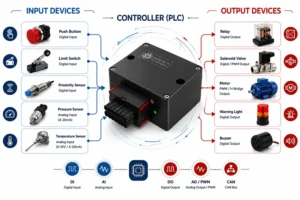
Many engineers simply tally the total I/O channels required—but ignore how signals should be grouped by subsystem.If safety, hydraulics, sensors, lighting, and engine signals are mixed together, troubleshooting becomes difficult and wiring grows messy.
Tip: Start with a structured I/O list organized by subsystem and signal type.

No Spare I/O Channels for Expansion
Machines evolve. New sensors, automation functions, or safety upgrades are inevitable.
Designing with zero spare channels leads to expensive retrofits.
Tip: Reserve 20–30% spare DI/DO/AI/PWM channels and at least one extra CAN bus port.
Poor Cable Routing and Shielding
Running analog sensors next to high-current loads is a classic mistake that causes noise, signal drift, and false triggers.
Tip: Separate power and signal harnesses, use shielded cables, and ensure proper grounding.
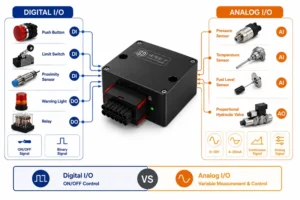
Selecting the Wrong Signal Type
Choosing 0–5 V analog when 4–20 mA is needed for long distances, or mismatching PWM specifications, results in unstable performance.
Tip: Match signal type to cable length, operating environment, and sensor requirements.
Incorrect CAN Bus Topology and Termination
Star wiring, missing termination resistors, or long stubs lead to intermittent CANopen or J1939 communication failures.
Tip: Use a linear bus, terminate with 120 Ω at both ends, and maintain consistent cable impedance.
Using Industrial PLC I/O on Mobile Machines
Factory-grade PLC modules (IP20) are not designed for vibration, mud, water ingress, shocks, or voltage instability typical in off-road equipment.
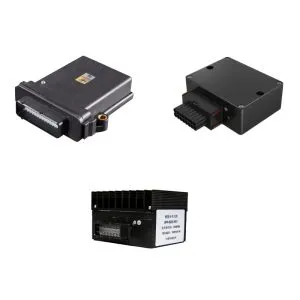
Tip: Use ruggedized IP67 modules with wide voltage tolerance, high EMI immunity, and sealed connectors.
Incomplete Documentation & Naming
Vague signal names such as “Sensor1” or missing I/O lists create confusion during wiring, testing, and service.
Tip: Use standardized naming and maintain a continuously updated I/O sheet.
Ignoring Environmental Conditions
Mobile machinery faces harsh realities: vibration, EMI, humidity, wide temperature swings, load dumps, and electrical noise.
Tip: Specify required IP rating, EMI protection, operating temperature, and connector robustness early in design.
Missing Inter-Module Handshake Logic
Without READY, RUN, and FAULT handshake signals between controllers or I/O modules, machines may start unpredictably or fail silently.
Tip: Define inter-module communication logic during the architecture phase.
Insufficient Testing and Validation
Bench testing alone is not enough.
Real-world vibration, voltage drops, EMI, and thermal changes often reveal issues that paperwork cannot.
Tip: Perform bench tests, field tests, and fault-injection tests before final release.