Skip to content

Robust HMI Guide 2025: Rugged Displays for Harsh Environments
Table of Contents
In mobile machinery and off-highway equipment, the HMI is no longer just a display—it is the core interface for control, diagnostics, and operator interaction. Unlike standard factory HMIs, these systems must withstand harsh outdoor conditions such as vibration, mud, rain, direct sunlight, extreme temperatures, and EMI.
This is why robust HMIs—also called rugged HMIs—have become crucial in 2025. This guide explains how to select the right rugged HMI for construction, agricultural, sanitation, and mining machinery.
1. Why Robust HMIs Matter in Harsh Environments
A robust HMI is designed with reinforced hardware, industrial-grade components, and protective structures to withstand environmental and mechanical challenges. In mobile machinery applications, standard office or factory HMIs often fail because:
Water and dust enter the panel
Vibration loosens connectors or damages PCBs
Direct sunlight makes the screen unreadable
Operators wear gloves, making touch input difficult
EMI noise disrupts communication
Large temperature fluctuations affect performance
A rugged HMI prevents these failures through dedicated industrial design and testing. Choosing the right one greatly improves machine uptime and operator experience.
Key Features of a Robust HMI
Robust HMIs must meet a set of engineering standards. Below are the core features to evaluate.
2.1 Protection Level: IP65 vs IP67
Protection level defines a device’s resistance to dust and water.However, the required IP rating depends heavily on the installation location and actual working conditions.
IP65:
Dustproof
Resistant to light rain and water spray
Suitable for operator cabins, indoor panels, covered consoles, and protected enclosures
Commonly used when the HMI is not directly exposed to high-pressure washing, mud splash, or long-term rain
In many mobile machinery projects, the HMI is installed inside a cabin or inside a sealed dashboard, where IP65 already provides stable and reliable protection.
IP67:
Fully dust-tight
Withstands temporary immersion
Required when the HMI is mounted outside, fully exposed, or regularly cleaned with high-pressure water jets
Typical applications include exterior-mounted displays, open platforms, or machines working in direct rain, mud, or frequent washing.
2.2 Operating Temperature Range
Mobile machinery often works outdoors year-round. A robust HMI must handle:
High temperatures inside cabs under sunlight
Low temperatures in northern regions or winter mornings
Rapid temperature shifts when machines start or stop
Typical requirements:
Standard HMIs: 0°C to +50°C
Robust HMIs: −20°C to +70°C, sometimes −30°C to +85°C
Wide-temperature LCD modules and automotive-grade components are essential.
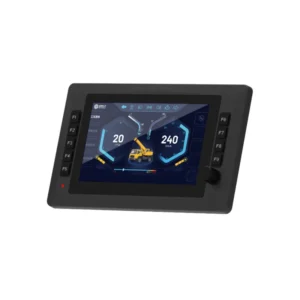
10.1” CAN Display | SPD-101-H2x
2.2 Operating Temperature Range
Mobile machines generate much higher vibration levels than stationary industrial systems. Poor anti-vibration design leads to:
Loose connectors
Cracked LCD glass
Damaged FPC cables
Component fatigue
Robust HMIs feature:
Die-cast aluminum housings
Reinforced mounting frames
Automotive-grade connectors
Vibration-resistant PCB design
This ensures stable performance even on excavators, compactors, or mining dump trucks.
2.4 Sunlight Readability
Outdoor environments require high-brightness displays. Standard HMIs with 300–500 nits are usually invisible under direct sunlight.
A robust HMI should provide:
800–1000+ nits brightness
Anti-glare (AG) or anti-reflective (AR) coatings
Optical bonding to reduce condensation and internal reflection
This ensures clear visibility for operators in daylight.
2.5 Touchscreen Technology: Capacitive vs Resistive
Touchscreen selection greatly affects operator experience.
Resistive Touch
Works with gloves
Reliable in dusty, wet environments
Lower cost
Requires physical pressure
Lower optical clarity
Capacitive Touch
High clarity and sensitivity
Supports gestures and multi-touch
Excellent user experience
Less effective with thick gloves
Sensitive to water droplets
Recommendation:
Agriculture / sanitation / dusty environments → Resistive
Premium engineering machinery / high-end UI → Capacitive
3. Communication Interfaces for Mobile Machinery
3.1 CAN bus Is Essential
Most off-highway vehicles use:
CAN J1939 (engine and drivetrain communication)
CANopen (modular systems and attachments)
A robust HMI must support CAN bus natively, or it cannot integrate with controllers and sensors.
3.2 Multiple CAN Channels
Modern equipment often requires:
One CAN channel for engine ECU
One for vehicle control
One for attachments or expansion modules
Therefore, 2–3 CAN ports is becoming standard for rugged HMIs in 2025.
3.3 Additional Interfaces
Ethernet (diagnostics, remote updates)
RS232 / RS485 for backward compatibility
Digital inputs for soft keys or sensors
4. Software Platforms: CODESYS, Qt, Linux
4.1 CODESYS
IEC61131-3 support
PLC + HMI integrated programming
Popular in machinery fields
4.2 Qt
Highly customizable UI
Smooth animations
Ideal for premium operator experience
4.3 Linux-based HMIs
Open architecture
Easy integration with communication stacks
Cost-effective for OEM customization
5.How Industries Choose HMIs
5.1 Construction Machinery
Equipment: excavators, loaders, cranes, pump trucks
Requirements:
High vibration resistance
High brightness screen
Multi-CAN communication
Wide temperature design
6.2 Agricultural Machinery
Equipment: tractors, harvesters
Requirements:
Glove operation → resistive touch
Protection against dust and mud
Affordable hardware
6.3 Sanitation Vehicles
Equipment: sweepers, garbage compactors
Requirements:
Waterproof IP67
Easy operator interface
Good nighttime visibility
6.4 Mining Equipment
Equipment: dump trucks, drilling rigs
Requirements:
Extreme temperatures
Strong vibration resistance
EMC robustness