Skip to content
How Backlit CAN Keypads Reduce Mining Truck Errors
Table of Contents
Mining trucks operate in harsh environments — low light, heavy dust, vibration, and often in night or underground modes. In such conditions, operator interface clarity and reliability become critical. Traditional dense switch panels suffer from label wear, poor illumination, and high wiring complexity — all of which contribute to operator errors (mis-press, wrong toggles, delayed response).
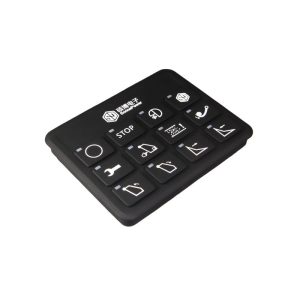
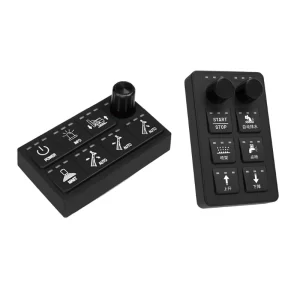
Backlit CAN Bus keypads present a modern alternative: they integrate adjustable illumination, iconography, feedback LEDs, and networked event reporting over CAN (e.g. J1939). In this article, we explore how and why such keypads reduce operator errors, backed by engineering mechanisms, best practices, and validation methods.
Mechanisms: How Backlit CAN Keypads Mitigate Errors
1. Adaptive Backlight & Uniform Illumination
-
Keypads with ambient light sensing or adjustable brightness ensure icons remain legible under variable lighting (dusk, tunnel, night).
-
Uniform backlight prevents “hot spots” or uneven visibility, reducing hesitation or accidental presses.
2.Clear Iconography and Color Coding
-
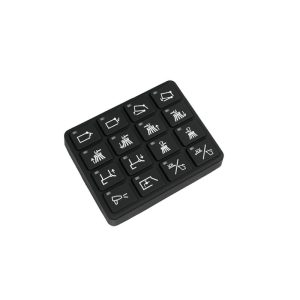
Custom, high-contrast icons reduce reliance on text labels, minimizing misinterpretation.
-
Color coding (e.g. red for stop/alarm, green for confirm) conveys meaning at a glance, cutting cognitive load.
3. Functional Consolidation & Combination Inputs
-
Low-frequency functions may be grouped (e.g. long-press + shift) to reduce the number of physical buttons, thereby reducing adjacent-key mispresses.
-
This reduces clutter and increases spacing between frequently used keys.
4. Feedback & Self-Diagnostic Indicators
-
LED indicators or status colors (on or above each key) immediately reflect state (active, fault, lockout).
-
Built-in self-diagnostic (health check of key circuits, communication) can alert operators in pre-shift checks to failures that otherwise could lead to error when unlit keys are pressed.
5. CAN Event Messaging & Traceability
-
Press/release events are timestamped and packaged into PGNs for logging/monitoring.
-
Example: Key code 0x20 pressed → PGN 65280 with data bytes [keyID, state, timestamp].
-
Such event logs enable post-hoc analysis (when errors occur, you know which key + when + in what vehicle state).
-
Integration: The keypad is a CAN node; it participates in the overall J1939 network, enabling centralized error-monitoring and in-cab alerts.
6. Human Factors Alignment
-
The design aligns with known human factors: enhance visibility, discriminability, reducing load.
-
Studies in mining automation show that improving interface clarity and reducing mental workload reduces operator mistakes under stress or fatigue.
Comparison with Traditional Switch Panels
| Feature | Traditional Switch Panel | Backlit CAN Bus Keypad |
|---|---|---|
| Button density | 20+ separate switches | 6–12 backlit buttons + menu logic |
| Wiring | Many discrete lines, multiplexers | Single CAN bus + power |
| Label durability | Wear off over time | Engraved icons + backlight |
| Feedback | Status lamps or none | Integrated LEDs + event report |
| Fault isolation | Hard to pinpoint | Self-test and CAN diagnostic |
| Mistake tracing | Little or none | Full press/release logs |
This table helps frame the functional uplift in switching to CAN keypads.
Engineering Design Checklist for Mining Truck Keypads
Backlight & Visuals
-
Auto/adjustable brightness (day/night modes)
-
Uniformity across keys
-
Color temperature / contrast ratios
-
Glare mitigation (avoid reflective surfaces)
Key Properties
-
Key travel, actuation force, tactile feedback
-
Size & spacing for gloved hands
-
Low-profile design to avoid accidental touches
-
Relegendable or replaceable key icons
Environmental Durability
-
Ingress protection (IP67 / IP68)
-
Vibration, shock, EMC resistance
-
Temperature ranges (-40 °C to +85 °C or higher)
-
Life cycle (≥1,000,000 actuations)
CAN / Protocol Integration
J1939 / CANopen compatibility
PGN mapping & documentation
Debounce logic, long-press vs short-press
Error frames and fallback behavior
Feedback & Diagnostics
LED indicators for key states
Self-test routines with health messaging
Redundant health checks (e.g. CRC of firmware)
Logging & Traceability
Event format (keyID, state, timestamp, vehicle mode)
Integration with vehicle logger / telematics
Linking key events with machine state data (speed, load, alarms)
Safety & Security
Authorization / lockout for critical functions
Prevent spurious presses under vibration
CAN message integrity (checksum, validation)
Fail-safe modes when keypad fails
Validation & Testing
Human Factors tests (low light, gloves, distractions)
A/B experiments vs traditional panel
Field trials logging error rates over cycles
Accelerated aging, thermal cycling, vibration testing
Validation Strategies & Templates
A/B Testing Protocol
Group A: Mining trucks with traditional switch panels
Group B: Same fleet + retrofit or new trucks with backlit CAN keypads
Duration: ≥ 30 operating days, multiple shifts
Metrics to collect:
Number of operator errors (mis-presses, inconsistent toggles)
Time taken to perform certain tasks (e.g. enable dump, retract, lights)
Operator subjective workload (survey)
Number of interventions/undo actions
| Metric | Group A (Switch Panel) | Group B (Backlit CAN Keypad) |
|---|---|---|
| Avg mis-presses per 100 operations | 0.x | 0.y |
| Task completion time (sec) | 12.5 | 10.3 |
| Operator error rate reduction | — | (A − B) / A × 100% |
| Survey: “Ease of use under low light” (scale 1–5) | 3.2 | 4.5 |
Use this template to quantify ROI.
Event Log Correlation Sample
When a safety interlock is triggered unexpectedly, you can correlate it to key events:
Time 12:34:56.789 – Key ID 0x05 pressed (dump enable)
Time 12:34:57.012 – Alarm PGN 65202 triggered
Time 12:35:00.100 – Key ID 0x05 released
From this, you can identify if accidental toggling or timing mismatch caused the alarm, improving training or redesign.
Conclusion
Backlit CAN bus keypads — by enhancing visibility, providing clear feedback, simplifying wiring, and enabling event traceability — significantly reduce operator error risk in mining trucks, improving both safety and operational efficiency.
Ready to upgrade your mining truck control interface?
Contact SonnePower to explore rugged CAN keypads, controllers, and HMI solutions built for extreme environments.