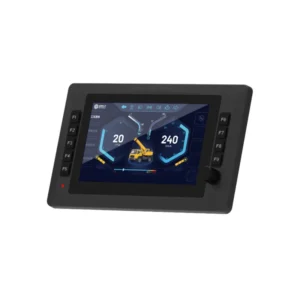
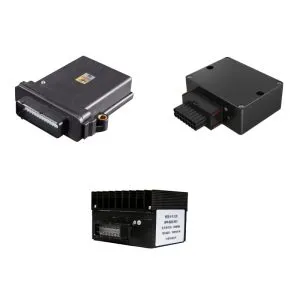
Programmable Graphic Display for Machine Control
Table of Contents
Modern machinery is becoming more complex, with increasing demands for real-time monitoring, automation, and connectivity. Traditional text displays and status LEDs no longer provide enough information for operators to make quick, informed decisions.
A programmable graphic display (PGD) acts as the intelligent control hub, combining a high-resolution screen, touchscreen input, and programmable logic to deliver data visualization and system control on one interface. This improves operator efficiency, reduces errors, and keeps equipment running smoothly.
Key Capabilities of Programmable Graphic Displays
Programmable graphic displays are more than just screens — they function as compact HMIs built for demanding industrial and mobile machinery environments.
Core features include:
High-Visibility Displays: Sunlight-readable TFT/LCD panels with wide viewing angles and adjustable backlight for all lighting conditions.
Responsive Touch Interface: Choose resistive touch for glove-friendly operation or capacitive touch for modern multi-touch control, with optional physical buttons for safety-critical tasks.
Multi-Protocol Communication: Seamless integration with CAN-bus (CANopen, J1939), Modbus, RS232/485, and Ethernet networks.
Programmable UI: Drag-and-drop screen editors, script support, and UI libraries make it easy to build custom workflows without deep coding knowledge.
Data Visualization: Real-time gauges, alarms, trend graphs, and status indicators keep operators fully informed.
Why Choose a Programmable HMI Over a Simple Display?
Compared with fixed-function displays, a programmable HMI provides greater flexibility, control, and scalability:
Real-Time Monitoring: Display motor speed, hydraulic pressure, temperature, and alarms on one screen for faster decision-making.
Dynamic Control: Adjust settings or activate machine functions directly from the touchscreen, reducing the need for extra switches and panel wiring.
Localization & Multi-Language: Support multiple languages in one system to reduce training time and serve operators worldwide.
User Access Control: Password-protected access prevents unauthorized changes and maintains safe operation.
Applications Across Industries
Programmable graphic displays are widely used wherever operators need clear visualization and reliable machine control:
Mobile & Construction Machinery: Excavators, asphalt pavers, rollers, cranes, loaders, and forklifts.
Industrial Control Panels: Pump stations, compressors, HVAC systems, and conveyor systems.
Energy & Power: Solar inverter displays, genset controllers, battery storage monitoring, and EV charging stations.
Agriculture: Tractors, irrigation pumps, fertilizer spreaders, and harvesters with smart controls.
Example: In an asphalt paver, a PGD shows engine speed, screed temperature, material feed rate, and travel speed on a single dashboard, helping operators maintain consistent paving quality.
Best Practices for HMI Design
Even the most powerful HMI is only as effective as its interface design. Follow these UI/UX guidelines for optimal results:
Logical Layout: Place critical data in the center, group related functions, and minimize unnecessary operator movement.
Color & Icon Standards: Use a consistent color scheme, high-contrast alarms, and ISO/IEC-compliant icons for quick recognition.
Fast Touch Response: Target <200 ms response time, especially for safety-critical operations.
Safety-Critical Functions: Provide a physical emergency stop and add confirmation prompts to prevent accidental activation.
Global Readability: Standardized icons and color coding make the interface easy to use worldwide and reduce training costs.
Engineered for Reliability
Because programmable graphic displays are often deployed in harsh industrial and mobile environments, reliability is a key design requirement:
Rugged Protection: IP65/IP67-rated sealing guards against dust, moisture, and water spray.
Wide Temperature Range: Many models operate from –40°C to +85°C, ideal for outdoor and off-road applications.
Vibration & EMC Resistant: Tested to withstand shock, vibration, and electromagnetic interference in demanding conditions.
Long Lifecycle: OTA firmware updates and modular replacement extend service life and reduce maintenance costs.
Business Impact and ROI
Investing in a programmable display system can deliver measurable benefits:
Reduced Downtime: Built-in diagnostics quickly pinpoint issues, reducing unplanned stops.
Lower Maintenance Costs: OTA software updates replace costly hardware redesigns.
Faster Development: GUI editors and code libraries speed up development and shorten time-to-market.
Improved Operator Productivity: Clear visualization and intuitive controls reduce training time and errors.
Explore SonnePower Programmable Displays
At SonnePower, we design and manufacture rugged HMIs for mobile and industrial machinery. Our product range includes 4.3″, 5″, 7″, 10.1″, and 12.1″ programmable displays with sunlight-readable screens, multiple CAN-bus ports, and IP65/IP67 protection.
Whether you need a compact display for a sanitation vehicle or a large-screen solution for an asphalt paver, our team can help you select the right model and customize the UI for your workflow.
Get a Quote or Talk to Our Engineers to discuss your project and download detailed product datasheets.