 Skip to content
J1939 Transport Protocol Explained: BAM vs RTS/CTS
Table of Contents
In SAE J1939, Transport Protocol is used when a parameter group is too large to fit into a single 8-byte CAN frame. Instead of sending the full payload in one message, J1939 splits it into multiple packets using TP.CM for connection management and TP.DT for the actual data transfer.
This is the mechanism behind longer messages such as diagnostic data, larger text-based fields, and other multi-packet transfers.
Most explanations stop there. They tell you that BAM is the broadcast method and RTS/CTS is the peer-to-peer method. That is correct, but it is not enough for real engineering work.
In practice, the better question is this: when is BAM good enough, and when does RTS/CTS become the safer choice? That decision affects reliability, bus behavior, troubleshooting difficulty, and how much control the receiver has over the session.
What J1939 Transport Protocol Actually Does
J1939 Transport Protocol exists because classic CAN can only carry 8 bytes of data per frame. When a PGN is larger than that, the sender starts a transport session and sends the payload in multiple packets. The transport layer uses two main PGNs:
- TP.CM (PGN 60416 / 0xEC00) for connection management
- TP.DT (PGN 60160 / 0xEB00) for the segmented data packets
Each TP.DT packet includes a sequence number so the receiver can reassemble the message in order. In classic J1939 Transport Protocol, the commonly cited maximum payload size is 1785 bytes, which comes from 255 packets with 7 data bytes per TP.DT frame.
So at the protocol level, TP is simple: one message becomes many frames. But at the engineering level, the important difference is how the sender and receiver coordinate that transfer.
What BAM Really Means
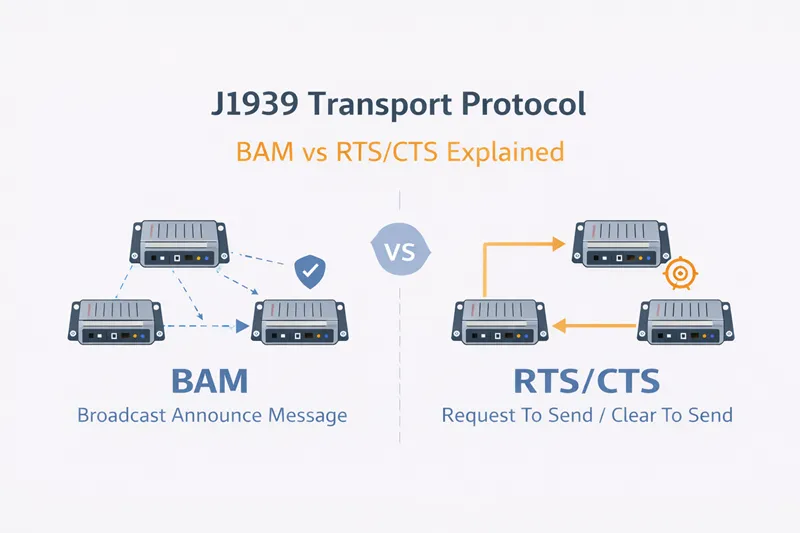
BAM stands for Broadcast Announce Message. It is used when the sender wants to broadcast a multi-packet message to all nodes on the network. The sender announces the transfer through TP.CM, then starts sending TP.DT packets at defined intervals. There is no per-receiver handshake and no receiver-managed flow control in the transfer itself.
That makes BAM attractive because it is simpler. The sender does not need to wait for CTS frames, maintain the same level of session negotiation, or track per-receiver control during the transfer. If the goal is to make the same larger message visible to all interested nodes, BAM is often the most straightforward option.
But simplicity is not the same thing as control. Once BAM starts, the sender transmits the packet stream and the receivers must keep up.
If a receiver misses packets, cannot reassemble in time, or closes the session because of timeout behavior, the sender does not get the same kind of direct receiver-controlled pacing that exists in RTS/CTS mode.
That is one of the biggest practical limits of BAM, and it is where many “BAM is easier” explanations become misleading.
How RTS/CTS Works in Connection Mode
RTS/CTS is the connection-oriented, destination-specific transport method in J1939. Instead of broadcasting the transfer to everyone, the sender first sends RTS (Request To Send) to one target node. The receiver answers with CTS (Clear To Send) and tells the sender how many packets it is ready to accept in the next block.
After the full transfer is complete, the receiver can respond with EndOfMsgACK, or the session may be terminated with Conn_Abort if something goes wrong.
This design gives the receiver much more control. It can pace the transfer, limit block size, and stop the session when conditions are not acceptable.
That makes RTS/CTS more complex than BAM, but it also makes the session more visible and more manageable when reliability matters.
From an implementation point of view, RTS/CTS is not just “the complicated one.” It is the mode you use when the receiver must actively participate in transfer control.
BAM vs RTS/CTS: The Real Engineering Difference
At a high level, the difference looks simple:
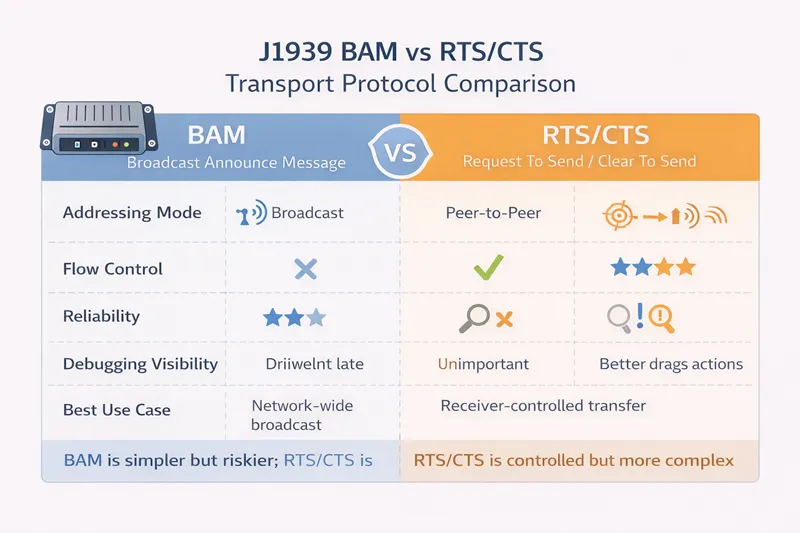
- BAM = broadcast, no receiver flow control
- RTS/CTS = peer-to-peer, receiver-managed flow control
But the practical difference is deeper.
BAM is better when:
- the same larger message needs to be visible to multiple nodes
- the sender can tolerate less receiver-specific control
- implementation simplicity matters more than session-level control
- the message fits a broadcast-oriented use case
RTS/CTS is better when:
- the transfer is meant for one specific ECU
- the receiver needs to control pacing
- you want clearer session behavior and better failure visibility
- the application benefits from acknowledgements and abort semantics
That is why treating BAM as the “easy default” is often a bad habit. A method can be simpler to implement and still be the worse engineering choice for a given use case.
Why BAM Is Simpler but Not Always Better
This is the part many articles do not state clearly enough.
BAM feels attractive because it removes handshake steps. But that also means the sender has less knowledge of what the receiver is actually handling during the transfer. When something fails, the result is often less obvious: the sender may keep transmitting, while the receiver times out, misses reassembly, or silently drops the session. Timing behavior becomes especially important here. Engineering notes and implementation guidance emphasize that packet intervals and receive-side timeout handling matter a lot in BAM behavior.
So the real trade-off is not:
BAM = simple, RTS/CTS = complex
It is closer to this:
BAM = simpler sender behavior, less receiver control
RTS/CTS = more session overhead, but better control and diagnosability
That is a much more useful way to frame the decision for real ECU, HMI, and service tool projects.
Common RTS/CTS Failure Points
RTS/CTS gives better control, but it also introduces more places where the session can fail.
A common field problem is: RTS was sent, but no CTS came back. When that happens, engineers should not jump straight to blaming the CAN bus. Better first checks include:
- wrong destination address
- receiver not ready to allocate the transport session
- block size handling logic not implemented correctly
- timeout window mismatch
- receiver-side conditions that trigger abort behavior
Another failure case is receiving CTS but later seeing an unexpected Conn_Abort or never getting EndOfMsgACK. That usually points to transport-layer session handling problems, not just generic network instability. In other words, once you are in RTS/CTS mode, you need to debug the transport session as a session, not just as a stream of CAN frames.
A Practical Rule of Thumb
A good engineering rule is this:
- Use BAM when the message is naturally broadcast-oriented and you do not need receiver-managed pacing.
- Use RTS/CTS when the transfer is specific to one node and the receiver needs control over the session.
For HMI and service tool designers, this distinction matters more than it may seem. If your diagnostics workflow or tool logic depends on predictable transport behavior and clear error visibility, RTS/CTS is often the safer design choice. If your goal is efficient network-wide distribution of a larger message, BAM may be the better fit. The point is not that one mode is universally better. The point is that they solve different problems.
What to Log During Debugging
If you want Transport Protocol issues to be diagnosable in the field, do not only log the final application-layer result. Also log:
- TP.CM session type
- source and destination address
- total message size
- packet count
- CTS block size
- timeout events
- EndOfMsgACK presence
- Conn_Abort presence and reason when available
That turns TP debugging from guesswork into something structured.