 Skip to content

ISOBUS vs J1939 for Agricultural OEMs
Agricultural OEMs often treat ISOBUS and J1939 as if they were interchangeable. They are not. ISOBUS is built on a CAN foundation and is harmonized with J1939, but it adds agriculture-specific functions for tractor-implement interoperability that J1939 alone does not provide.
That distinction matters in product planning. J1939 is strong for vehicle networking and diagnostics, while ISOBUS is designed to make tractors, terminals, and implements from different manufacturers work together through standardized functions such as Virtual Terminal, Task Controller, and Tractor ECU data exchange.
The practical question for an OEM is not “Which standard is better?” The real question is where J1939 is enough, where ISOBUS becomes necessary, and where both must coexist in the same architecture.
Why this comparison keeps confusing OEM teams
The confusion starts because the two standards share technical DNA. Vector describes ISO 11783, commonly called ISOBUS, as a J1939-based protocol for agriculture, and notes that the protocol has been harmonized with J1939 so both systems may be used in parallel in the same network or segment.
That makes the boundary look blurry. If both are CAN-based, and both can exist in the same machine environment, it is easy to assume that “supporting J1939” gets you most of the way to ISOBUS. In reality, the missing pieces are usually not at the raw CAN layer but at the application, interoperability, and certification layers.
For agricultural OEMs, that difference shows up quickly in the field. A machine may exchange basic data over CAN and still fail to deliver the cross-brand user experience customers expect from an ISOBUS-ready system.
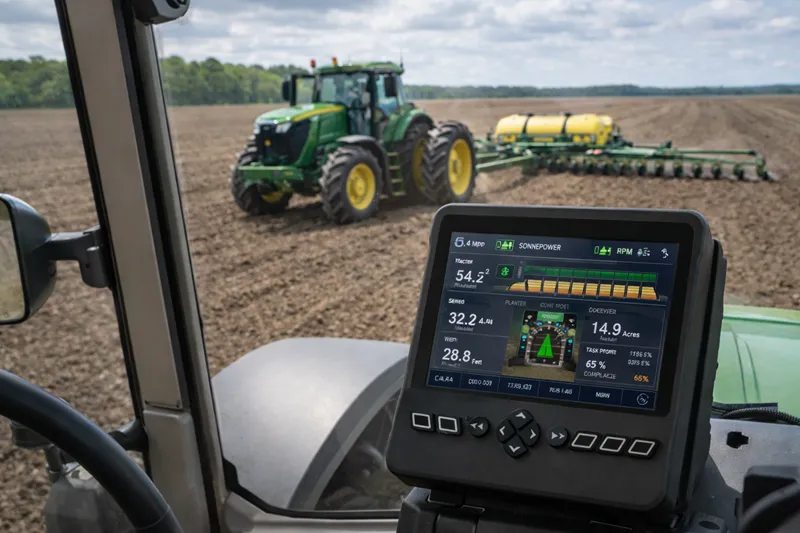
What J1939 does well
J1939 remains a strong fit for internal vehicle communication. It is widely used for heavy-duty networking, diagnostics, and structured CAN communication between ECUs, which is why it still makes sense on the tractor side for engine, drivetrain, and internal machine data exchange.
For many OEMs, J1939 is enough when the goal is internal networking rather than cross-brand implement interoperability. If you are moving data between ECUs inside one platform, or exposing diagnostic and machine-status information to your own HMI, J1939 may already cover the core requirement.
This is why the answer is not “replace J1939 with ISOBUS everywhere.” In many agricultural machines, J1939 is still the right protocol for internal communication, while ISOBUS becomes the layer that handles tractor-implement coordination across brands.
What ISOBUS adds beyond J1939
ISOBUS adds a standardized agriculture-specific function layer. ISOBUS standardizes the “language” between implements, tractors, and terminals from different manufacturers, and it also standardizes data exchange with farm management systems through ISO-XML.
This matters because agricultural interoperability is not just about passing bytes. It is about making sure the implement can present its interface on the tractor terminal, receive the right tractor data, exchange task information, and support consistent workflows across mixed-brand combinations.
That is where functions such as Virtual Terminal, Task Controller, and TECU become critical. They are not optional “nice-to-have” features layered on top of J1939. In many real OEM use cases, they are the reason ISOBUS exists as a distinct system.
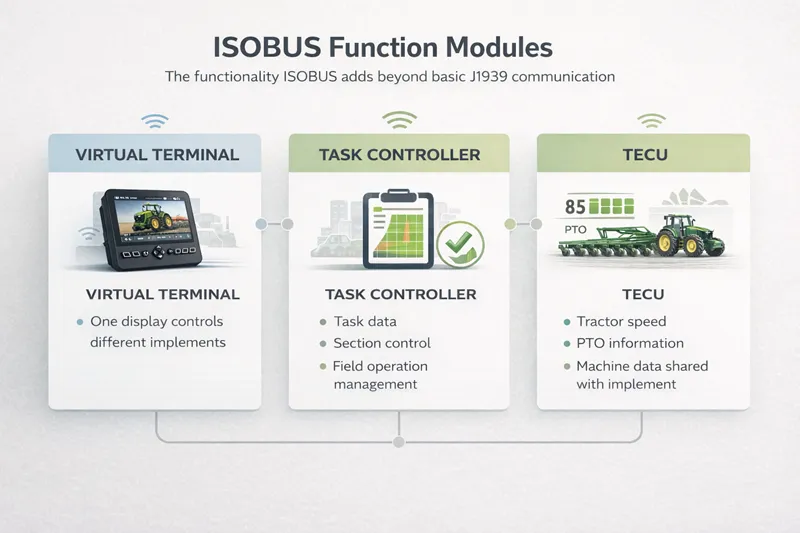
Virtual Terminal, Task Controller, and TECU
Virtual Terminal, sometimes referred to as Universal Terminal, allows one terminal to control different implements through a standardized interface. This is one of the clearest points where J1939 alone stops being enough, because the value is not only communication but standardized operator interaction across equipment brands.
Task Controller goes further. It supports functions tied to implement jobs and precision-ag workflows, including work documentation, section control, and geo-based tasks, which are central to modern seeding, spraying, and other application-specific operations.
TECU is another important layer. The AEF materials describe standardized tractor-side signals such as speed and PTO-related information being made available to implements, which is exactly the kind of shared operational data an implement needs if it is going to behave correctly across multiple tractor brands.
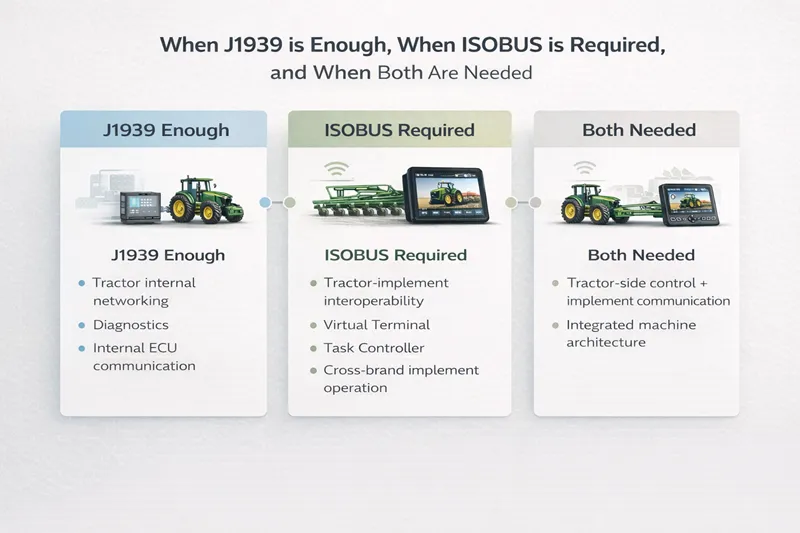
When J1939 is enough
J1939 is usually enough when your requirement is tractor-side machine communication, diagnostics, and internal network coordination. If your HMI, controller, or subsystem only needs to work inside your own machine family, J1939 can remain the main protocol without forcing a full ISOBUS feature stack.
It can also be enough when the implement is not expected to interoperate broadly with third-party terminals or tractor ecosystems. In that situation, adding full ISOBUS functionality may create development and validation overhead without creating equal commercial value.
But that boundary must be defined honestly. “We use CAN” or “we support J1939” is not the same as “we support mixed-brand implement integration.” That shortcut is where many OEM roadmaps start drifting into later compatibility problems.
When ISOBUS becomes necessary
ISOBUS becomes necessary when the business requirement is cross-brand tractor-implement interoperability. If your implement must run on multiple tractor brands, display its UI on the in-cab terminal, exchange task data, and work inside established precision-ag workflows, then J1939 alone is not enough.
It also becomes necessary when Task Controller functions are part of the value proposition. Functions such as work documentation, prescription-based execution, and section control are not just “protocol features.” They are customer-facing capabilities tied to agronomic efficiency and workflow integration.
The real divide is not “truck standard versus farm standard.” The real divide is “internal machine networking versus standardized agricultural interoperability.”
Why “ISOBUS ready” is not enough
AEF explicitly warns that not all machines are fully compatible even if they are within the ISOBUS ecosystem. The handbook explains that the functions which will actually work together are the functionalities supported by all connected components, which is effectively the lowest common denominator of the system.
That is one of the most important points for OEM teams. A label, connector, or marketing claim does not tell you whether VT, TC, AUX, or other required functions will work in the exact tractor-terminal-implement combination your customer will use.
This is why the AEF ISOBUS Database matters. It exists so manufacturers, dealers, and customers can verify which certified functions are actually supported across a given equipment combination, instead of assuming compatibility from a generic “ISOBUS supported” statement.
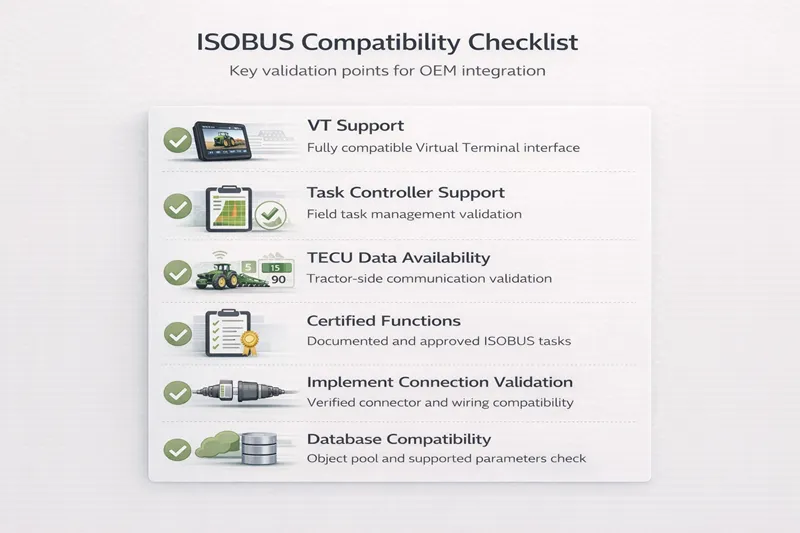
Mixed-brand reality: where projects fail
In the field, failures rarely appear as clean protocol problems. They usually show up as practical issues, such as a missing implement interface, a disconnected Virtual Terminal, or a Task Controller that fails to load.
These problems are not always caused by the protocol itself. In many cases, the real causes are connector issues, wiring problems, restart and initialization errors, object pool validation issues, or mismatches in software versions and supported functions.
That is why agricultural OEMs should not treat ISOBUS as a simple yes-or-no label. In real mixed-brand setups, connector quality, software compatibility, validation behavior, and tractor-side implementation details often determine success more than the protocol name alone.
A Simple OEM Decision Model
If the project mainly involves tractor-side diagnostics, internal ECU networking, and proprietary machine logic, J1939 is often a practical starting point. If the project must support standardized implement interfaces, cross-brand compatibility, and Task Controller workflows, ISOBUS should be considered from the beginning.
If the product needs both, then the architecture should support both. In many cases, that means keeping J1939 for internal vehicle communication while using ISOBUS at the tractor-implement boundary where interoperability, VT, TC, and TECU functions matter most.
The mistake is defining that boundary too late. Once ISOBUS requirements are added late in development, the cost usually appears in validation, UI redesign, compatibility support, and launch delays.
What Changes in 2026 and Beyond
Another important topic that many comparison articles still understate is bandwidth. CAN-based ISOBUS remains limited in data capacity, which means future agricultural applications may place much greater pressure on the network than many current systems were originally designed for.
This matters because modern agricultural machines are expected to handle more complex implements, heavier task data, richer operator interfaces, and more data-intensive workflows. What looks acceptable today may become a bottleneck as product requirements continue to grow.
So the future question is no longer only “J1939 or ISOBUS?” It is also whether the chosen architecture can scale with the next generation of agricultural connectivity without forcing a costly redesign later.
Conclusion
J1939 and ISOBUS are related, but they solve different layers of the OEM problem. J1939 remains highly suitable for internal vehicle communication and diagnostics, while ISOBUS adds the agricultural interoperability layer needed for standardized tractor-implement interaction.
For agricultural OEMs, the key is defining the boundary correctly. If the requirement is mainly tractor-side networking, J1939 may be enough. If the requirement includes cross-brand implement compatibility, VT, TC, and standardized workflows, ISOBUS becomes necessary where J1939 alone is no longer sufficient.