 Skip to content
Is CAN 5V or 12V? CAN Bus Voltage Explained for Mobile Machinery
Many engineers new to CAN bus systems ask a simple question:
Is CAN bus 5V or 12V?
The confusion usually comes from automotive and mobile machinery systems where:
- the vehicle battery may be 12V or 24V,
- the CAN transceiver may use 5V or 3.3V,
- but CANH and CANL do not behave like normal GPIO voltage lines.
In reality:
CAN bus communication is based on differential signaling, not fixed 5V or 12V logic levels.
This article explains the difference between:
- vehicle power voltage,
- CAN transceiver supply voltage,
- and actual CAN bus signal voltage.
We will also look at CANH/CANL voltage levels, J1939 systems, and common troubleshooting mistakes in mobile machinery.
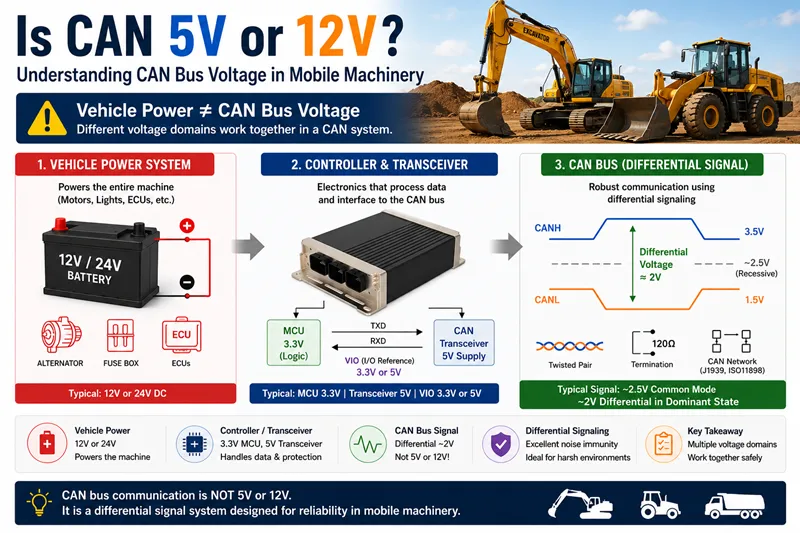
Is CAN 5V or 12V? The Short Answer
Vehicle Power Supply vs CAN Bus Signal Voltage
One of the biggest misunderstandings is confusing vehicle power with CAN communication voltage.
These are not the same thing.
The short answer is:
CAN bus itself is not simply “5V” or “12V.”
Instead:
- vehicles may use 12V or 24V power systems,
- CAN transceivers may use 5V or 3.3V supply voltage,
- while CANH and CANL use differential signaling for communication.
This is why many CAN systems operate normally even when:
- the controller MCU is 3.3V,
- the transceiver supply is 5V,
- and the machine battery system is 24V.

12V and 24V Systems in Mobile Machinery
Mobile machinery commonly uses:
- 12V systems
- 24V systems
Examples include:
- excavators
- wheel loaders
- agricultural sprayers
- sanitation trucks
- harvesters
The battery and alternator provide machine power.
But CAN communication uses a completely different electrical layer.
Why Device Power Is Not the Same as CANH/CANL
A CAN node may contain:
| Component | Typical Voltage |
|---|---|
| Vehicle battery | 12V / 24V |
| MCU logic | 3.3V |
| CAN transceiver supply | 5V |
| CANH/CANL signal | Differential voltage |
This means a 24V machine does not have “24V CAN communication.”
Likewise, a 5V CAN transceiver does not mean CANH is fixed at 5V.
CANH and CANL Voltage Levels Explained
CAN bus uses two communication wires:
- CANH
- CANL
Communication depends on the voltage difference between them.
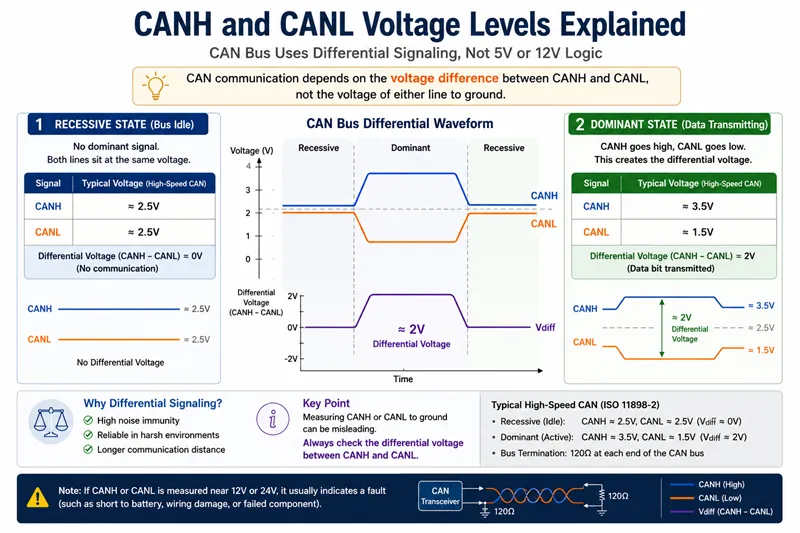
Recessive State: CANH and CANL Around 2.5V
When the bus is idle:
| Signal | Typical Voltage |
|---|---|
| CANH | ~2.5V |
| CANL | ~2.5V |
At this moment:
- no differential signal exists,
- and the bus is in recessive state.
Dominant State: CANH High, CANL Low
During communication:
| Signal | Typical Voltage |
|---|---|
| CANH | ~3.5V |
| CANL | ~1.5V |
The differential voltage becomes approximately 2V.
This differential signal allows CAN to resist noise in harsh environments.
Differential Voltage Matters More Than Single-Wire Voltage
A common mistake is checking only:
- CANH to ground
and assuming the bus should read “5V.”
This is incorrect.
CAN communication depends on:
CANH − CANL differential voltage
—not simple single-wire voltage.
CANH and CANL Voltage Levels Explained
Modern CAN systems may use either:
- 5V CAN transceivers
- 3.3V CAN transceivers
Both are common.
5V CAN Transceiver Supply
Many traditional automotive CAN transceivers use:
- 5V supply voltage
especially in older industrial and vehicle systems.
Examples include:
- TJA1050
- MCP2551
3.3V CAN Transceiver and VIO Pin
Modern embedded systems often use:
- 3.3V MCU logic
Some CAN transceivers include a VIO pin that allows:
- TXD/RXD logic compatibility
- with either 3.3V or 5V MCU interfaces.
Why 5V Supply Does Not Mean 5V GPIO Communication
The CAN transceiver converts:
- MCU logic signals
- into CAN differential signals.
This means:
- 5V transceiver supply
- does not mean CANH/CANL are fixed 5V outputs.
The CAN physical layer follows ISO11898 standards instead.
Is Automotive CAN Bus 12V?
Another common misunderstanding is:
“The car battery is 12V, so automotive CAN must also be 12V.”
This is false.
12V Vehicle Battery vs CAN Physical Layer
The vehicle battery powers:
- ECUs
- displays
- sensors
- controllers
But CAN communication itself uses:
- CANH
- CANL
- differential signaling
The bus voltage behavior is independent of the battery voltage.
What 12V on CANH or CANL Usually Means
If CANH or CANL measures close to:
- 12V
- or 24V
this is usually abnormal.
Possible causes include:
- short to battery
- damaged wiring
- water ingress
- failed transceiver
- connector damage
This is an important troubleshooting point in mobile machinery.
Is J1939 CAN 12V or 24V?
J1939 on Heavy Equipment and Mobile Machinery
A machine may contain:
- 24V battery system
- 5V CAN transceiver
- 3.3V MCU
- CANH/CANL differential network
simultaneously.
All these layers work together.
24V Machine Power vs CAN Differential Signal
J1939 communication still relies on:
- differential signaling,
- proper termination,
- grounding,
- shielding,
- and CAN physical layer compliance.
The machine power system does not directly define CAN signal voltage.
Common CAN Voltage Measurement Mistakes
Measuring CANH Alone
Checking only CANH voltage can be misleading.
Always evaluate:
- CANH
- CANL
- differential voltage
- communication status
together.
Confusing Power Pins with CAN Pins
Some engineers accidentally measure:
- module power pins
instead of: - CANH/CANL
This leads to incorrect diagnosis.
Ignoring Short-to-Battery Faults
If CANH or CANL measures near:
- 12V
- 24V
check for:
- wiring damage
- crushed harnesses
- connector corrosion
- failed modules
- short-to-battery conditions
before assuming the network is normal.
FAQ
Is CAN bus 5V or 12V?
CAN bus itself is not simply 5V or 12V. Vehicles may use 12V or 24V power systems, while CAN communication uses CANH/CANL differential signaling.
Is automotive CAN bus 12V?
No. Automotive devices may use 12V battery power, but CAN communication uses differential bus signaling.
What voltage should CANH and CANL be?
In high-speed CAN:
- recessive state:
- CANH ≈ 2.5V
- CANL ≈ 2.5V
- dominant state:
- CANH ≈ 3.5V
- CANL ≈ 1.5V
What does 12V on CANH or CANL mean?
It usually indicates an abnormal condition such as:
- short to battery
- damaged wiring
- failed transceiver
- connector fault
rather than normal CAN communication.
Can 3.3V and 5V CAN transceivers work together?
Yes. ISO11898-compatible CAN transceivers can usually communicate on the same CAN network.