 Skip to content

Garbage Truck Control System Solution
Table of Contents
This article discusses the design of a CAN-based control system for garbage trucks, focusing on how vehicle controllers coordinate hydraulic actuation, safety interlocks, operator interfaces, and diagnostics. It explains the control challenges associated with different garbage truck configurations—such as rear loaders, side loaders, and hook-lift trucks—and outlines a distributed control architecture that supports safe operation, reliable sequencing, and flexible OEM integration.
Equipment Overview
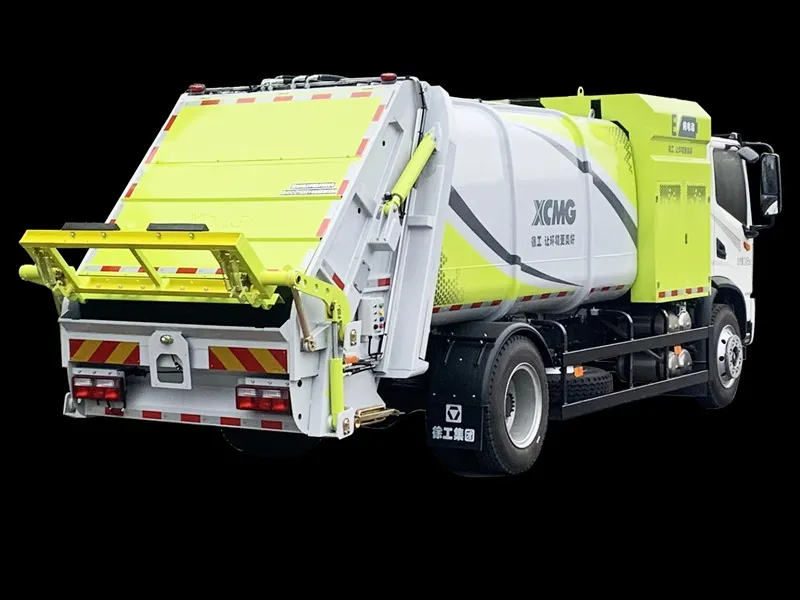
Garbage trucks are purpose-built municipal vehicles used for waste collection, compaction, and unloading.
Compared with standard commercial trucks, garbage trucks integrate hydraulic lifting mechanisms, compaction units, safety interlocks, and operator control interfaces, all operating under frequent stop-and-go duty cycles and harsh outdoor conditions.
A garbage truck control system must coordinate multiple hydraulic and electrical subsystems while ensuring safe operation during lifting, compaction, and unloading processes.
Typical Garbage Truck Configurations
This control solution applies to the most common refuse truck configurations:
Rear Loader Garbage Trucks
Rear compaction systems with container lifting and discharge mechanisms.Side Loader Garbage Trucks
Automated side-arm collection systems with multi-axis motion control.Hook Lift / Roll-Off Trucks
Container loading and unloading using hook mechanisms and load monitoring.
Each configuration shares a common control architecture while requiring different motion sequences and safety logic.
Control Challenges in Garbage Truck Applications
Hydraulic Motion Sequencing
Garbage truck operations involve repeatable work cycles combining lifting, compaction, unloading, and reset actions.
The control system must manage hydraulic valve actuation, timing, and pressure feedback to ensure smooth and predictable motion.
Safety Interlocks and Protection Logic
Unsafe operation can lead to equipment damage or injury.
The control system must implement logic such as:
Door and lock position verification
Load and pressure monitoring
Motion inhibition under unsafe conditions
Emergency stop handling
Harsh Operating Conditions
Garbage trucks operate in environments exposed to dust, moisture, vibration, and temperature variation.
Control components must maintain stable performance under continuous daily operation.
Operator Interaction and Diagnostics
Operators require clear feedback on operating status, alarms, and fault conditions.
Maintenance personnel need diagnostic access to quickly identify hydraulic, electrical, or communication issues.
CAN-Based Control Architecture
A typical garbage truck control system is built on a CAN-based distributed architecture, consisting of:
Vehicle Controller
Executes control logic, safety interlocks, and work cycle sequencing.Distributed I/O Modules
Interface with hydraulic valves, sensors, and actuators close to the equipment to reduce wiring complexity.HMI
Provides mode selection, manual and automatic operation, alarm indication, and diagnostic information.CAN Network
Connects controllers, I/O modules, and HMI, and supports integration with engine or chassis systems where required.
This architecture enables scalable system design across different garbage truck models.
Typical Signals and Interfaces
A garbage truck control system commonly handles the following signals:
Inputs
Position sensors (doors, lifting arms, hook position)
Pressure and load sensors
Safety and limit switches
Outputs
Hydraulic valve control (proportional or on-off)
Auxiliary device control
Visual and audible alarms
Communication
CAN-based communication between controller, I/O modules, and HMI
Integration with J1939 or CANopen networks as required
Fault Handling and Diagnostics
To improve operational reliability, the control system supports:
Real-time fault monitoring
Alarm generation and fault logging
Motion limitation or safe shutdown under fault conditions
Diagnostic information accessible via the operator interface
These functions reduce downtime and support efficient maintenance.
Integration and Customization
Garbage truck control systems often require adaptation to:
Different hydraulic layouts and valve configurations
Regional safety regulations
OEM-specific operating logic
New vehicle development or retrofit projects
The control architecture supports flexible customization while maintaining a consistent system foundation.
Engineering Inquiry
To evaluate system integration for your project, please provide:
Garbage truck configuration (rear loader / side loader / hook lift)
Hydraulic system type (valve block, proportional or on-off)
Vehicle network (J1939 / CANopen / mixed)
HMI requirement (yes / no)
This information allows a preliminary control architecture review.