 Skip to content
How Distributed I/O Modules Extend Mobile Machinery Controller Functions
Modern mobile machinery continues to add more functions:
- additional hydraulic valves
- more sensors
- work lights
- cameras
- safety switches
- pumps
- relays
- alarms
- auxiliary attachments
As machine complexity grows, controllers eventually reach a limitation:
There are no more available inputs or outputs.
Many engineers assume the only solution is:
Replace the controller with a larger one.
However, in many cases:
Distributed I/O modules provide a more flexible and cost-effective way to extend controller functions without redesigning the entire system.
This article explains how distributed I/O modules work, why they reduce wiring complexity, and how they expand mobile machinery control capabilities.
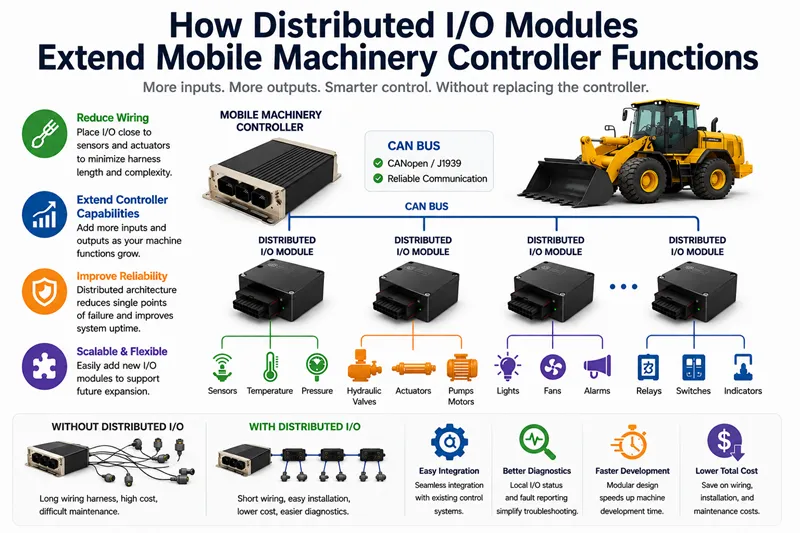
Why Mobile Machinery Controllers Eventually Run Out of I/O Channels
Controllers have limited:
- digital inputs (DI)
- digital outputs (DO)
- analog inputs (AI)
- PWM outputs
- frequency inputs
Example:
An agricultural machine initially requires:
8 sensors
4 hydraulic valves
2 lights
1 alarm
After adding new attachments:
+8 sensors
+6 valves
+camera trigger
+warning lights
The original controller may no longer have enough channels.
Traditional solution:
↓
Larger controller
↓
Higher cost
↓
Rewiring
↓
Long downtime
Distributed I/O offers another option.
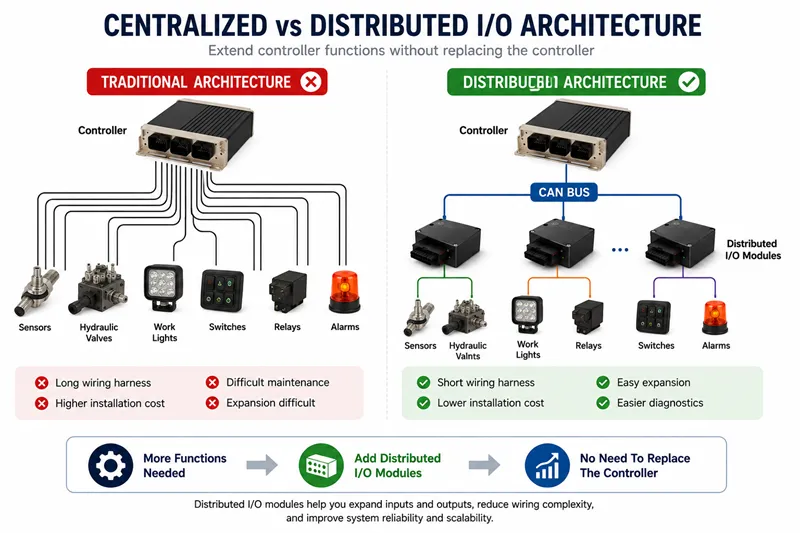
What Does a Distributed I/O Module Actually Do?
A distributed I/O module acts as:
A remote extension of the controller
Instead of wiring everything directly back to the controller:
Controller
      ↓
CAN Bus
      ↓
Distributed I/O
↓      ↓      ↓

Sensors Valves Lights
The module:
- collects sensor signals
- controls outputs
- communicates with the controller through CAN
The controller still makes decisions.
The I/O module executes local input/output tasks.
How Distributed I/O Modules Extend Controller Functions?
Distributed I/O modules increase:
Inputs
Examples:
Additional:
- pressure sensors
- temperature sensors
- proximity switches
- level sensors
Outputs
Examples:
Additional:
- hydraulic valves
- relays
- alarms
- pumps
- work lights
Without changing the controller.
Supporting More Hydraulic Functions
Hydraulic systems often grow over time.
Adding:
- attachments
- auxiliary circuits
- additional actuators
requires more outputs.
Distributed I/O modules provide:
Local valve control
↓
Reduced wiring
↓
Faster installation
Reducing Wiring Complexity in Mobile Machinery
Traditional architecture:
Controller
 ↓
Long harnesses
 ↓
Valves
Lights
Sensors
Problems:
- heavier harnesses
- more installation work
- difficult troubleshooting
- higher maintenance cost
Distributed architecture:
Controller
 ↓
CAN Bus
 ↓
Distributed I/O
 ↓
Local devices
Benefits:
✔ shorter wiring
✔ easier maintenance
✔ modular expansion
✔ improved diagnostics
Why Distributed I/O Improves Reliability
Distributed systems reduce:
Single points of failure
When one local module fails:
The entire machine does not necessarily stop.
Fault isolation becomes easier.
Engineers can identify:
- which node failed
- communication status
- local faults
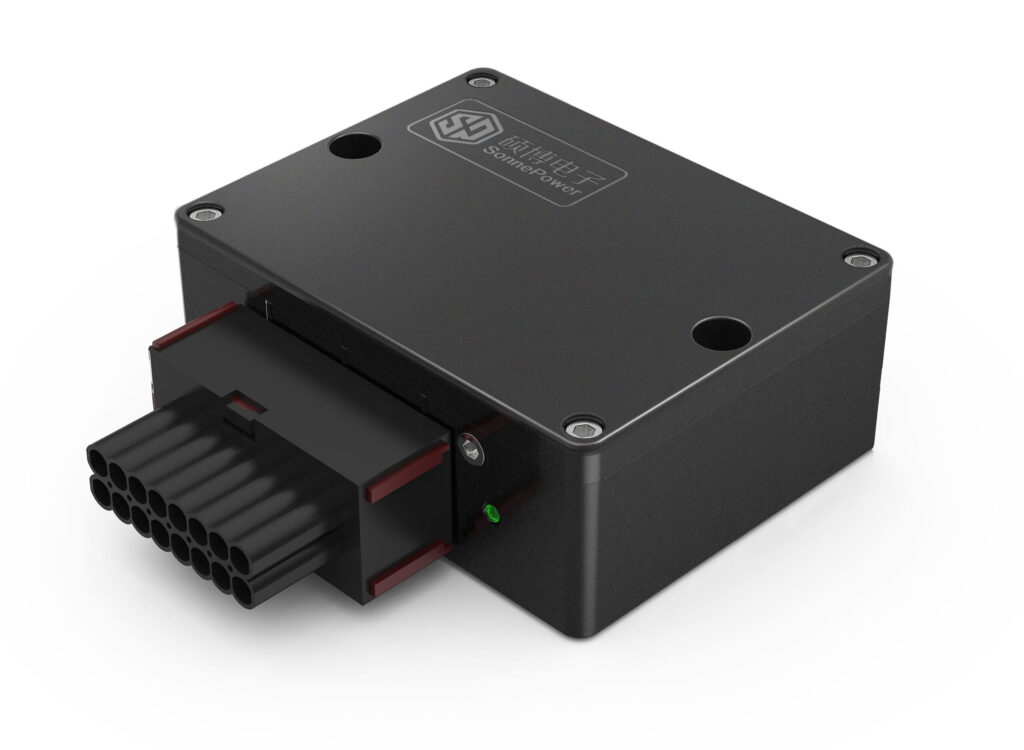
CAN Bus Makes Distributed Control Possible
Distributed I/O modules commonly use:
- CAN bus
- CANopen
- SAE J1939
These protocols enable:
Reliable communication between:
Controller

↓

Distributed I/O

↓

Machine functions
Even under:
- vibration
- dust
- moisture
- temperature changes
Distributed I/O vs Replacing the Controller
When more functions are needed:
Many engineers immediately upgrade controllers.
But first ask:
Do you simply need more I/O channels?
If yes:
Adding distributed I/O may be:
- cheaper
- faster
- easier
than replacing the controller.
Typical Applications
Distributed I/O modules commonly support:
Construction machinery
- work lights
- attachments
- valves
Agricultural machinery
- sprayers
- seeders
- sensors
Sanitation vehicles
- pumps
- warning systems
- brushes
Mining machinery
- alarms
- hydraulic functions
- safety systems
When Should You Add Distributed I/O?
Consider distributed I/O when:
✔ controller channels are insufficient
✔ wiring becomes excessive
✔ new machine functions are added
✔ modular expansion is needed
✔ maintenance complexity increases
Final Thoughts
Distributed I/O modules do more than reduce wiring.
Their biggest advantage is often overlooked:
They extend controller capability without replacing the controller.
For growing mobile machinery systems, distributed architecture improves:
- flexibility
- scalability
- diagnostics
- maintenance efficiency
- system reliability