 Skip to content
What Does It Mean If CANH and CANL Are Both 2.5V?
Table of Contents
When troubleshooting a CAN bus network, many engineers measure CANH and CANL with a multimeter and notice something unexpected:
- CANH ≈ 2.5V
- CANL ≈ 2.5V
At first glance, this may look strange.
Some people assume:
- the CAN bus is not working,
- communication is missing,
- or the network has failed.
However, in many cases:
CANH and CANL both sitting around 2.5V is completely normal.
The key is understanding:
- recessive state,
- differential signaling,
- and whether the network actually has CAN traffic.
This article explains what 2.5V on both CAN lines really means, when it is normal, and when it may indicate a fault in a J1939 or mobile machinery CAN network.
Why CANH and CANL Are Both Around 2.5V
CAN bus communication uses two wires:
- CANH
- CANL
Unlike normal GPIO communication, CAN does not rely on a single voltage referenced to ground.
Instead:
CAN communication depends on the voltage difference between CANH and CANL.
CAN Recessive State Explained
When no device is actively transmitting data, the CAN bus enters:
Recessive State
also called:
- idle state
- bus idle
In this condition:
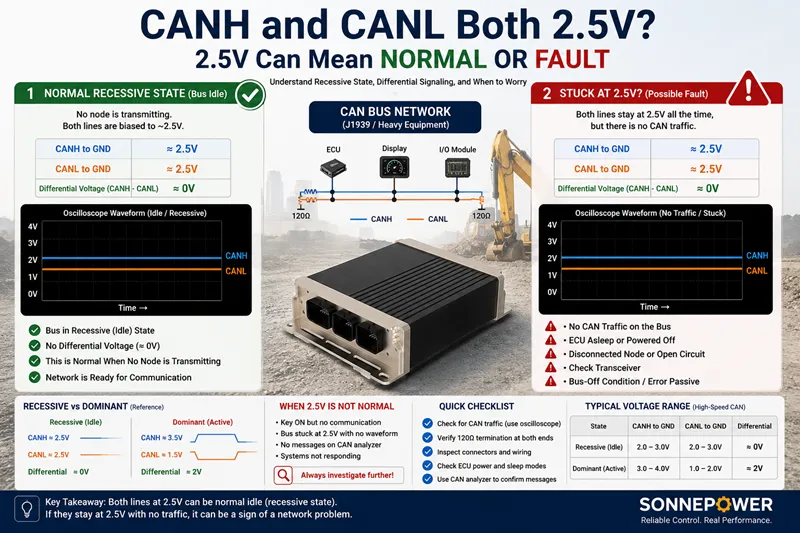
| Signal | Typical Voltage |
|---|---|
| CANH | ~2.5V |
| CANL | ~2.5V |
Because both lines sit at nearly the same voltage:
Differential voltage is approximately 0V.
This is normal behavior for high-speed CAN systems.
Why Differential Voltage Is Near 0V
CAN communication works using differential signaling.
During recessive state:
- no node is driving the bus dominant,
- both lines remain balanced,
- and no meaningful differential voltage exists.
This allows the network to remain stable until a node begins transmission.
CAN Differential Signaling Basics
Understanding differential signaling is essential for interpreting CAN voltage measurements correctly.
Dominant vs Recessive State
CAN bus has two communication states:
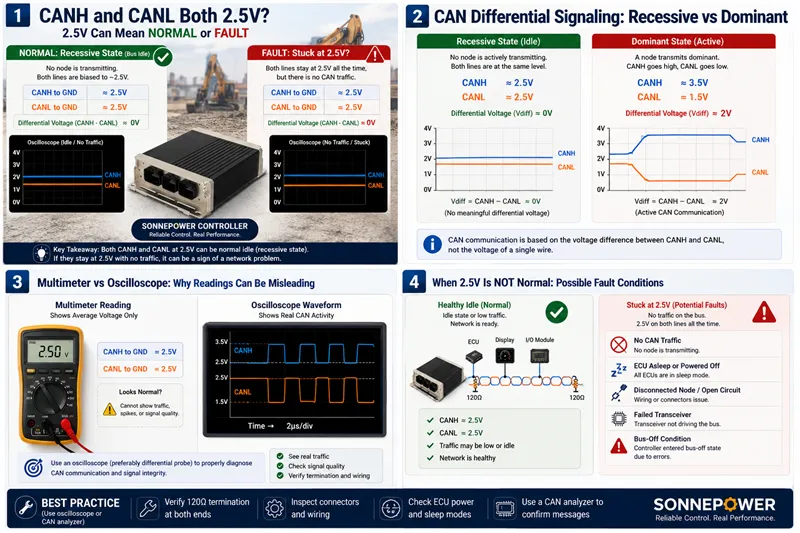
Recessive State
Typical values:
- CANH ≈ 2.5V
- CANL ≈ 2.5V
Differential voltage:
- approximately 0V
No active communication occurs.
Dominant State
When a node transmits:
| Signal | Typical Voltage |
|---|---|
| CANH | ~3.5V |
| CANL | ~1.5V |
The voltage difference becomes approximately:
2V differential
This differential signal represents active CAN communication.
How CAN Communication Actually Works
CAN receivers monitor:
CANH − CANL
—not simply the voltage of one wire.
This is why:
- CAN is highly noise resistant,
- and works reliably in harsh mobile machinery environments.
What a Multimeter Usually Shows on CAN Bus
Many field technicians use a multimeter first when diagnosing CAN issues.
This is useful, but it also creates confusion.
With:
Key ON
engine OFF
low traffic
you may see:
| Measurement | Typical Value |
|---|---|
| CANH to GND | ~2.5V |
| CANL to GND | ~2.5V |
This usually indicates:
Bus Idle / Recessive State
—not necessarily a fault.
Why Oscilloscopes Show More Information
Many field technicians use a multimeter first when diagnosing CAN issues.
This is useful, but it also creates confusion.
When 2.5V Is Normal — and When It Is Not
This is the most important part of the diagnosis.
Bus Idle With No Traffic
If the network is idle:
- CANH ≈ 2.5V
- CANL ≈ 2.5V
is completely normal.
This often happens when:
- ignition is ON,
- but no ECU is transmitting,
- or traffic is very low.
CAN Bus Stuck at 2.5V
Problems begin when:
- CANH and CANL remain permanently fixed at 2.5V,
- but communication is expected.
Possible causes include:
- no active CAN traffic
- sleeping ECU
- disconnected node
- failed controller
- transceiver disabled
- bus-off condition
This is why:
2.5V alone does not guarantee the network is healthy.
Failed Transceiver or Bus-Off Condition
A CAN transceiver may stop transmitting because of:
- excessive errors
- wiring faults
- incorrect termination
- EMC interference
In these situations:
- the bus may still measure 2.5V,
- but actual communication no longer exists.
CANH/CANL 2.5V in J1939 Mobile Machinery
In heavy equipment and mobile machinery, CAN idle measurements around 2.5V are extremely common.
Key ON, Engine OFF Conditions
A machine may have:
- powered displays,
- active controllers,
- but minimal network traffic.
In these situations:
- both CAN lines often remain near 2.5V.
Heavy Equipment CAN Networks
J1939 systems in:
- excavators
- loaders
- harvesters
- sanitation vehicles
often contain:
- long harnesses
- multiple ECUs
- distributed I/O modules
- CAN displays
Proper diagnosis should combine:
- voltage measurements
- termination checks
- CAN traffic analysis
- waveform inspection
—not just a single multimeter reading.
Common CAN Voltage Measurement Mistakes
Measuring Only One Wire
Some technicians only measure:
- CANH to ground
and ignore:
- CANL
- differential voltage
This can lead to incorrect conclusions.
Assuming 2.5V Always Means Healthy Communication
This is one of the biggest troubleshooting mistakes.
2.5V may indicate:
- healthy recessive state
OR - inactive network
OR - failed communication
Context matters.
Ignoring Bus Traffic
Always ask:
Is the network actually transmitting data?
A bus with no traffic may still appear electrically normal.
FAQ
- Is 2.5V on CANH and CANL normal?
Yes. In recessive state, both CAN lines are typically around 2.5V.
2.What is CAN recessive state?
Recessive state is the idle condition where no node is actively transmitting dominant data onto the CAN bus.
3.Why is there no differential voltage at idle?
Because CAN communication only occurs when a node creates a voltage difference between CANH and CANL.
4.Can CAN bus be faulty even if both lines are 2.5V?
Yes. A bus stuck at 2.5V with no traffic may indicate:
- sleeping ECUs
- failed transceivers
- disconnected nodes
- bus-off condition
- communication failure