 Skip to content

CAN Bus vs RS485: 5 Critical Differences Engineers Should Know
Table of Contents
While both CAN bus and RS485 utilize differential signaling to thrive in electrically noisy environments, they operate on different logic planes. To a hardware engineer, the choice isn’t just about “speed” or “wires”—it’s about where the complexity lives: in the silicon or in your firmware.
1. The OSI Scope: PHY vs. Data Link
The most fundamental distinction is where the standard ends.
RS485 (TIA/EIA-485): Strictly a Physical Layer (PHY) standard. It defines electrical signals (voltage levels, drivers) but remains “protocol agnostic.” It does not dictate who speaks or how data is framed.
CAN Bus (ISO 11898): A comprehensive Data Link Layer protocol. It handles message framing, hardware-level arbitration, and error signaling directly in the controller silicon.
2. Network Topology & Communication Models
A common misconception is that RS485 “is” a Master-Slave system.
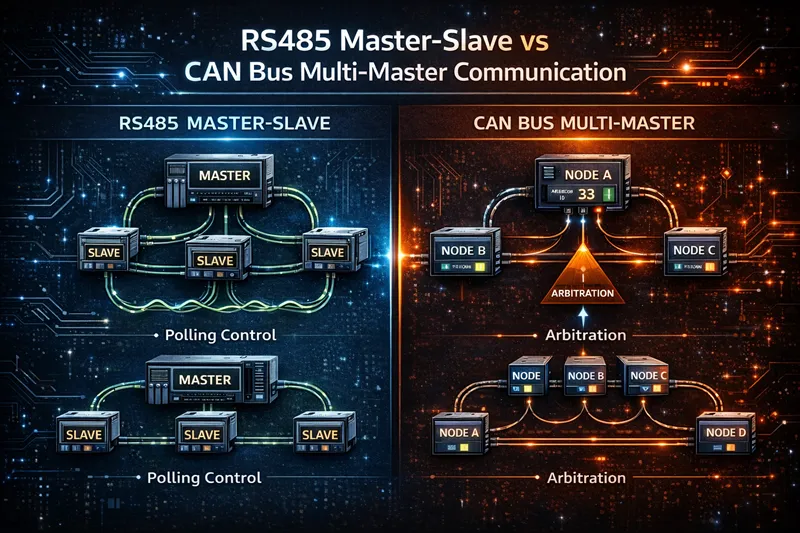
RS485: Does not define a communication model. However, because it lacks hardware-level collision avoidance, most implementations adopt a Master-Slave architecture (e.g., Modbus RTU) or Token Passing to manage bus access.
CAN Bus: Natively supports a Multi-Master architecture. Its Non-Destructive Bitwise Arbitration allows any node to transmit when the bus is idle, using message IDs to resolve conflicts without losing data.
3. Node Capacity: Unit Loads vs. Drive Capability
The “how many devices” question depends on electrical constraints, not just a hard number in a manual.
RS485: The standard defines support for 32 Unit Loads (UL). However, modern high-impedance transceivers (1/4 or 1/8 UL) allow for networks of 128 to 256 physical nodes on a single segment.
CAN Bus: Typical engineering guidelines suggest 30 to 110 nodes per segment. This is not a protocol limit but a practical trade-off influenced by transceiver drive capability, bus capacitance, and the timing requirements of the arbitration phase.
4. Fault Tolerance: Hardware vs. Software Logic
How the system reacts to a “bad actor” or environmental noise is a key differentiator.
The "Babbling Node" Scenario
RS485: Lacks built-in hardware fault confinement. While protocol-level watchdogs and master timeouts can mitigate a hung node, a hardware-level short or a transceiver stuck in “transmit” can still paralyze the bus.
CAN Bus: Features robust Hardware Fault Confinement. Each node uses TEC/REC (Transmit/Receive Error Counters) to track its own health. If a node fails consistently, it transitions from Error Active to Error Passive, and eventually to Bus-Off, where it physically disconnects itself to save the network.

5.Speed, Distance, and Termination
In both systems, you cannot have maximum speed at maximum distance.
The Speed-Distance Trade-off
| Technology | Data Rate | Max Distance (Approx.) | Termination Requirement |
| RS485 | 10 Mbps | < 15 m | Recommended (for high speed/long cables) |
| RS485 | 100 kbps | ~1200 m | Recommended |
| CAN | 1 Mbps | ~40 m | Mandatory (120Ω) |
| CAN | 125 kbps | ~500 m | Mandatory (120Ω) |
Technical Note: In CAN, 120Ω termination is not just for signal integrity; it is electrically required to return the bus from a “Dominant” state to a “Recessive” state.
6. Resource Overhead & Cost
CPU Load: CAN hardware handles arbitration, CRC generation, and retransmission in silicon, which can reduce the MCU’s communication overhead. However, the application layer (e.g., CANopen or J1939) still requires significant message processing.
System Cost: While RS485 transceivers are generally lower in unit cost, CAN can be more cost-effective in complex, multi-master real-time systems by significantly reducing software development time for collision handling.
FAQ
1.Can RS485 and CAN use the same cable?
Both typically run on 120Ω shielded twisted-pair (STP). While the physical wire is compatible, the hardware transceivers and logic controllers are completely different and cannot interoperate.
Is CAN bus more reliable than RS485?
CAN offers superior hardware-level reliability through automated error handling and fault isolation. RS485 reliability is highly dependent on the robustness of the software protocol (like Modbus) and the implementation of external watchdogs.