 Skip to content

CAN Bus Troubleshooting Guide for Off-Highway Equipment
Common mistake
Table of Contents
When an off-highway machine suddenly shows communication faults, warning lights, engine derate, hydraulic lockout, or even a no-start condition, the first reaction is often to suspect the controller or software. In practice, that is often the wrong starting point.
Many CAN bus problems in off-highway equipment begin much lower in the system: damaged wiring harnesses, loose connectors, poor grounding, incorrect termination, water ingress, or intermittent faults caused by vibration and movement. If those physical-layer issues are not ruled out first, replacing modules or digging into higher-level diagnostics can waste a lot of time.
This guide explains how to troubleshoot CAN bus faults in off-highway equipment in a practical order. Instead of starting with theory, it starts with what matters in the field: machine symptoms, quick checks, test results, and the right next step.
Why CAN Bus Faults in Off-Highway Equipment Cause Machine-Wide Problems
In off-highway equipment, the CAN bus is not just a communication line. It is the network that allows multiple electronic modules to exchange critical operating data. When that communication becomes unstable, one local network fault can quickly create machine-wide symptoms.
A CAN bus issue may cause:
- communication loss between control units
- warning lights on the display
- missing sensor data
- hydraulic functions to stop responding
- engine power limitation
- intermittent shutdown behavior
- failure to start
This is why CAN faults can look much bigger than they really are. A damaged section of harness or a poor connector may appear to be a major system failure because several modules lose communication at the same time.
In off-highway environments, these faults are more difficult to diagnose because machines work under vibration, dust, mud, moisture, heat, cold, and repeated mechanical stress. A machine may pass a static inspection in the workshop but still fail in the field when the boom moves, the chassis twists, or the harness vibrates under load.

The Most Common CAN Bus Problems in Off-Highway Equipment
Before moving into detailed diagnostics, it helps to understand the most common causes.
Incorrect termination
CAN networks typically rely on proper termination resistance at both ends of the bus. If termination is missing, damaged, or incorrectly installed, network communication may become unstable or fail completely.
Wiring harness damage
Harnesses on off-highway machines are exposed to rubbing, crushing, bending, oil contamination, heat, and repeated movement. Over time, this can lead to broken conductors, insulation damage, or short circuits.
Connector problems
Loose pins, corrosion, poor pin tension, incomplete locking, and water ingress are common causes of intermittent or permanent communication faults.
Grounding issues
Poor grounding can create unstable network behavior, abnormal voltage readings, or inconsistent module communication.
Short circuits between CAN lines or to power/ground
A short between CAN_H and CAN_L, or between one of the lines and power or ground, can bring the whole network down.
Faulty transceivers or network nodes
A damaged transceiver in one module can disrupt communication for the entire network.
Intermittent faults
These are often the hardest to diagnose. The machine may work normally at rest, then fail only during movement, vibration, turning, lifting, or after washing.
Start With Machine Symptoms, Not With Assumptions
A better troubleshooting process begins with what the machine is doing, not with what you assume is broken.
Ask these questions first:
- Is the fault constant or intermittent?
- Does it appear only during machine movement?
- Did it start after washing, rain, maintenance, or harness repair?
- Are multiple modules offline, or just one?
- Does the machine show derate, lockout, or no-start?
- Does the problem change when the boom, steering, body, or attachment moves?
These questions help narrow the fault path. For example:
- multiple modules offline often points to a bus-level issue rather than a single sensor fault
- fault appears only when moving often points to harness flex, connector looseness, or vibration-related failure
- fault after washing or wet conditions often suggests water ingress or connector contamination
- one module offline while others communicate normally may point to a local branch fault, power issue, or failed node
A Practical CAN Bus Troubleshooting Workflow
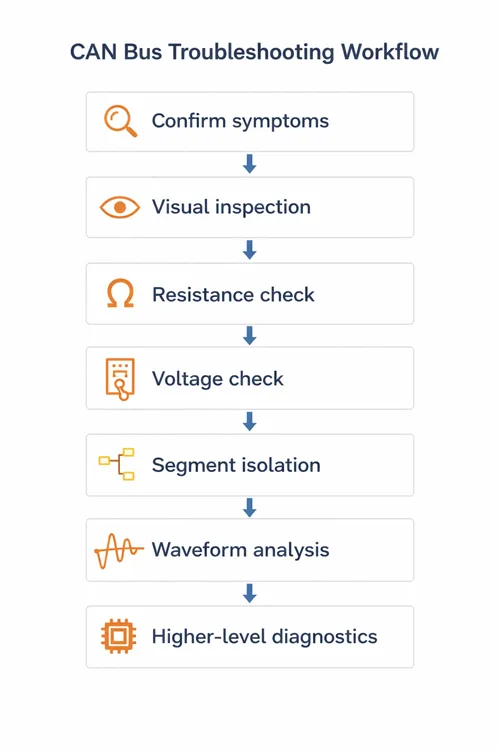
The most efficient workflow is usually:
- confirm the fault symptoms
- inspect the physical layer
- test resistance
- test voltage
- isolate segments or nodes
- use waveform or protocol tools only when necessary
This order prevents wasted effort.
Step 1: Visual inspection
Before using instruments, inspect the obvious points:
- damaged harness sections
- crushed or stretched cables
- connectors not fully seated
- bent, loose, or corroded pins
- signs of moisture, dirt, or oil inside connectors
- poor grounding points
- recent repair areas
- areas where harnesses move with articulation, lifting, or steering
A careful visual inspection can save a lot of time, especially on machines where the failure is mechanical rather than electronic.
Step 2: Power-off resistance check
With power off, measure resistance between CAN_H and CAN_L.
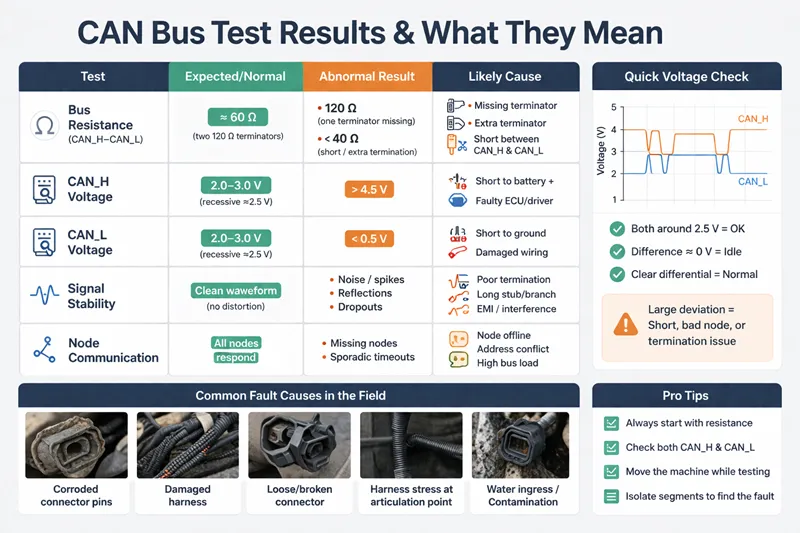
In many systems, you expect to see about 60 ohms across the bus when both termination resistors are present and healthy.
Typical interpretations:
- around 60 ohms: termination is likely present and generally correct
- around 120 ohms: one terminator may be missing or disconnected
- much lower than 60 ohms: possible extra termination, short, or wiring issue
- open circuit / very high resistance: broken line, disconnected section, or missing termination
This is one of the fastest ways to judge whether the network basics are intact.
Step 3: Key-on voltage check
With the system powered, check CAN_H and CAN_L relative to ground.
Abnormal voltage may indicate:
- short to power
- short to ground
- failed transceiver
- module pulling the bus down
- unstable supply or ground reference
Do not rely only on resistance if the problem is intermittent. A network can look acceptable when powered off but still fail dynamically when active.
Step 4: Connector and pin inspection under real stress
This step is often skipped, but it matters.
A connector may look fine visually and still fail under vibration. Check:
- pin retention
- pin tension
- signs of micro-corrosion
- water trails
- seal damage
- pull-out risk
- movement-related stress
On off-highway machines, many real faults are not clean open circuits. They are borderline contact failures that appear only when the machine vibrates or the harness shifts.
Step 5: Segment isolation
If the bus-level readings are abnormal or the fault is difficult to localize, isolate the network in sections.
This can help answer:
- is the problem in the main trunk or a branch?
- is one node pulling down the network?
- does the bus recover when a certain section is disconnected?
A segment-by-segment approach is often much faster than randomly replacing parts.
Step 6: Waveform analysis when basic checks are not enough
A multimeter is useful, but it cannot show everything.
If the fault is intermittent, load-related, or timing-related, waveform analysis becomes much more useful. It can help reveal:
- unstable bus levels
- noise
- reflections
- distorted signals
- communication collapse under certain conditions
This is especially important when static resistance and voltage checks appear normal but the machine still reports network errors.
How to Diagnose Intermittent CAN Bus Faults in Real Working Conditions
Intermittent faults are where many troubleshooting guides become too theoretical. In real off-highway equipment, these are some of the most common and most frustrating failures.
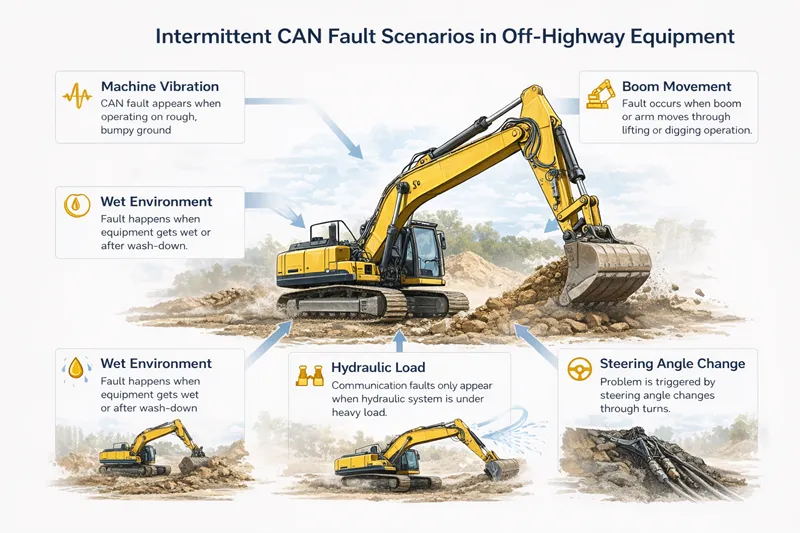
An intermittent CAN problem may appear:
- only while driving over rough ground
- only when the boom or arm moves
- only when steering reaches a certain angle
- only after warm-up
- only in wet conditions
- only during hydraulic load
- only after the machine has been vibrating for some time
Why intermittent faults are different
A constant fault is usually easier to locate because the failure is present during testing. An intermittent fault may disappear as soon as the machine is parked for inspection.
This means troubleshooting must include fault reproduction.
Better ways to reproduce the fault
You may need to test while:
- moving the harness by hand
- flexing suspect sections carefully
- operating the function that triggers the fault
- checking connectors during vibration or movement conditions
- observing whether the issue follows heat, moisture, or articulation
This is where field experience matters. Some failures are only visible under real operating stress.
Common mistake
A major mistake is treating an intermittent fault like a constant one. If the machine only drops communication during motion, a clean static test in the workshop does not prove the network is healthy.
When a CAN Bus Problem Is Physical-Layer Trouble and When It Is Time to Check Higher-Level Diagnostics
Many teams go into message-level diagnostics too early.
Higher-level analysis can be helpful, but only after the physical layer is reasonably confirmed.
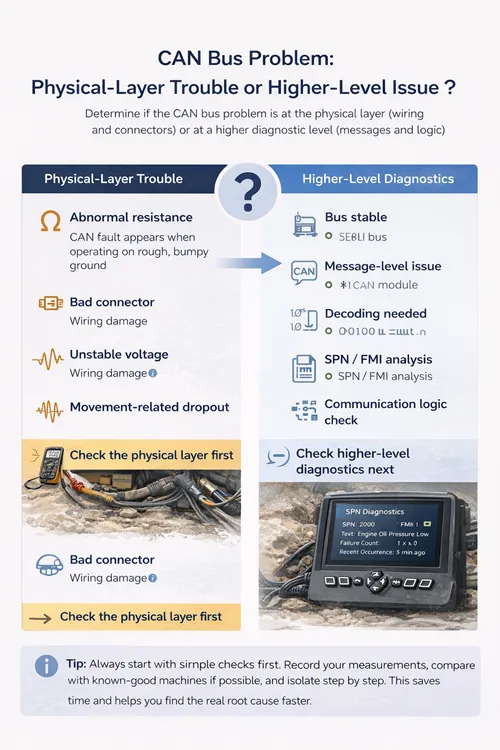
You should stay focused on the physical layer when you still have:
- abnormal resistance
- unstable voltage
- suspected connector or harness issues
- moisture or corrosion evidence
- bus-level communication collapse
- fault changes triggered by movement or vibration
You should consider moving further into higher-level diagnostics when:
- termination is correct
- voltage looks stable
- connectors and harnesses have been checked
- segment isolation has not revealed a physical fault
- the problem appears to involve message interpretation rather than bus integrity
In simple terms:
- physical-layer fault = the network itself is unstable
- higher-level diagnostic issue = the network is alive, but communication content, addressing, or logic still needs investigation
That distinction saves time.
Common Test Results and What They Usually Suggest
If you measure about 60 ohms
The network termination is likely present and generally correct. You still need to check connectors, wiring condition, power, and dynamic behavior.
If you measure about 120 ohms
One termination point may be missing, disconnected, or no longer connected to the full network.
If the resistance is too low
There may be an extra terminator, wiring damage, or a short between lines.
If voltage is abnormal
Look for shorts, failed nodes, poor grounding, or unstable supply conditions.
If the machine only fails during motion
Suspect connector integrity, harness flex damage, vibration-related contact problems, or articulation-point wiring issues.
If many systems fail at once
Think bus-level problem first, not individual component failure first.
Field Mistakes That Waste Troubleshooting Time
Replacing the controller too early
A controller is often blamed before the wiring basics are confirmed. This can waste money and delay repair.
Reading codes before confirming the network basics
Fault codes can point to communication loss, but they do not automatically identify the real root cause.
Ignoring connectors because they “look fine”
Many connector faults are not obvious until you inspect pins, seals, tension, and movement effects closely.
Skipping dynamic checks
A machine that passes inspection while parked may still fail in operation.
Treating all CAN faults the same way
A constant total bus failure and an intermittent movement-related dropout are not the same problem and should not be diagnosed the same way.
What a Better Off-Highway CAN Troubleshooting Guide Should Help You Decide
A useful guide should not just explain CAN bus theory. It should help technicians and engineers decide:
- what to check first
- what not to assume too early
- when a reading is normal
- when the problem is probably physical rather than logical
- when to isolate a segment
- when basic tools are enough
- when advanced signal analysis becomes necessary
That is especially important in off-highway equipment, where environmental stress and machine movement can create faults that are difficult to catch with a purely static test process.