 Skip to content

CAN Bus High and Low Voltage the Same?
Short answer
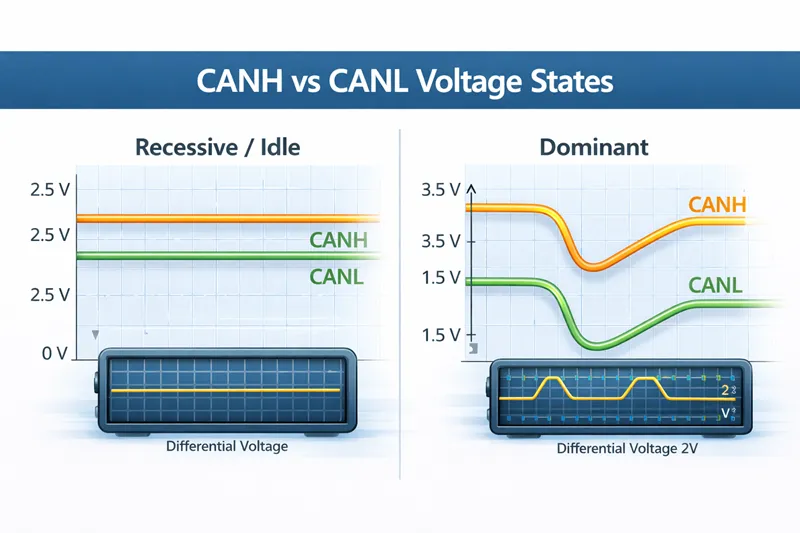
Yes, CAN High and CAN Low can be the same voltage in a normal CAN network. On a typical high-speed CAN bus, both lines sit at about 2.5 V in the recessive or idle state. When a dominant bit is transmitted, CANH usually rises to about 3.5 V and CANL drops to about 1.5 V, creating the differential signal the receiver uses to detect data.
That means seeing “the same voltage” on CANH and CANL does not automatically mean the bus is faulty. It may simply mean the network is idle, your meter is averaging the signal, or you are measuring single-ended voltage instead of the voltage difference between the two lines.
Why CAN High and CAN Low Can Be the Same
CAN is a differential communication bus, so the receiver mainly cares about the voltage difference between CANH and CANL, not just the absolute voltage of one wire to ground. In a normal recessive state, both lines are biased to nearly the same level, commonly around 2.5 V on 5 V high-speed CAN systems, so the differential voltage is close to 0 V.
When a dominant bit is sent, the transceiver drives the pair apart: CANH goes up and CANL goes down. A common example shown in training and diagnostics material is CANH ≈ 3.5 V and CANL ≈ 1.5 V, which gives a differential voltage of about 2 V.
So the right engineering question is not just “Are the voltages the same?” but also:
Is the bus idle or active, and am I measuring single-ended voltage or differential voltage?
What “Same Voltage” Means in the Recessive State
On a healthy high-speed CAN network, the recessive state is the default state of the bus. In this condition, both wires are passively biased to nearly the same common-mode level. Texas Instruments and Kvaser both describe this as roughly 2.5 V on both lines for common 5 V CAN transceivers, while TI also notes that 3.3 V CAN transceivers may bias recessive a little differently, often around 2.3 V.
This is one reason a technician using a multimeter may conclude that CANH and CANL “look the same.” In many cases, the bus is simply resting in recessive, and the meter is not showing the brief dominant transitions that appear during real data traffic.

What Changes in the Dominant State
When a CAN node transmits a dominant bit, it actively creates a voltage difference between the two wires. Industry examples commonly show CANH moving from about 2.5 V to 3.5 V and CANL moving from about 2.5 V to 1.5 V. The exact numbers can vary by transceiver and measurement setup, but the key point is that the lines separate and the receiver detects that differential swing.
Analog Devices summarizes the logic from the receiver’s point of view: CAN is decoded by the CANH-CANL differential voltage. If that differential is large enough, the receiver reads a dominant state; if it is very small, it reads a recessive state.
When Equal Voltage Is Normal
Seeing the same or nearly the same voltage on CANH and CANL is usually normal in these situations:
1. The bus is idle
If no node is currently driving a dominant bit, both lines return to the recessive level. On many high-speed CAN networks, that means both are near 2.5 V.
2. You are using a multimeter
A multimeter often averages fast activity, so even an active bus can appear close to its bias level unless you use a scope or a proper CAN analysis setup. Kvaser’s troubleshooting material emphasizes waveform-based diagnosis rather than relying only on simple DC readings.
3. You are looking at single-wire voltage
Single-ended measurement to ground can be useful, but it does not tell the whole story. CAN is fundamentally about the difference between CANH and CANL, so a differential measurement is often more meaningful than looking at each line alone.
When Equal Voltage Can Be a Warning Sign
Equal voltage is not always harmless. It can also point to a problem if the bus never leaves recessive, if there is expected traffic but no dominant transitions appear, or if wiring and termination issues prevent the normal differential swing from forming. Kvaser’s testing articles point engineers toward checking signal behavior, termination, and measurement method before blaming higher-level devices.
Possible fault scenarios include:
no actual message traffic on the network
missing or incorrect termination
wiring problems
transceiver issues
measurement errors caused by ground reference or probe method
So the real troubleshooting rule is simple:
same voltage is normal if the bus is recessive; same voltage is suspicious if the bus should be active but never shows differential transitions.
Why Termination Matters
High-speed CAN normally uses two 120 Ω termination resistors, one at each end of the bus, which together present about 60 Ω across the differential pair. These resistors help control reflections and support proper signal integrity. If termination is missing or incorrect, the observed voltages and waveforms can become misleading.
That is why termination should be part of any serious CAN voltage diagnosis. If your voltage readings look strange, checking the expected resistance across the bus and verifying end-of-line termination is often more useful than guessing from one voltage number alone.

How to Measure CANH and CANL Correctly
The most useful way to diagnose this question is:
Step 1: Confirm whether the bus is active
If there is no traffic, equal voltage may simply be normal recessive bias.
Step 2: Measure both lines, not just one
Check CANH and CANL individually to ground, but do not stop there.
Step 3: Check the differential signal
The most important measurement is often CANH minus CANL. This shows whether dominant bits are actually being created. Analog Devices explicitly describes CAN as a protocol where the logic state is determined by that differential voltage.
Step 4: Verify termination
A voltage reading without termination context can be misleading. Proper bus resistance and end-of-line layout matter.
Step 5: Consider transceiver type
Not every system uses identical recessive bias values. TI notes that 3.3 V CAN can sit at a different recessive common-mode voltage than traditional 5 V CAN, so exact absolute numbers are not universal.
A Practical Engineering Interpretation
In real troubleshooting, engineers often ask this question after probing a machine network and seeing both lines sit near the same value. The safest interpretation is:
If the bus is idle, that can be completely normal
If the bus is active, you should expect the lines to separate during dominant bits
If they never separate, investigate traffic, termination, grounding, and transceiver behavior
For mobile equipment, vehicle electronics, and distributed control systems, this distinction matters because CAN problems are often misdiagnosed from static voltage checks alone. If your application uses a dedicated CAN bus controller, it is still the physical layer behavior of CANH and CANL that determines whether the network is actually healthy.
Final Answer
So, are CAN bus high and low voltage the same?
Sometimes yes. In the normal recessive state, CANH and CANL are typically biased to nearly the same voltage. In the dominant state, they separate to create the differential signal used for communication. That is why “same voltage” can be either perfectly normal or a warning sign, depending on whether the bus is idle, active, or faulted.