 Skip to content
CAN Bus Grounding Problems Explained: Why Communication Becomes Intermittent
Table of Contents
CAN bus communication problems are not always caused by damaged wiring or missing termination resistors.
In many mobile machinery and industrial vehicle projects, the CAN network appears to work normally most of the time, but communication becomes unstable under certain conditions.
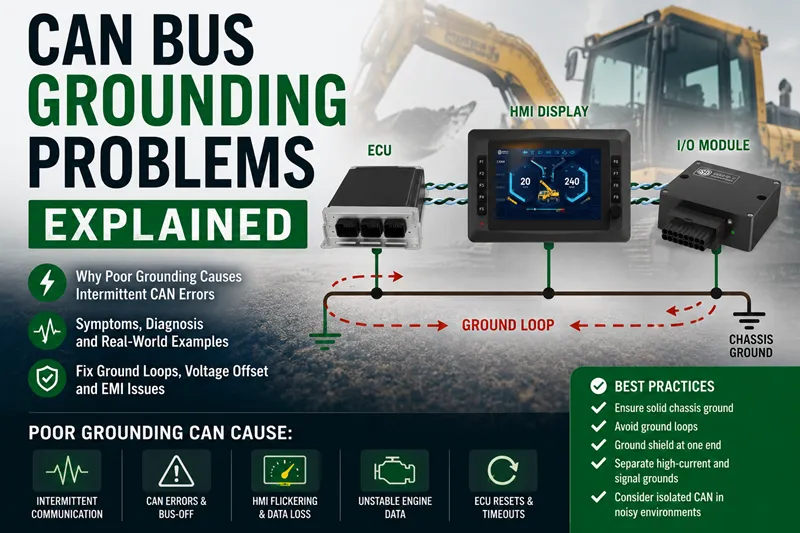
Typical symptoms include:
- intermittent communication
- random CAN errors
- HMI display flickering
- engine RPM fluctuations
- CAN bus-off errors
- ECU resets during startup
- communication failures under hydraulic load
In many of these cases, the real problem is poor grounding.
This article explains how CAN bus grounding problems affect communication, why intermittent failures occur, and how engineers can diagnose and fix grounding issues in real CAN networks.
Common Symptoms of CAN Bus Grounding Problems
Grounding problems rarely cause complete communication failure immediately.
Instead, they usually create unstable and misleading symptoms first.
Intermittent Communication
One of the most common signs of poor CAN grounding is intermittent communication.
The network may:
- work normally for several minutes
- randomly disconnect
- recover automatically
- fail only under certain operating conditions
This often happens when voltage differences between nodes change dynamically.
CAN Error Frames and Bus-Off State
Poor grounding can increase:
- CAN error frames
- communication retries
- bit errors
If the error counters continue increasing, the controller may eventually enter:
CAN Bus-Off State
At this point, communication stops completely until the node resets or recovers.
HMI Display Flickering or Freezing
In mobile machinery, grounding problems may cause:
- unstable RPM values
- frozen gauges
- intermittent warning lights
- display rebooting
- touchscreen instability
These problems are often mistaken for HMI hardware failure even though the root cause is grounding quality.
ECU Communication Failure Under Load
Some machines only experience CAN problems when:
- hydraulic pumps operate
- actuators move
- alternators charge heavily
- high-current devices activate
This is a major clue that grounding or EMI is affecting the CAN network.
Why CAN Bus Still Needs a Ground Reference
Many engineers know CAN uses differential signaling and assume ground is not important.
However, CAN transceivers still require a valid common reference voltage range to communicate reliably.
Differential Signaling
CAN uses two signal lines:
- CAN_H
- CAN_L
The receiver measures the voltage difference between these lines rather than absolute voltage to ground.
This improves noise immunity.
Common Ground Still Matters
Although CAN is differential, nodes still require a reasonably similar ground reference.
Large voltage differences between devices can create:
- communication instability
- signal distortion
- receiver errors
- bus-off conditions
Common-Mode Voltage Problems
CAN transceivers only tolerate a limited common-mode voltage range.
If the voltage offset between nodes becomes too large, the receiver may no longer correctly interpret the CAN signal.
This is especially common in:
- long vehicle harnesses
- poor chassis grounding
- high-current equipment
- retrofit systems
Ground Loops and Shield Grounding Problems
What Is a Ground Loop?
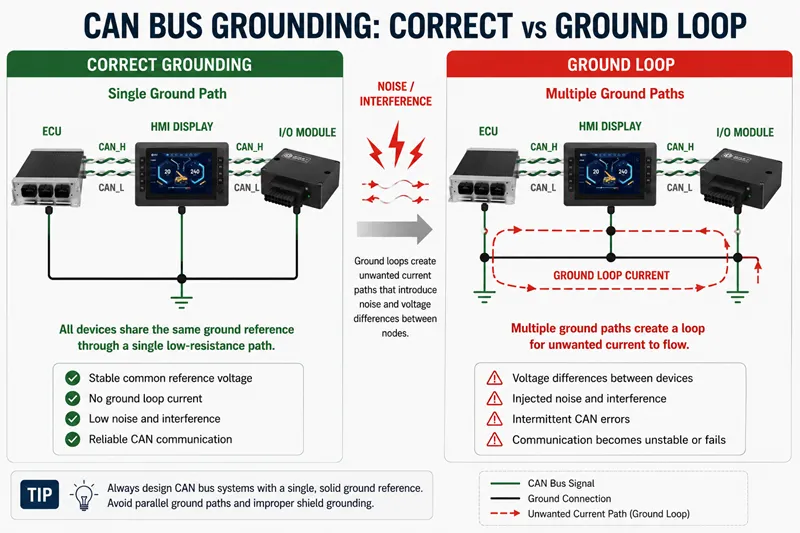
A ground loop occurs when multiple grounding paths create unwanted current flow between devices.
In CAN networks, this can introduce:
- electrical noise
- voltage fluctuations
- communication instability
Ground loops are common in:
- industrial systems
- mobile machinery
- long-distance CAN installations
Shield Grounding at Both Ends
In some situations, grounding the CAN shield at both ends may create a loop between different chassis ground potentials.
This can increase interference instead of reducing it.
Symptoms may include:
- intermittent CAN errors
- unstable HMI data
- random communication loss
When Single-End Shield Grounding Is Safer
Many CAN troubleshooting guides recommend grounding the shield at one end only to reduce the risk of ground loops.
However, the best grounding strategy depends on:
- vehicle architecture
- EMC requirements
- harness length
- noise environment
There is no universal grounding rule for every machine.
Why Mobile Machinery Has More Grounding Problems
Mobile machinery environments are much harsher than laboratory CAN systems.
Hydraulic EMI
Hydraulic valve switching and pump motors can generate strong electromagnetic interference.
If grounding quality is poor, this noise may affect CAN communication.
Typical symptoms include:
- HMI freezes during hydraulic operation
- intermittent CAN errors under load
- unstable ECU data
Alternator Noise
Engine startup and alternator charging can create temporary voltage shifts.
In poorly grounded systems, this may cause:
- HMI rebooting
- ECU reset
- communication timeout
especially during startup.
Long Wiring Harnesses
Construction and agricultural machines often use long CAN harnesses.
Longer harnesses increase:
- ground resistance
- voltage offset
- susceptibility to noise
This makes proper chassis grounding more important.
Vibration and Corrosion
Off-highway equipment operates in:
- mud
- moisture
- vibration
- dust
- temperature extremes
Over time, grounding points may loosen or corrode, increasing resistance and reducing communication stability.
How to Diagnose CAN Bus Grounding Problems
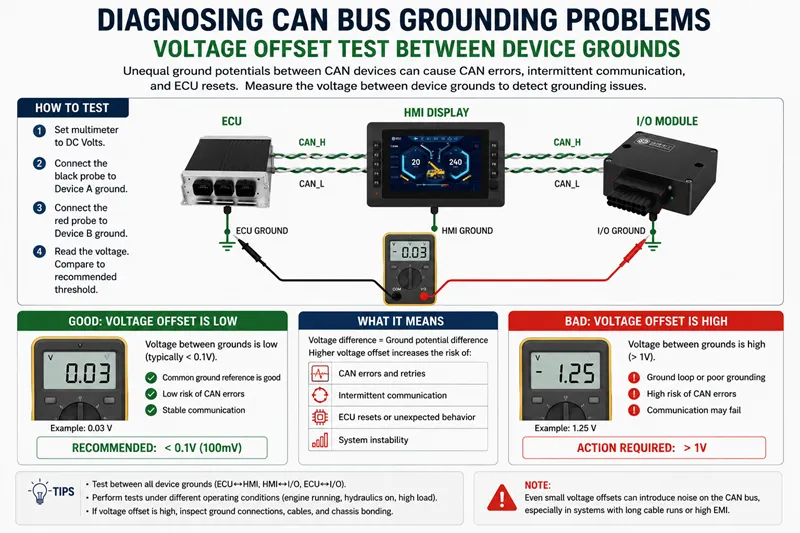
Measure Voltage Offset Between Nodes
One important test is measuring voltage difference between:
- ECU ground
- HMI ground
Unexpected voltage offset may indicate poor grounding.
Check CAN_H and CAN_L to Ground
Measure:
- CAN_H to ground
- CAN_L to ground
Abnormal readings may suggest:
- floating ground
- damaged transceiver
- short circuit
- grounding instability
Inspect Chassis Ground Connections
Check for:
- loose ground bolts
- corrosion
- paint under grounding terminals
- damaged connectors
Poor chassis grounding is one of the most common root causes of intermittent CAN problems.
Use an Oscilloscope for Intermittent Problems
Some grounding faults only appear dynamically.
An oscilloscope can help identify:
- transient voltage spikes
- common-mode noise
- unstable signal quality
- EMI during hydraulic operation
This is especially useful in difficult field troubleshooting situations.
How to Fix CAN Grounding Problems
Improve Chassis Ground Quality
Use:
- clean metal grounding surfaces
- short grounding paths
- low-resistance connections
Avoid grounding through painted or corroded surfaces.
Avoid Unnecessary Ground Loops
Do not automatically connect every shield or ground point together without understanding the grounding structure.
Improper shield grounding can create unwanted current paths.
Separate High-Current and Signal Grounds
Keep CAN signal grounding separated from:
- motor power grounding
- hydraulic pump grounding
- alternator high-current paths
This reduces noise coupling.
Use Isolated CAN When Necessary
In noisy systems or long-distance networks, isolated CAN transceivers may improve reliability by reducing ground-related communication problems.
Isolation is especially useful in:
- retrofit projects
- mixed-voltage systems
- heavy industrial machinery