 Skip to content
SAE J1939 Display for Off-Highway Engines: What Operators Should See
Table of Contents
A SAE J1939 display connects to the CAN bus and reads engine data from the ECU.
But in real machines, the challenge is not data access—it is information selection.
A good display does not show everything.
It shows what the operator needs to act on.
What Does a J1939 Display Actually Read?
A J1939 display listens to broadcast messages from the engine ECU and decodes:
- Engine RPM
- Coolant temperature
- Engine oil pressure
- Fuel level
- Battery voltage
- Fault data (DM1, SPN, FMI)
These values are transmitted over the network using PGNs and SPNs.
However, not all ECUs broadcast the same data.
What can be displayed depends on the engine and configuration.
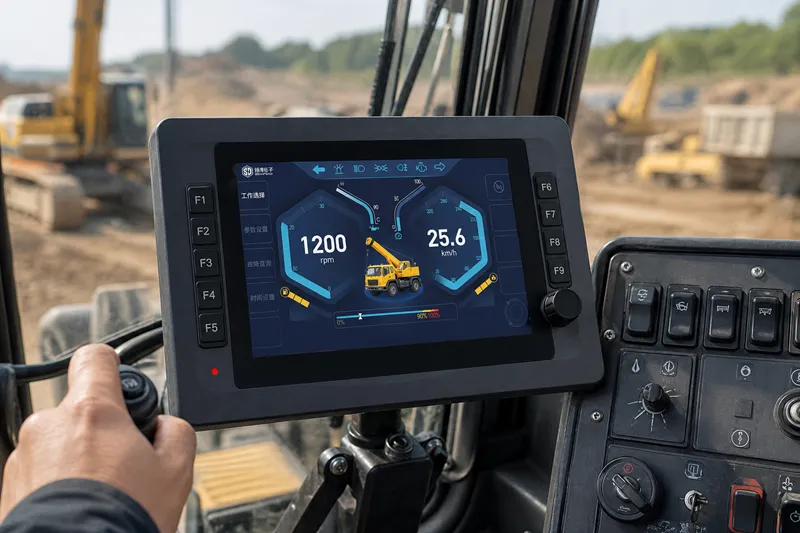
Core Engine Parameters: What Should Be on the Main Screen
The main screen should focus on operational safety and visibility.
Typical core parameters:
- Engine RPM → reflects load and working condition
- Coolant temperature → prevents overheating
- Oil pressure → critical for engine protection
- Fuel level → supports operation planning
Secondary data (fuel rate, hours, exhaust temp) can be placed on secondary pages.
👉 Rule:
If the operator needs it in seconds, it belongs on the main screen.
Fault Information: From SPN/FMI to Actionable Alerts
J1939 diagnostics are based on:
- SPN (what parameter failed)
- FMI (how it failed)
But showing raw codes like:
is not useful for operators.
A proper display should translate this into:
- Fault level (warning / derate / shutdown)
- Affected system
- Clear message
- Recommended action
Example:
- ❌ SPN 100 FMI 1
- ✅ “Engine oil pressure low – reduce load”
👉 This is where many systems fail:
they show data, but not decision guidance.
Screen Design: What Operators Should See at Each Stage
A flat interface is not enough.
A J1939 display should follow state-based design.
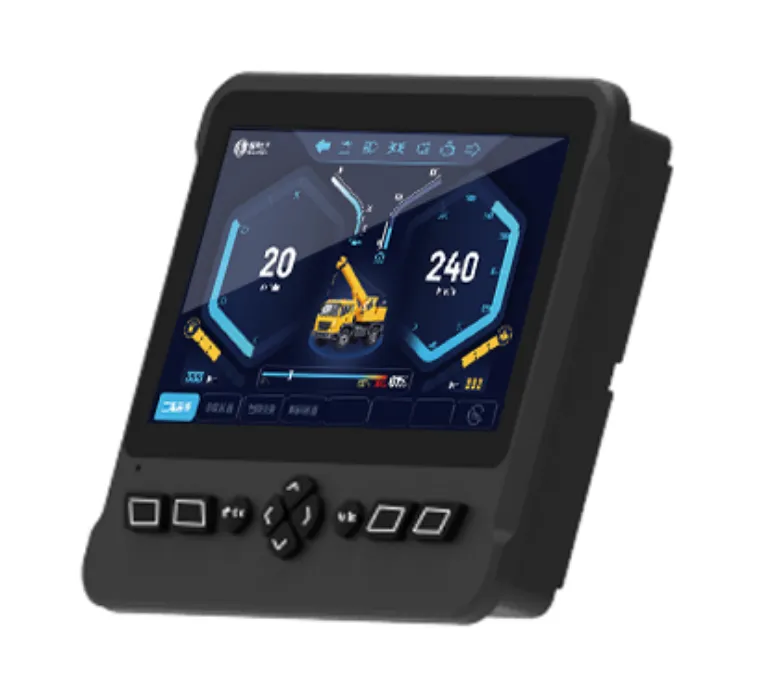
Normal Operation
- RPM, temperature, oil pressure
- Clean layout, minimal distraction
Warning Condition
- Highlighted alert
- Short explanation
- No deep diagnostics
Critical Fault
- Full-screen alarm
- Immediate action required
- No hidden information
Service / Diagnostic Mode
- SPN / FMI
- Fault history
- Detailed data
👉 Important:
Operators need clarity.
Technicians need detail.
These should not be mixed.
Off-Highway Display Requirements
Unlike automotive dashboards, off-highway displays operate in harsh conditions.
Environmental Requirements
- Sunlight readability
- Dust and water protection
- Vibration and shock resistance
Electrical & Communication
- 12V / 24V compatibility
- Stable J1939 communication
Operator Interaction
- Physical buttons (for gloves)
- Rotary knob (for precise control)
- Simple navigation logic
Off-Highway Display Requirements
Many J1939 displays fail not because of hardware, but because of interface design.
Too Much Data
Showing all available parameters reduces usability.
Raw Diagnostic Codes on Main Screen
Operators should not interpret SPN/FMI.
Hidden Critical Alerts
Warnings must be visible immediately.
👉 Key principle:
If action is required, the information must be impossible to miss.
Practical Insight from Real Integration
In real off-highway projects, we rarely put all available J1939 data on the first screen.
Instead, we separate:
- Operational data
- Warning data
- Diagnostic data
This improves:
- Reaction speed
- Safety
- Operator confidence
Final Insight
A basic J1939 display shows engine data.
A good one improves visibility.
A well-designed display helps operators make faster, safer decisions—especially under pressure.