 Skip to content

Decoding Proprietary J1939 Messages: Techniques, Limits, and Risks
Table of Contents
Modern machines rely on J1939 to connect controllers, displays, engines, hydraulic systems, and other electronic components. While many J1939 messages are standardized, OEMs also use proprietary messages for custom functions that are not publicly defined.
This makes decoding much harder. A logger may capture clear traffic, and some bytes may change with machine behavior, but that does not automatically mean the message is fully understood.
What Proprietary J1939 Messages Are
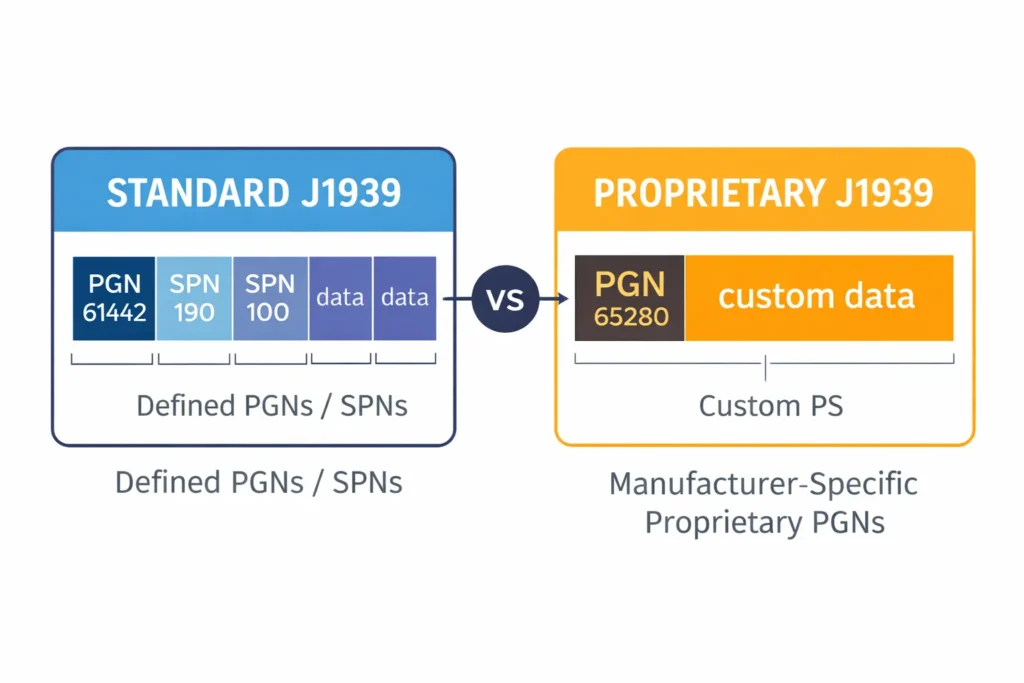
Standard J1939 messages use known PGNs and SPNs with defined meanings. Proprietary messages are different. They are manufacturer-specific and often carry custom logic, internal states, or special machine functions.
So even if you identify a proprietary PGN, you still may not know what the payload actually means. In many machine projects, these messages are tied to OEM-specific control strategies, application functions, or internal coordination between displays, controllers, and other electronic modules.
What You Can Learn from Monitoring
Passive monitoring is usually the safest way to start. By logging traffic without transmitting onto the bus, engineers can observe:
- message frequency
- payload length
- source behavior
- timing patterns
- correlation with machine actions
This helps identify which messages may be related to certain functions or operating conditions.
In real machine development, effective analysis often depends not only on logging tools, but also on how clearly engineers can access machine data and communication behavior. In some applications, a practical J1939 architecture built around rugged displays, controllers, and distributed I/O modules can make diagnostics and system observation much more efficient.
The Main Limit of Decoding
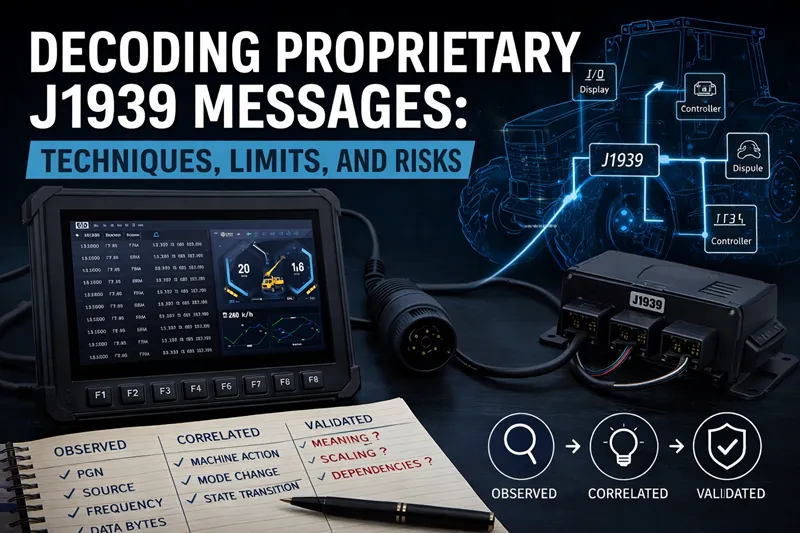
The biggest mistake is assuming that a changing byte is already a trusted signal.
A value may change with machine behavior, but its real meaning can still be unclear. It may be a physical value, a state flag, a request signal, or an internal variable used only under certain conditions.
Common decoding errors include:
- wrong scaling
- wrong offset
- wrong byte order
- signed versus unsigned confusion
- ignoring mode-dependent behavior
Because of this, correlation alone is not enough.
What You Can and Cannot Trust
In many cases, you can reasonably identify:
- who sends the message
- when it appears
- how often it updates
- which machine behavior it seems related to
But without stronger validation, you usually cannot confirm:
- exact engineering meaning
- true unit and scaling
- valid operating range
- hidden state logic
- whether the signal is safe for control use
This is especially important in mobile machinery, where one message may behave differently across startup, working mode, fault state, or application-specific conditions.
A Practical Way to Think About It
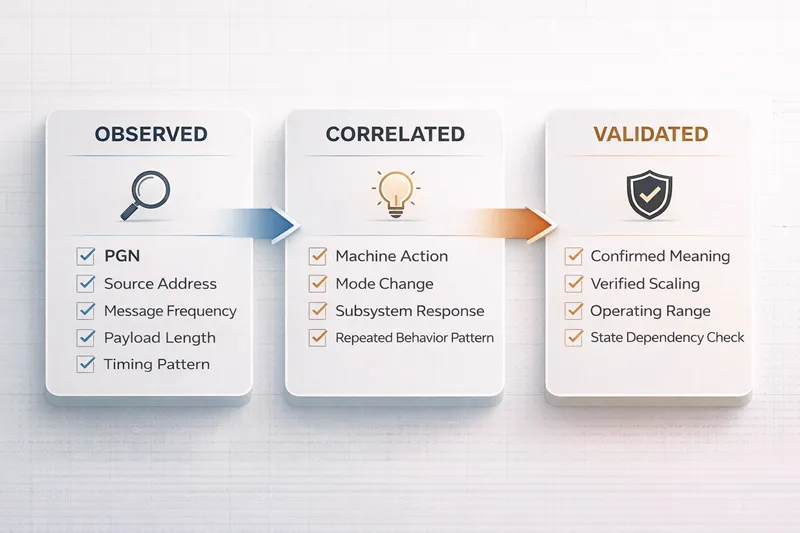
A simple way to approach proprietary J1939 decoding is to separate findings into three levels:
Observed — what is directly visible on the bus
Correlated — what seems related to machine behavior
Validated — what has been confirmed strongly enough to trust
Most analysis stops at the second level. That is why overconfidence becomes a real risk.
For OEMs and system integrators, this also means that communication visibility should be considered together with hardware architecture. A machine platform with properly designed controllers, HMI displays, and I/O expansion modules often makes signal tracing, diagnostics, and function validation much more manageable.
Risks in Real Projects
The main risk is not failing to decode a message. The real risk is believing the interpretation is correct when it is not.
That can lead to:
- wrong troubleshooting conclusions
- bad integration assumptions
- misleading HMI logic
- unsafe control decisions
If a proprietary message may affect machine enable logic, motion, or protected functions, guesswork should never be treated as proof.
Final Thoughts
Decoding proprietary J1939 messages is possible to a certain extent, but it always has limits.
The real engineering skill is not just reading traffic. It is knowing the difference between what the network clearly shows, what testing only suggests, and what still requires validation before it can be trusted.
For machine builders working on J1939-based systems, the communication challenge is not only about message decoding. It is also about building a reliable electronic architecture around the machine. Rugged displays, mobile controllers, and distributed I/O modules can all play a role in improving visibility, diagnostics, and overall system integration.