 Skip to content

How Does J1939 Work? From CAN Frames to Usable ECU Data
Short Answer
J1939 works by using CAN bus as the transport layer and adding a standardized communication structure on top of it, so ECUs can exchange data in a predictable way. Instead of sending raw CAN frames with private meanings, J1939 defines how identifiers, parameter groups, source addresses, and diagnostic data should be organized. That is what allows engine ECUs, displays, controllers, and diagnostic tools to understand each other on the same network.
A simple way to think about it is this: CAN bus moves the message, but J1939 tells the receiving device what that message means. Without the J1939 layer, a device may see CAN traffic but still not know how to interpret engine speed, temperatures, or fault information.
J1939 Is Not the Same as CAN Bus
A common mistake is treating J1939 and CAN bus as interchangeable terms. They are related, but they are not the same. CAN bus handles low-level communication such as arbitration and frame transport. J1939 is a higher-layer protocol built on top of CAN, mainly for heavy-duty vehicles and machinery. It defines how the data inside those frames should be structured and interpreted.
This distinction matters in real engineering work. A controller, display, or data logger may support CAN hardware, but unless it also supports J1939 parsing, it will not automatically understand J1939 messages. That is why CAN support does not always mean J1939 support.
The Basic Idea Behind How J1939 Works
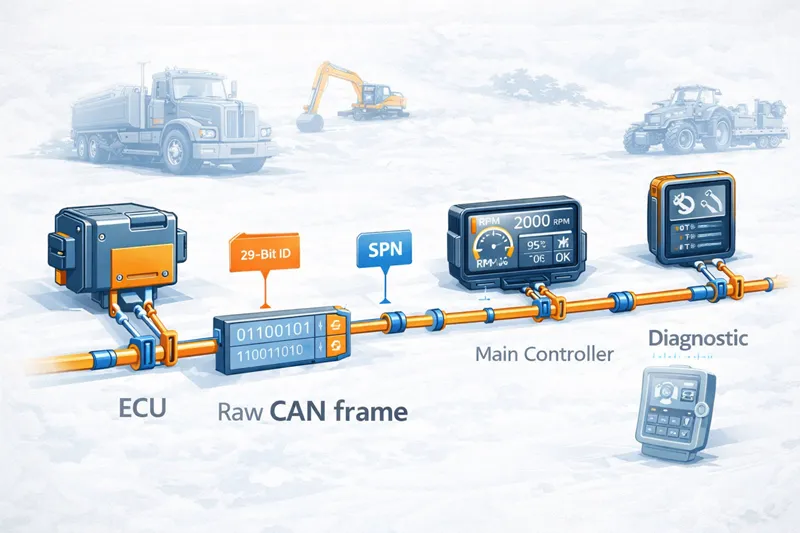
At a practical level, J1939 allows multiple ECUs on the same CAN network to share structured data. One ECU collects data, packages it into a message defined by J1939 rules, and broadcasts it on the network. Other devices on the bus receive that message and decide whether they care about it. If they do, they decode it using the identifier, PGN, and SPN definitions.
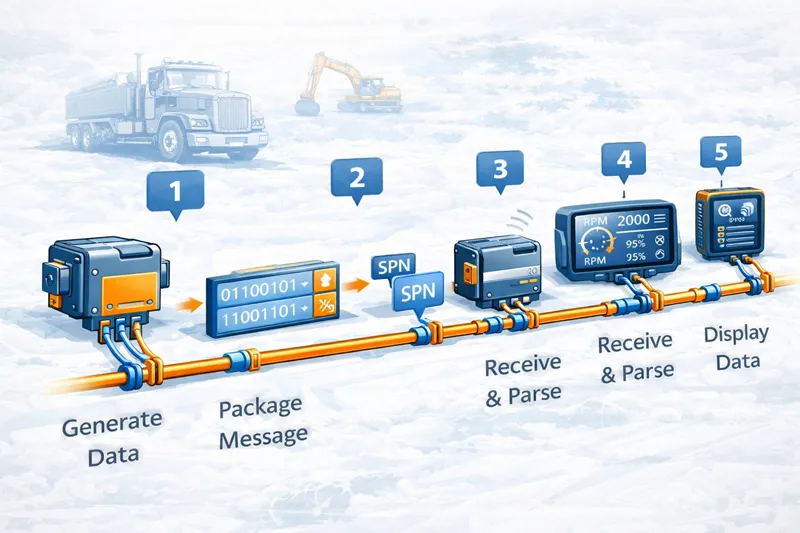
That means J1939 communication usually follows this logic:
A device generates data
The device packages that data into a J1939 message
The message is sent over CAN bus
Other devices read the identifier and recognize the message type
The relevant parameter values are extracted and displayed, logged, or used for control decisions
So when people ask “How does J1939 work?”, the real answer is: it turns CAN frames into a standardized language for ECU communication.
How the 29-Bit Identifier Fits In
One of the most important parts of J1939 is its use of the 29-bit CAN identifier. This extended identifier carries more structured information than a standard 11-bit CAN identifier. Instead of being just an ID number, it helps describe the message priority, the type of data being sent, and the source address of the transmitting ECU.
This is a big reason J1939 works so well in multi-ECU systems. Devices are not just hearing random traffic. They are reading identifiers that already contain meaning and routing logic. That makes it easier for displays, controllers, and service tools to decide which messages they need to process.
What PGNs and SPNs Actually Do
Many J1939 explanations mention PGNs and SPNs, but they often stop at the definition. To really understand how J1939 works, it helps to see what those terms do in practice.
PGN: the message category
A Parameter Group Number (PGN) defines the message type or group meaning. It tells the receiving device what kind of data this message contains. You can think of the PGN as the message topic.
SPN: the actual data item
A Suspect Parameter Number (SPN) defines a specific parameter inside that message, such as engine speed, oil pressure, or coolant temperature. If the PGN tells you the subject, the SPN tells you the exact data points inside it.
This is what makes J1939 more powerful than plain raw CAN communication. The receiving ECU does not just see bytes. It sees structured parameters with standard meanings.
How a J1939 Message Works Step by Step
This is the clearest way to explain the protocol.
Step 1: An ECU creates data
Imagine an engine ECU measuring current engine speed, coolant temperature, and operating status. That raw data starts inside the ECU.
Step 2: The ECU selects the right message structure
Instead of inventing a private message format, the ECU uses the J1939 standard to determine which PGN and parameter structure fit that data. That gives the message a standard meaning on the network.
Step 3: The message is sent over CAN bus
The ECU places the message on the CAN network using a 29-bit identifier and the CAN frame transport rules underneath. This is where CAN bus does its part: arbitration, physical transmission, and bus access.
Step 4: Other devices see the message
A display, main controller, telematics unit, or diagnostic logger listens to the same bus. Each receiving device checks the identifier and determines whether the message is relevant.
Step 5: The data is decoded
If the message is relevant, the receiving device uses the J1939 definitions to decode the PGN and the SPNs inside it. That is how raw bytes become an RPM value, a temperature reading, or a warning condition on the screen.
This step-by-step flow is the most practical explanation of how J1939 works.
How J1939 Handles Multiple Devices on One Network
Heavy-duty systems often include many ECUs on a shared bus. To make that workable, J1939 includes address claim and source address concepts so devices can identify themselves on the network. Kvaser’s material highlights address management as part of the broader J1939 structure.
This matters because a display does not just need to know that a message exists. It may also need to know which device sent it. In a multi-ECU machine, proper source identification helps avoid confusion and supports more reliable communication between engine, transmission, controller, and HMI devices.
How J1939 Handles More Than 8 Bytes
This is one of the most overlooked parts of the protocol.
A normal classic CAN frame has a limited payload size, so larger J1939 messages cannot always fit into a single frame. To solve that, J1939 uses a Transport Protocol (TP) for longer messages. Kvaser’s J1939 technical materials cover this as an important part of the protocol stack.
One important mechanism here is BAM, or Broadcast Announce Message, which is used to transfer multi-packet data in a broadcast-style workflow. This is one reason J1939 is more than “just CAN with standard IDs.” It also includes rules for how longer information is split, announced, and reassembled.
That means J1939 works not only for simple periodic signals, but also for larger data transfers when the application requires it.
How Broadcast Communication Fits Into J1939
A lot of J1939 traffic works through broadcast communication. In many cases, ECUs periodically send useful data onto the network without being individually requested every time. This is one reason displays, loggers, and controllers can easily subscribe to machine data once they know which PGNs matter.
This broadcast model is especially useful in heavy-duty and off-highway systems because several devices may need the same information at once. The engine ECU can broadcast data, and multiple listeners can use it for display, control, and diagnostics at the same time. That improves efficiency and simplifies multi-device integration.
How Diagnostics Work in J1939
J1939 is not only about real-time operating data. It also supports diagnostics, which is one reason it is so important in commercial vehicles and heavy machinery. Diagnostic information can be organized in standard ways so service tools can read fault-related data more consistently. Industry sources tie J1939 closely to heavy-duty diagnostics and network troubleshooting workflows.
This matters because maintenance teams do not just want bytes on a bus. They want structured fault information they can use to identify machine issues faster. That diagnostic layer is one of the practical reasons J1939 remains so valuable.
Why J1939 Works So Well in Heavy-Duty Systems
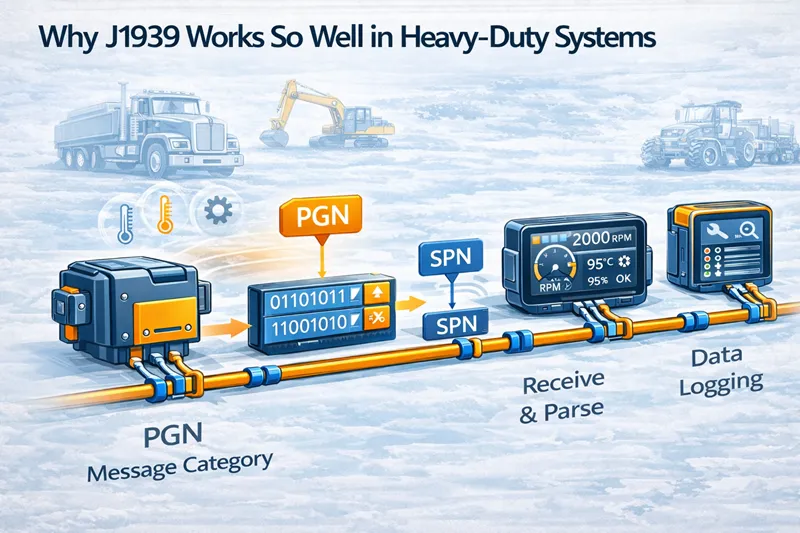
J1939 works well in heavy-duty systems because it gives machine builders a shared communication language. Instead of every supplier using a completely private format, devices can exchange standardized information across engine, transmission, display, and controller networks. That improves integration, diagnostics, and expandability.
In real machine projects, that means:
easier display integration
cleaner controller development
simpler data logging
better service diagnostics
more predictable communication between third-party ECUs
For example, if a display needs to read standardized engine data, a controller needs to react to machine status, and a logger needs to record those signals, J1939 gives them a common structure to work from. That is much more practical than reverse-engineering private CAN traffic.
What Engineers Most Often Misunderstand
The biggest misunderstanding is thinking that J1939 is just “CAN bus for trucks.” That is too vague to be useful.
The more accurate explanation is:
CAN bus handles the transport
J1939 defines the communication language
PGNs organize the message type
SPNs define the individual data items
address claim helps devices coexist
transport protocol handles longer transfers
diagnostics standardize service communication
Another common mistake is assuming a CAN-capable device automatically works on a J1939 network. That is not always true. A device may electrically connect to the bus and still fail at the protocol level if it cannot interpret J1939 message structures.
Final Answer
So, how does J1939 work?
J1939 works by combining CAN bus transport with a standardized higher-layer protocol that tells ECUs how to identify, send, receive, and interpret machine data. One ECU places a structured message on the CAN network using a 29-bit identifier. Other devices read that message, identify the PGN, decode the SPNs, and turn raw bytes into meaningful data for control, display, logging, or diagnostics.
The reason this matters is simple:
J1939 does not just move data. It makes CAN data understandable across a multi-ECU system.
FAQ
How does J1939 work?
J1939 works by using CAN bus as the transport layer and adding standardized rules for identifiers, parameter groups, addresses, and diagnostics so ECUs can exchange structured data.
Is J1939 the same as CAN bus?
No. CAN bus is the underlying network, while J1939 is a higher-layer protocol that defines message structure and meaning.
What are PGNs and SPNs in J1939?
PGNs define message groups, while SPNs define the individual parameters inside those messages.
How does J1939 handle long messages?
J1939 uses a Transport Protocol for messages that do not fit into a single CAN frame, including mechanisms such as BAM for broadcast-style multi-packet transfers.
Does a CAN device automatically support J1939?
No. A device can support CAN hardware without supporting J1939 message parsing and interpretation.