 Skip to content

J1939 Protocol for Heavy Equipment: What It Is and Why It Matters
Table of Contents
Short Answer
SAE J1939 is a higher-layer communication protocol built on CAN bus and widely used in heavy equipment to let different ECUs exchange standardized machine data. In practical terms, it gives engines, transmissions, displays, controllers, and diagnostic tools a shared language, which makes integration easier than relying only on proprietary CAN messages.
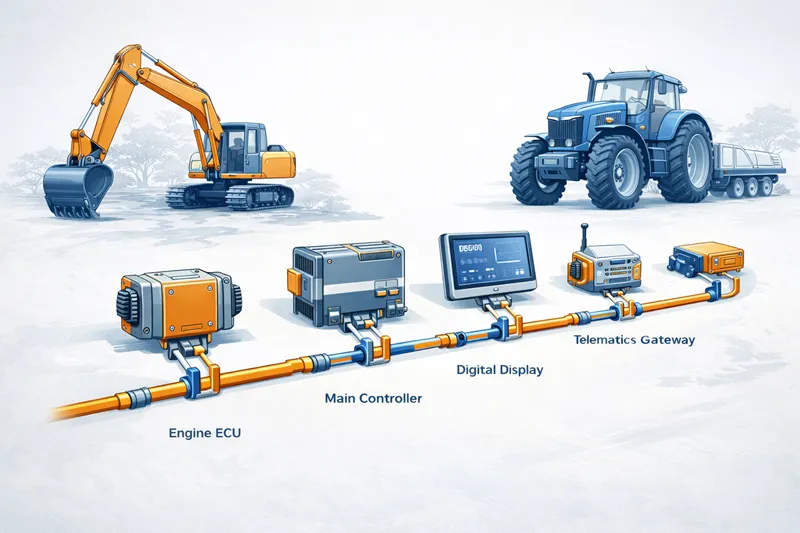
For heavy equipment manufacturers and system integrators, that matters because machine networks rarely involve just one controller. A typical machine may include an engine ECU, transmission controller, instrument display, hydraulic controller, telematics unit, and diagnostic interface. J1939 helps those devices share structured information such as engine speed, temperatures, pressure values, fault codes, and operating status in a standardized way.
What Is J1939?
SAE J1939 is a communication standard designed for heavy-duty vehicles and machinery. It runs on CAN bus, but it is not the same thing as CAN bus itself. CAN is the underlying transport layer, while J1939 defines how identifiers, parameters, diagnostic information, and network behavior are organized on top of that bus.
This distinction is important because many product pages simply say “supports CAN,” which does not automatically mean the device can interpret J1939 data correctly. J1939 adds a defined message structure, including 29-bit identifiers, Parameter Group Numbers (PGNs), Suspect Parameter Numbers (SPNs), and address management rules that plain CAN alone does not provide.
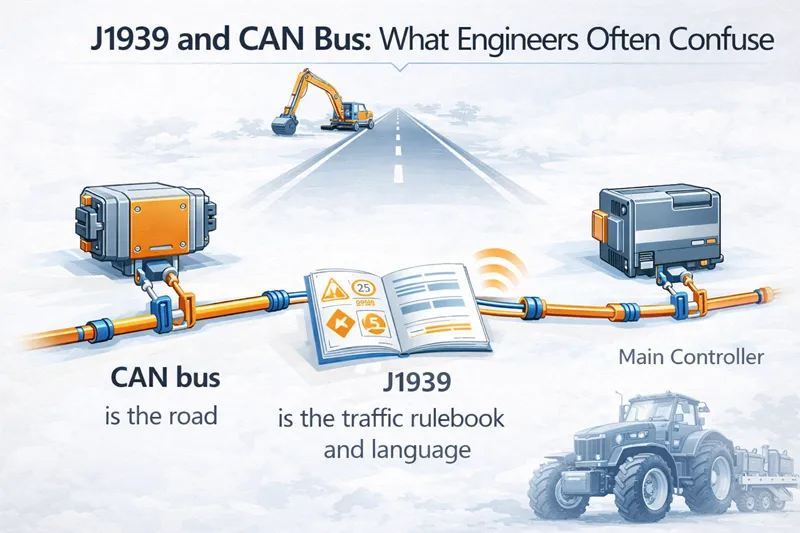
A simple way to explain it is this:
CAN bus is the road
J1939 is the traffic rulebook and language used on that road
That is why two devices can both be “CAN capable” but still fail to communicate properly unless they support the same higher-layer protocol.
Why J1939 Matters in Heavy Equipment
Heavy equipment is rarely a single-controller system. Even a mid-range machine may need data from multiple subsystems at the same time. The display may need engine speed and coolant temperature, the main controller may need torque or operating state, and the telematics unit may need diagnostic and performance data for remote reporting. J1939 is valuable because it standardizes much of that exchange.
That standardization offers three major advantages.
1. Easier multi-ECU integration
When engine suppliers, transmission suppliers, and vehicle electronics vendors all use the same protocol family, system integration becomes faster. Instead of decoding a completely custom message set from each vendor, engineers can work with standardized PGNs and SPNs. This reduces integration effort and lowers the risk of misunderstanding signal meaning.
2. Better diagnostics
J1939 is closely tied to heavy-duty diagnostics. Standardized fault and parameter structures make it easier for diagnostic tools to read machine status, detect problems, and log data. That is one reason J1939 remains closely associated with commercial vehicles and heavy machinery service workflows.
3. Faster expansion of machine functions
When machine builders want to add displays, remote monitoring, additional controllers, or smart accessories, working on a standardized protocol foundation usually makes expansion easier than building every communication link from scratch.
J1939 and CAN Bus: What Engineers Often Confuse
A common misunderstanding is treating J1939 and CAN bus as interchangeable terms. They are related, but they are not equivalent. CAN bus handles low-level message transport and arbitration. J1939 adds a defined structure on top of it for heavy-duty equipment applications.
This matters in real product selection.
For example, a display, controller, or I/O module may support CAN hardware, but unless it also supports J1939 parsing and interpretation, it will not automatically understand engine PGNs, SPNs, or diagnostic data. In other words, CAN support does not always mean J1939 support. That is one of the most important practical distinctions for OEMs and integrators to understand.
So if you are evaluating a display or controller for a heavy equipment project, the better question is not just:
“Does it have CAN?”
It is:
“Does it support the J1939 communication objects and diagnostics my machine actually uses?”
How J1939 Works in a Heavy Equipment Network
At a practical level, J1939 lets multiple ECUs communicate over the same CAN network using standardized identifiers and data meanings. Each ECU can claim an address, transmit parameter groups, and receive data from other devices on the bus. Vector and CSS Electronics both describe the protocol in terms of networked ECUs exchanging structured data rather than just raw CAN frames.
Several protocol elements are especially important.
29-bit identifier
J1939 typically uses the extended 29-bit CAN identifier. This allows more structured addressing and message classification than standard 11-bit CAN identifiers. That added identifier space helps the network encode priority, message type, source, and related context in a consistent way.
PGN (Parameter Group Number)
A PGN defines a message group or packet meaning. In practice, it helps devices know what kind of information a message contains. This is one of the reasons J1939 is more useful than raw proprietary CAN in multi-vendor machine networks.
SPN (Suspect Parameter Number)
SPNs define specific data items inside the protocol, such as engine speed or pressure-related values. They give engineers and diagnostic tools a structured way to interpret data rather than guessing signal meaning from custom byte layouts.
Address claim
Address claim allows devices to negotiate and manage source addresses on the network. This is especially important in machines with multiple smart ECUs, optional modules, or changing equipment configurations.
Where J1939 Is Used in Heavy Equipment
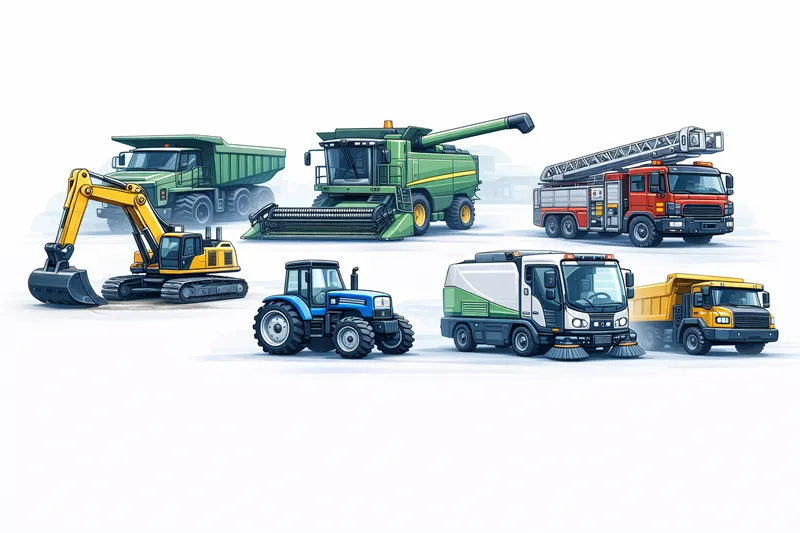
J1939 is strongly associated with heavy-duty vehicles, but in practice its reach goes well beyond on-road trucks. Industry sources also connect it to construction machinery, agricultural equipment, mobile hydraulics, and other heavy mobile systems.
Construction equipment
Excavators, loaders, graders, cranes, and other off-highway construction machines often rely on communication between the engine, display, controller, and auxiliary modules. J1939 helps standardize much of that data exchange, especially where engine and powertrain communication is involved.
Agricultural machinery
In agricultural machines, standardized communication becomes especially useful when multiple electronic systems must cooperate under harsh field conditions. J1939 is also relevant as part of the broader ecosystem that intersects with agriculture-focused standards such as ISOBUS.
Mobile hydraulic systems
Heavy equipment often depends on hydraulic control, distributed sensors, and multiple smart controllers. J1939 gives those systems a practical framework for sharing status and operational data, especially when the machine must integrate third-party subsystems.
Special vehicles and industrial equipment
Firefighting vehicles, mining machines, forestry equipment, municipal vehicles, and other special-purpose heavy machines often need standardized communication for diagnostics and integration. J1939 remains attractive in these environments because it balances standardization with rugged CAN-based networking.
Why OEMs Use J1939 Instead of Only Proprietary CAN
It is true that many heavy equipment projects still use proprietary CAN messages somewhere in the architecture. But OEMs often adopt J1939 for the parts of the machine where interoperability matters most. The reason is not that proprietary CAN is “wrong,” but that J1939 reduces integration friction where multiple vendors or subsystems must work together.
J1939 is especially valuable when:
the machine uses a third-party engine ECU
the display must read standardized engine or transmission data
diagnostic access matters for field service
multiple ECUs must share a common data model
future expansion may involve additional smart devices
In these situations, standardized communication usually saves engineering time.
When J1939 Is Not Enough by Itself
This is where many competitor pages stay too general. They explain what J1939 is, but they do not always explain its limits.
J1939 is excellent for standardized machine communication, but it is not always enough for every application layer in a modern heavy equipment project. OEMs may still use proprietary CAN for specialized control logic, high-frequency custom functions, or unique HMI interactions that fall outside the standard signal set. That means a real machine network may use both J1939 and proprietary CAN at the same time. This coexistence is common in advanced equipment design.
So the real engineering choice is often not:
J1939 or CAN
It is:
Where should I use J1939, and where do I still need proprietary communication?
That framing is much more useful for heavy equipment projects.
Why J1939 Matters for Displays, Controllers, and HMI Integration
For display and controller suppliers, J1939 matters because it shortens the distance between raw machine data and usable interface logic.
A machine display that supports J1939 can read standardized parameters from the network and present them as operator-friendly values, warnings, menus, and alarms. A controller that supports J1939 can exchange data with engine and transmission ECUs without requiring every signal to be reverse-engineered from scratch.
This becomes especially useful in heavy equipment integration projects involving:
engine data on the display
transmission status on the HMI
diagnostic alerts for service staff
telematics data upload
controller coordination across subsystems
In real projects, this often means faster development, cleaner documentation, and fewer communication mismatches between suppliers.

J1939 Diagnostics and Troubleshooting Value
One of the biggest advantages of J1939 in heavy equipment is diagnostic clarity. Standardized identifiers and data definitions make it easier to trace problems across the network. Instead of treating the machine as a black box full of custom messages, engineers can inspect known PGNs, SPNs, and diagnostic information with compatible tools.
This improves several workflows:
commissioning
service troubleshooting
fleet maintenance
field diagnostics
remote machine monitoring
For service teams, that matters just as much as the protocol itself. A communication standard is only useful if it helps people keep machines running.
A Practical Selection Rule for Heavy Equipment Projects
If you are planning a heavy equipment electronics architecture, this is a useful rule of thumb:
Use J1939 if:
you need standardized communication with engine or powertrain ECUs
multiple vendors must interoperate
diagnostics and service access matter
the display or controller must read widely used heavy-duty parameters
Use proprietary CAN if:
the function is highly custom
the signals are not covered well by standard J1939 data
you need very application-specific control behavior
Use both if:
the machine combines standard subsystem communication with proprietary control logic
you want interoperability without giving up design flexibility
This mixed approach is often the most realistic architecture for modern heavy equipment.
Final Answer
So, what does J1939 protocol for heavy equipment really mean?
It means using a standardized higher-layer CAN communication language that allows heavy equipment ECUs to exchange structured machine, engine, and diagnostic data in a way that is easier to integrate and troubleshoot than raw proprietary CAN alone. J1939 matters because heavy equipment rarely depends on one device. It depends on an ecosystem of displays, controllers, engines, and service tools that all need to understand the same machine state.
The most important takeaway is this:
J1939 is not just a protocol name. It is an integration strategy for multi-ECU heavy equipment systems.
FAQ
What is J1939 protocol for heavy equipment?
SAE J1939 is a higher-layer communication standard built on CAN bus and widely used in heavy equipment so ECUs can exchange standardized data.
Is J1939 the same as CAN bus?
No. CAN bus is the underlying communication bus, while J1939 defines how data is organized, identified, and interpreted on top of CAN.
What are PGNs and SPNs in J1939?
PGNs identify parameter groups or message types, while SPNs identify specific parameters within the J1939 framework.
Why is J1939 common in construction and agricultural equipment?
Because it supports standardized ECU communication, diagnostics, and multi-vendor integration in heavy mobile machinery.
Does CAN support mean J1939 support?
No. A device can support CAN hardware without supporting J1939 message interpretation, PGNs, SPNs, or address management.