 Skip to content

CAN Bus vs Modbus: What Engineers Need to Know
Table of Contents
No, CAN bus and Modbus are not the same.
They are used for industrial and machine communication, but they do not play the same role in a system, and they are not designed around the same communication logic.
The confusion usually comes from the fact that both are used to connect controllers, sensors, displays, drives, and other electronic devices. However, CAN is fundamentally a bus-based communication technology with built-in arbitration and error handling, while Modbus is an application-layer messaging protocol used for exchanging data such as coils and registers between devices.
The official Modbus specification explicitly defines Modbus as an application layer protocol, while CAN-related standards and industry references describe CAN in terms of bus access, data-link behavior, and higher-layer protocols built on top of it.
For engineers, this difference matters because it affects network architecture, real-time performance, fault behavior, and device ecosystem choices. If you treat CAN bus and Modbus as interchangeable, you may choose the wrong network for your machine, or design an integration architecture that is much harder to scale and maintain.

What Is CAN Bus?
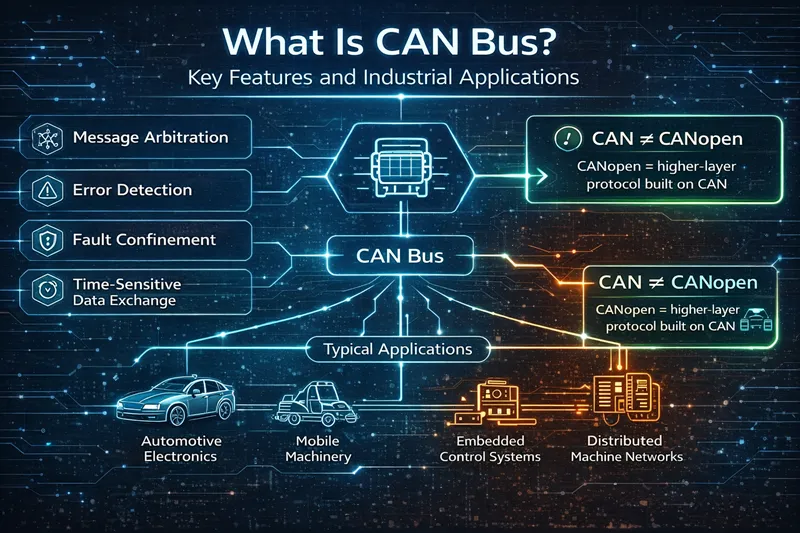
CAN bus, originally developed for distributed control in vehicles, is designed for reliable communication between multiple electronic nodes on the same network. A key strength of CAN is that multiple devices can share the bus, and the protocol includes message arbitration, error detection, and fault confinement behavior.
In practical terms, that means CAN is well suited for systems where many controllers or intelligent devices must exchange time-sensitive data without relying on one central master to poll every node.
This is one reason CAN is widely used in automotive electronics, mobile machinery, embedded control systems, and distributed machine networks.
In these environments, you often care about deterministic behavior, node-level robustness, and the ability to keep the rest of the network alive even when one device starts misbehaving. CAN’s architecture is built around those needs.
It is also important to understand that CAN itself is not the same as CANopen. CAN provides the lower-level communication foundation, while CANopen adds standardized communication objects, configuration, and network management on top of CAN.
CAN in Automation describes CANopen as a standardized embedded network that relieves developers from dealing directly with hardware-specific CAN details and provides standardized communication objects for time-critical processes and network management.
What Is Modbus?
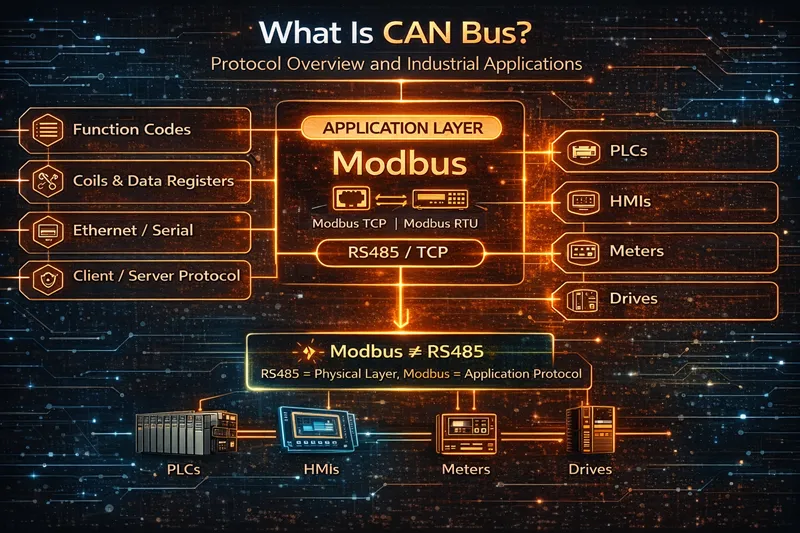
Modbus is a different kind of technology. The Modbus Organization defines it as an application protocol for distributed automation systems, and the Modbus Application Protocol Specification describes how clients and servers exchange data through function codes and data objects such as coils, discrete inputs, input registers, and holding registers.
In practice, many engineers encounter Modbus RTU on serial networks and Modbus TCP on Ethernet networks. That is why beginners often mix Modbus up with RS485.
But the two are not the same thing. RS485 is a physical-layer serial standard, while Modbus is the messaging protocol that often runs on top of a serial line or Ethernet. The official Modbus materials separate the application protocol from the transport or implementation layer, which is exactly why “Modbus = RS485” is not technically correct.
Modbus is extremely common in PLCs, HMIs, meters, drives, and SCADA-connected equipment because it is simple, widely supported, and easy to implement for register-based data exchange. If your goal is to expose process values, alarms, status bits, or parameter tables to a PLC or supervisory system, Modbus often feels very natural.
Why People Confuse CAN Bus and Modbus
The confusion is understandable. In a real project, both CAN and Modbus can appear in the same machine. A controller may talk to distributed I/O over CAN, while a PLC or energy meter may expose data over Modbus. From a distance, both look like “industrial communication protocols.”
But that similarity is superficial. The deeper difference is this:
CAN is centered around bus-level communication between multiple intelligent nodes
Modbus is centered around data exchange through defined requests and responses at the application level
That is why the better engineering question is not “Which one is better?” but rather:
What layer am I solving, and what kind of network behavior do I need?
CAN Bus vs Modbus: The Key Differences
1. Protocol Layer
This is the most important distinction.
Modbus is explicitly defined as an application-layer protocol. Its official specification focuses on function codes, request/response structures, and data addressing such as coils and registers.
CAN, by contrast, is commonly discussed in terms of the bus, frame, arbitration, and error signaling. Industry references from CiA explain CAN across physical, data-link, and application usage contexts, and higher-layer protocols such as CANopen are built on top of the CAN foundation.
So when someone asks whether CAN bus and Modbus are the same, the cleanest answer is:
No. They do not even occupy the same role in the protocol stack.
2. Communication Logic
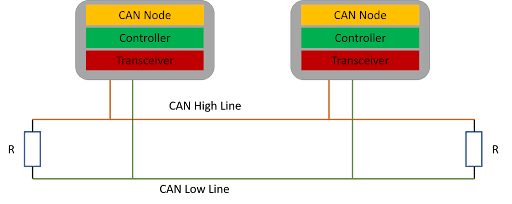
CAN is designed for multi-node bus communication, where messages are placed on the network and arbitration decides which message wins access when multiple nodes transmit. This design is particularly useful for distributed embedded systems that must move status, commands, and feedback quickly between controllers and peripherals.
Modbus is built around client/server request-response messaging. A client asks for data or writes data, and a server responds. This structure works very well for reading parameter maps, process values, and status tables from devices such as meters, VFDs, and remote I/O stations. The Modbus application protocol specification is structured around exactly these request and response operations.
3. Real-Time Behavior
In many machine-control scenarios, CAN is the better fit when you need fast, distributed, event-driven communication between electronic control units. That is one reason it is common in vehicle and mobile machine architectures.
Modbus can work well in many industrial systems, but its register-oriented request-response structure is typically more comfortable for supervision, configuration, parameter access, and process data acquisition than for tightly coordinated embedded control among many equal peers. This is not a flaw; it is simply a different design goal.
4. Fault Handling
A major reason embedded and vehicle engineers like CAN is its built-in attention to network robustness. CAN references emphasize error detection and fault-related behavior as part of the network design. In practical machine engineering, that means CAN networks are often better suited to situations where one faulty node should not easily bring down the entire control architecture.
Modbus, by comparison, is typically used in architectures where simplicity and interoperability matter more than bus-level self-management. It is excellent for broad device compatibility, but engineers should not assume it provides the same network behavior as CAN in terms of arbitration and node-level fault handling.
CAN Is Not CANopen, and Modbus Is Not RS485
This is the layer confusion that causes many bad decisions.
CAN is not the same as CANopen.
CANopen is a higher-layer, standardized network based on CAN. It adds communication objects, network management, and application structuring that raw CAN alone does not provide. CiA describes CANopen as a standardized embedded network with standardized communication objects for time-critical processes and network management.
Modbus is not the same as RS485.
Modbus is the protocol. RS485 is one possible physical medium often used with Modbus RTU. You can also have Modbus TCP, which makes the difference obvious: if Modbus can run over TCP/IP as well, then Modbus clearly is not identical to RS485.
Once you understand those two distinctions, the entire comparison becomes much clearer:
CAN vs CANopen = foundation vs higher-layer implementation
RS485 vs Modbus = physical medium vs application protocol
Where CAN Bus Makes More Sense
CAN is usually the stronger choice when you are building:
mobile machinery control networks
off-highway vehicle electronics
embedded controllers with distributed I/O
real-time communication between displays, controllers, and smart nodes
machine architectures where fault behavior and distributed coordination matter
In these applications, you often need more than simple register reads. You need a network that supports robust message exchange among multiple intelligent devices. That is where CAN-based architectures are a natural fit. CiA materials also show how CANopen extends CAN for many embedded and industrial applications, including time-critical processes and network management.
From an engineering perspective, this is why many machine OEMs keep controllers, HMI displays, keypads, and distributed I/O modules on CAN-family networks. The network behavior aligns well with machine control.
Where Modbus Makes More Sense
Modbus is usually the stronger choice when you are building or integrating:
PLC-centered control systems
SCADA-connected equipment
power meters and analyzers
variable frequency drives
simple remote I/O or instrument networks
projects where wide third-party compatibility matters most
The official Modbus ecosystem is built around distributed automation and standard function-code-based access to device data. That makes Modbus especially attractive when interoperability is more important than advanced bus behavior.
If your main job is to expose process data, allow parameter adjustment, and let a PLC or HMI read and write registers predictably, Modbus is often the more practical answer.
Can You Connect CAN and Modbus Together?
Yes, but usually through a gateway, not by pretending they are the same thing.
A gateway can translate or map data between a CAN-side network and a Modbus-side system. For example, a controller may collect distributed machine data over CAN and then expose selected values to a PLC over Modbus. That is a common integration pattern.
But a gateway does not erase the architectural difference between the two protocols. It only bridges them. The engineer still needs to decide:
which side owns the real-time control logic
which data must be cyclic, event-driven, or polled
how errors are handled on each network
how objects or signals are mapped across the protocol boundary
This is where many articles are too shallow. They say “you can convert between them,” but they do not explain that data exchange is bridgeable while network behavior is not automatically equivalent.
A Simple Engineer’s Rule of Thumb
If you are deciding between them, this rule is practical:
Choose CAN-family networking when the machine itself needs robust, distributed, time-sensitive embedded communication.
Choose Modbus when the system mainly needs broad industrial interoperability and register-based data exchange.
Or even shorter:
Machine control network? Think CAN
PLC / instrument integration? Think Modbus
That rule will not solve every architecture problem, but it prevents one of the most common early-stage mistakes: comparing CAN and Modbus as if they were just two brands of the same protocol.
Final Verdict
No.
They are different in purpose, structure, and system role.
CAN is built around bus-level distributed communication, with arbitration and fault-related behavior that make it attractive for embedded and mobile-machine networks. Modbus is an application-layer messaging protocol built for data exchange in automation systems, especially where PLCs, instruments, and supervisory systems need a common language.
The real engineering takeaway is not just that they are different. It is that they solve different layers of the communication problem. Once you understand that, protocol selection becomes much easier, and system architecture decisions become much cleaner.
FAQ
Are CAN bus and Modbus the same?
No. CAN bus and Modbus are different technologies with different roles in a communication system. Modbus is an application-layer protocol, while CAN is used as the communication foundation for distributed bus networking.
Is Modbus the same as RS485?
No. RS485 is a physical serial standard, while Modbus is a communication protocol that is often carried over RS485. Modbus can also run over TCP/IP.
Is CAN the same as CANopen?
No. CANopen is a higher-layer standardized protocol built on CAN. It adds standardized communication objects and network management functions.
Can Modbus run on CAN?
In practice, engineers usually bridge CAN-based systems and Modbus-based systems through gateways rather than treating them as the same native protocol family. Official references treat CAN/CANopen and Modbus as separate protocol ecosystems.
Which is better for PLC communication?
Modbus is often more natural for PLC communication because of its strong industrial automation ecosystem and register-based data model.
Which is better for mobile machinery?
CAN is often the better fit for mobile machinery and distributed embedded control because of its network behavior and widespread use in vehicle and machine electronics.