 Skip to content

Mobile HMI Controller with CODESYS Support
Table of Contents
Modern mobile machinery—whether agricultural equipment, construction vehicles, sanitation trucks, or forestry harvesters—demands intelligent control, intuitive interfaces, and reliable real-time communication.
A Mobile Machine HMI Controller with CODESYS product support combines visualization, control logic, and industrial networking into a single ruggedized platform—designed for harsh environments and distributed machine architectures.
This guide explains what it is, how it works, and how to choose the right solution.
What Is a Mobile Machine HMI Controller with CODESYS?
A mobile HMI controller is a rugged embedded device that integrates:
Human-Machine Interface (HMI) — Touchscreen or graphical display
Controller
Industrial communication interfaces
CODESYS runtime support
Unlike traditional HMI-only panels, these controllers allow developers to program control logic directly inside the device using the IEC 61131-3 standard supported by CODESYS.
This eliminates the need for a separate PLC in many mobile machine architectures.

Why CODESYS Matters in Mobile Machinery
CODESYS is a widely adopted industrial automation development platform based on IEC 61131-3 programming standards.
Key advantages:
Supports Structured Text, Ladder Logic, Function Block Diagram
Hardware-independent development environment
Standardized runtime architecture
Broad ecosystem across industrial hardware vendors
In mobile equipment, CODESYS enables:
Integrated machine control
CANopen / J1939 protocol handling
Real-time logic execution
On-screen visualization integration
For OEMs and system integrators, this means shorter development cycles and easier maintenance.
Core Technical Features
Integrated HMI + PLC Architecture
Instead of separating display and control hardware, CODESYS-enabled HMI controllers combine:
Visualization layer
Logic engine
I/O processing
Communication stack
This reduces:
Wiring complexity
Cabinet space
Latency between HMI and PLC
Communication Interfaces for Mobile Machines
Most mobile machine HMI controllers support:
CAN bus (ISO 11898)
SAE J1939
CANopen
Ethernet (TCP/IP)
Modbus TCP
Optional MQTT / OPC UA
In off-highway machinery, CAN bus is the backbone of distributed control systems, enabling real-time engine, hydraulic, and transmission communication.
Ruggedized Design for Harsh Environments
Mobile machines operate in:
High vibration environments
Extreme temperatures
Dust, mud, and water exposure
Typical rugged specifications include:
IP65 / IP67 front protection
Wide temperature range (−20°C to +70°C or more)
Sunlight-readable displays
Glove-friendly touch panels
Hardware Categories
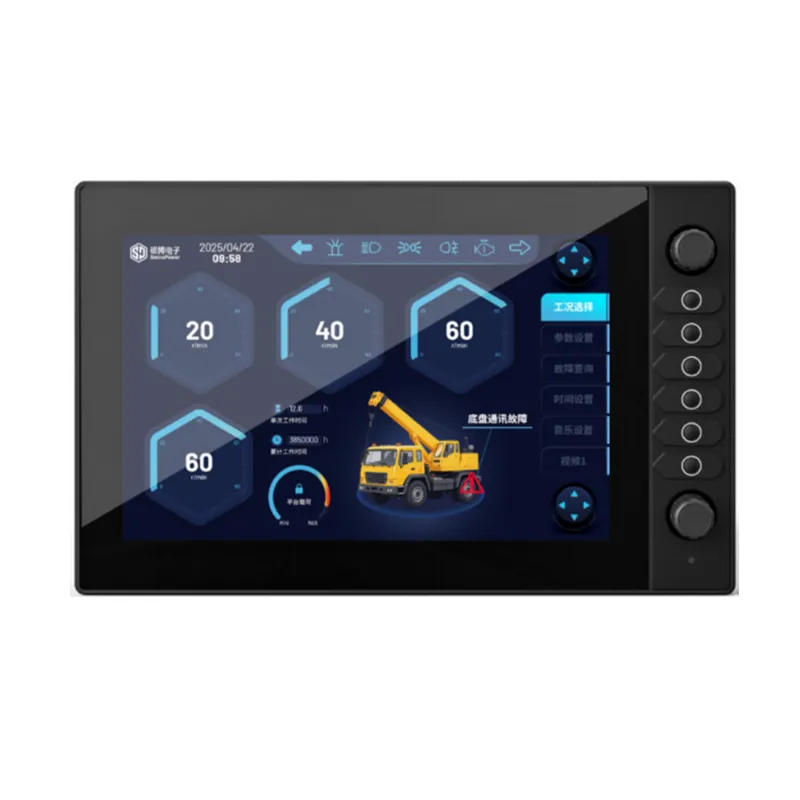
Industrial Touchscreen HMI Controllers
Common screen sizes:
4.3″
7″
10.1″
12.1″
Applications:
Agricultural tractors
Excavators
Road sweepers
Firefighting vehicles
HMI + PLC Combo Controllers
These are full programmable controllers with integrated display.
Ideal for:
Compact machine designs
Retrofit upgrades
Low-space cabins
Headless Controllers + Web HMI
Some mobile platforms require:
No physical display
Remote visualization
Cloud telemetry integration
In these cases, CODESYS controllers support:
Web visualization
VNC remote access
Edge gateway functionality
Typical Applications
Agriculture Machinery
Tractor ECU coordination
Implement control
Hydraulic monitoring
ISOBUS integration
Construction Equipment
Excavator control systems
Loader status visualization
Telematics dashboards
Forestry & Harvesters
Engine load monitoring
CAN-based hydraulic control
Data logging systems
Sanitation & Municipal Vehicles
Pump control
Tank level visualization
Fleet data integration
Benefits for OEMs
| Feature | Benefit |
|---|---|
| Single hardware platform | Reduced BOM |
| IEC 61131-3 support | Standardized programming |
| CAN/J1939 integration | Native vehicle compatibility |
| Rugged housing | Longer lifecycle |
| Remote diagnostics | Reduced downtime |
How to Choose the Right CODESYS HMI Controller
When selecting a solution, evaluate:
1. Runtime Compatibility
Confirm:
CODESYS V3 support
Service pack compatibility
Required protocol libraries
2.CPU & Memory Capacity
For:
Complex visualization
Multi-CAN networks
Data logging
3.CAN Interface Support
Verify:
Number of CAN channels
J1939 stack integration
CANopen master/slave capability
4. Environmental Rating
Check:
IP protection
Operating temperature
Vibration certification
Architecture Example
A typical mobile control system may include:
HMI Controller (CODESYS runtime)
Distributed CAN I/O modules
Engine ECU (J1939)
Hydraulic control valves
Telematics gateway
All communicating over a shared CAN backbone.