 Skip to content

What Are the Disadvantages of CAN Buses?
Table of Contents
CAN buses have several inherent disadvantages that limit their use in modern systems, including low bandwidth, small data payloads, lack of built-in security, poor scalability, and unpredictable latency under heavy load.
These limitations make CAN unsuitable for high-speed, data-intensive, or security-critical applications, despite its reliability in simple control networks.
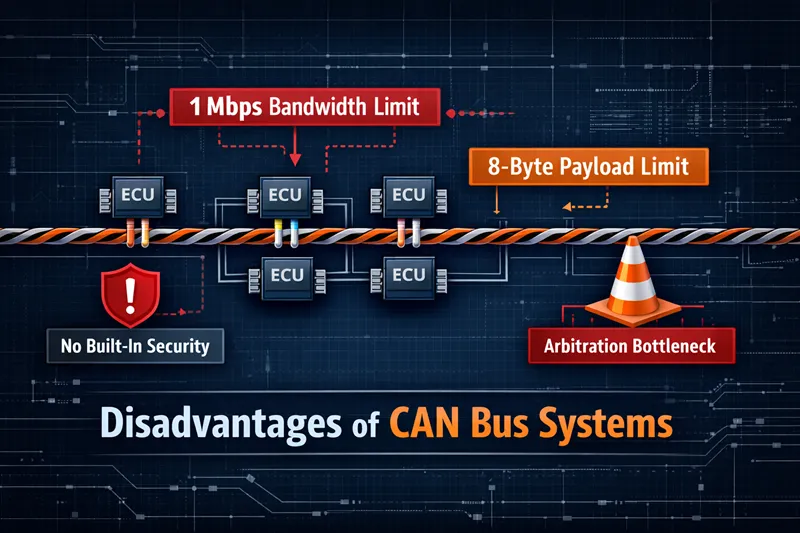
Key Disadvantages of CAN Bus Systems (Quick Overview)
Limited bandwidth (up to 1 Mbps in classic CAN)
Small payload size (8 bytes per frame)
No built-in security (no encryption or authentication)
Poor scalability in large or distributed systems
Latency and arbitration bottlenecks under high bus load
Physical distance and wiring constraints
Why Bandwidth Is a Major Limitation
CAN bus bandwidth is significantly lower than modern communication protocols.
As message traffic increases, arbitration delays become more frequent, reducing effective throughput and increasing latency—especially for low-priority messages.
Payload Size Restrictions Increase Bus Load
With only 8 bytes per frame in classic CAN, large datasets must be fragmented across multiple messages.
This increases overhead, bus congestion, and software complexity, particularly in sensor-rich systems.
Lack of Native Security Is a Critical Weakness
CAN does not provide encryption, authentication, or message integrity checks by design.
Any node on the bus can transmit messages, making CAN vulnerable to spoofing, injection, and eavesdropping without additional security layers.
Scalability and System Complexity Issues
As the number of nodes grows, arbitration becomes more frequent, timing predictability decreases, and fault isolation becomes more difficult.
In practice, system designers often rely on the capabilities of the CAN bus controller—such as message filtering, priority handling, buffering, and error management—to mitigate some of these scalability challenges, but protocol-level limitations still remain.
Physical and Electrical Constraints
CAN bus performance depends on cable length, termination quality, and electromagnetic conditions.
Higher speeds require shorter cable lengths, limiting CAN’s suitability for large-area or long-distance systems.
When CAN Bus Is Not the Right Choice
CAN buses are not well suited for:
High-speed data transfer
Large payload communication
Secure or internet-connected systems
Software-defined or highly modular architectures
In these cases, CAN is often supplemented or replaced by higher-bandwidth protocols.
Summary
CAN bus remains effective for simple, real-time control, but its disadvantages become significant as system complexity increases.
Understanding these limitations is essential when designing modern vehicle and industrial communication architectures.