 Skip to content

Why Does a CAN Bus Need Two Wires?
Table of Contents
Short Answer
A CAN bus needs two wires because it uses differential signaling.
By transmitting data as the voltage difference between two wires—CAN_H and CAN_L—the CAN bus can:
Reject electrical noise
Maintain reliable communication over long distances
Support multiple nodes on the same shared network
This two-wire design is a key reason why CAN remains stable and trustworthy in vehicles and industrial machines.
The Role of CAN_H and CAN_L
In a CAN system, communication does not rely on the absolute voltage of a single wire.
Instead:
CAN_H and CAN_L carry complementary signals
Data is encoded in the difference between their voltages
Each node reads the difference, not the individual signal levels
Because both wires are exposed to the same external interference, most electrical noise affects them equally and is canceled out during signal comparison.
This is the fundamental reason CAN uses two wires instead of one.

Differential Signaling: The Core Design Principle
Differential signaling is widely used in communication systems that must operate reliably in noisy environments.
In a CAN bus:
A dominant state is represented by a clear voltage difference between CAN_H and CAN_L
A recessive state occurs when both lines sit at nearly the same voltage
What matters is not whether one wire is “high” or “low”, but how large the voltage difference is between the two.
This approach provides:
Strong immunity to electromagnetic interference (EMI)
Stable communication even near motors and high-current devices
Consistent message interpretation across all nodes on the bus
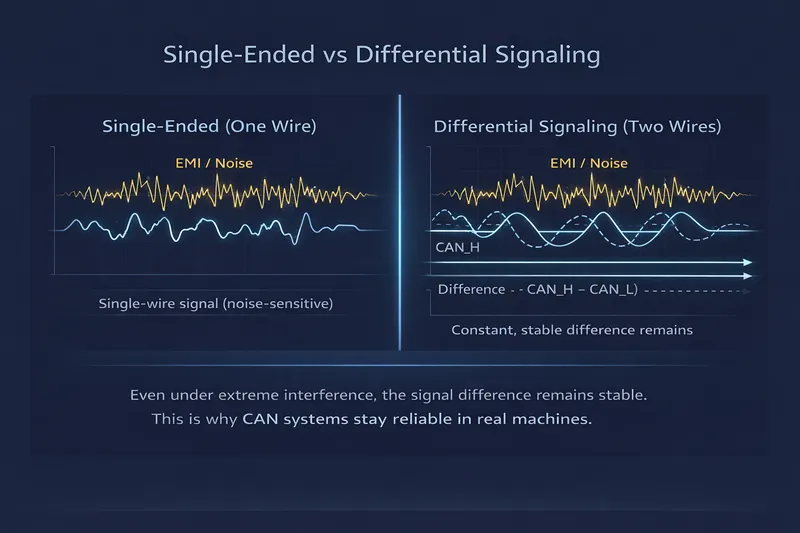
Why a Single Wire Is Not Enough
A single-wire communication system relies on an absolute voltage reference, which makes it vulnerable to interference and ground fluctuations.
In real-world machines, this is a serious limitation.
Vehicles and mobile equipment contain:
Electric motors
Solenoids and hydraulic valves
High-current switching circuits
These components generate electrical noise that can easily corrupt single-ended signals.
In practical terms:
For a construction excavator or an agricultural tractor, a single communication error caused by motor interference could lead to control stuttering, unexpected behavior, or even unsafe movements. The two-wire differential design acts as built-in insurance against these real-world risks, keeping machine communication stable under harsh conditions.
This is where CAN’s two-wire design moves from a technical choice to a safety-critical one.
Twisted Pair Wiring and Noise Rejection
CAN_H and CAN_L are typically implemented as a twisted pair.
Twisting the two wires:
Ensures both conductors experience nearly identical interference
Maximizes noise cancellation
Reduces electromagnetic emissions from the bus itself
The twisted-pair layout works together with differential signaling to maintain signal integrity across long cable runs and vibrating structures.
Termination Resistors and Signal Integrity
A two-wire CAN bus also depends on proper termination at both ends of the network.
Termination resistors:
Match the characteristic impedance of the cable
Prevent signal reflections
Preserve the voltage difference between CAN_H and CAN_L
Without correct termination, even a differential system can suffer from distorted signals, especially at higher data rates.
Hardware Quality Matters as Much as the Protocol
The robustness of a CAN network is not defined by the protocol alone.
In real machines, the physical environment places stress on wiring and interfaces through:
Vibration
Temperature changes
Electrical surges
Mechanical wear
To fully benefit from CAN’s two-wire differential design, controllers and I/O modules must protect these two critical signal lines against real-world electrical and mechanical stress.
Protocol-level reliability only translates into system-level reliability when the hardware carrying those signals is designed for harsh operating conditions.
Supporting Multiple Nodes on One Bus
CAN is a multi-node, multi-master network.
The two-wire shared bus allows:
All nodes to observe the same bus state
Reliable arbitration using dominant and recessive bits
Non-destructive collision handling
This arbitration mechanism depends on every node seeing the same voltage difference on the bus, which would not be possible with a single-wire design.
Long-Distance Operation and Harsh Environments
One of CAN’s original design goals was stable communication over distance.
The two-wire differential architecture enables:
Reliable operation over long cable runs
Resistance to vibration and electrical noise
Consistent behavior across vehicles, agricultural machinery, and industrial equipment
This is why CAN remains widely used decades after its introduction.
Summary: Why CAN Uses Two Wires
A CAN bus needs two wires because:
Communication is based on voltage difference, not absolute voltage
Differential signaling provides strong noise immunity
Twisted-pair wiring enhances signal stability
Proper termination maintains signal integrity
The design supports safe multi-node arbitration in real machines
The two-wire architecture is not an implementation detail—it is a core reason why CAN works reliably in demanding environments.