 Skip to content

Increasing Demand for IP67 Electronics in Off-Highway Vehicles
Table of Contents
Why Reliability Has Become a Core Requirement
Off-highway vehicles operate in harsh environments while becoming increasingly electrified and electronically controlled. As critical electronics move closer to dust, water, vibration, and extreme temperatures, reliability has become a system-level requirement rather than a design preference.
In this context, IP67-rated electronics are no longer a premium feature but a baseline expectation. This article explains why demand for IP67 protection is rising in off-highway vehicles and how ingress protection directly affects system reliability, operating costs, and long-term value.
Why Off-Highway Vehicles Demand Higher Protection Levels
Off-highway equipment operates in conditions that are fundamentally different from on-highway vehicles or factory automation systems. These machines are continuously exposed to:
Dust, mud, and debris
Rain, snow, and water splashes
High-pressure cleaning during maintenance
Extreme temperature fluctuations
Constant vibration and mechanical shock
As electronics become more deeply integrated into vehicle functions, failures caused by environmental exposure have more serious consequences.
In industries such as mining, construction, and large-scale agriculture, a single hour of unplanned downtime caused by a failed electronic component can result in thousands of dollars in lost productivity, delayed operations, and increased service costs. In this context, ingress protection is not just about durability—it is about risk management.
Electrification and Smart Controls Accelerate IP67 Adoption
The shift from mechanical and relay-based systems to electronic and intelligent control systems has dramatically increased the number of electronic components used in off-highway vehicles.
Modern machines now rely on:
- Keypad
Sensors and communication modules
These components are often installed outside sealed control cabinets and closer to the field, where exposure risks are significantly higher. As a result, IP67 protection has become essential to support the broader trend toward smart control and system integration.
Without sufficient ingress protection, the benefits of electrification—such as improved efficiency, diagnostics, and automation—are undermined by increased failure risk.
What IP67 Really Means in Off-Highway Applications
IP67 is defined under the IEC 60529 standard and represents two critical protections:
Dust-tight protection against solid particle ingress
Protection against temporary immersion in water, typically up to 1 meter
In off-highway applications, IP67 does not mean electronics are indestructible or permanently waterproof. Instead, it means components are designed to withstand realistic field conditions such as heavy rain, splashing water, mud exposure, and temporary immersion during operation or maintenance.
Understanding this distinction is important, as improper expectations around IP ratings can lead to poor design decisions and unexpected failures.
IP65 vs IP67 vs IP69K: Choosing the Right Protection Level
Different ingress protection levels serve different purposes, and selecting the correct rating depends on the actual operating environment.
| Feature | IP65 | IP67 | IP69K |
|---|---|---|---|
| Dust Protection | ✔ | ✔ | ✔ |
| Water Jets | ✔ | ✔ | ✔ |
| Temporary Immersion | ✖ | ✔ | ✖ |
| High-Pressure Wash | ✖ | ✖ | ✔ |
| Typical Off-Highway Use | Limited | Common | Specific |
IP65 may be sufficient for controlled environments but often falls short in outdoor, mud-heavy, or wash-down scenarios.
IP67 is widely adopted in off-highway vehicles because it balances protection, cost, and system flexibility.
IP69K is typically reserved for specific applications with frequent high-pressure cleaning and does not automatically replace IP67.
In practice, IP67 has emerged as the most versatile and widely accepted protection level for off-highway electronics.
Key Electronics Requiring IP67 in Off-Highway Systems
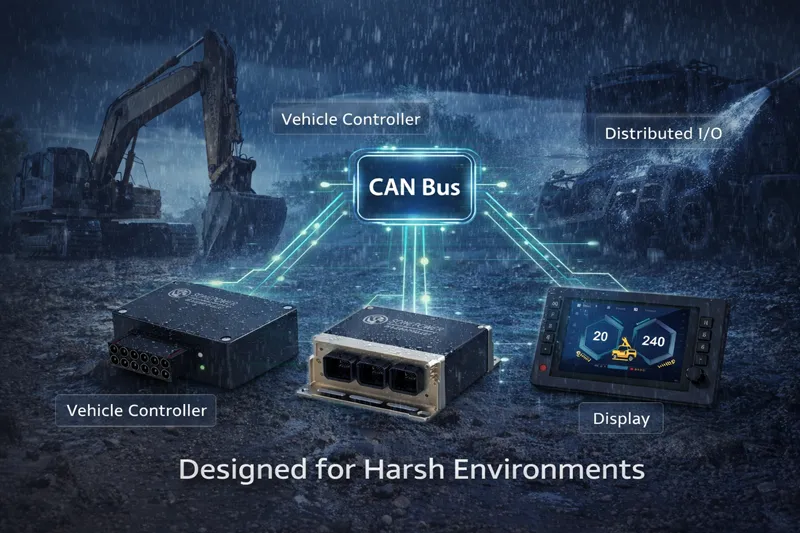
Ingress protection must be considered across all critical electronic components, not just a single device. Common IP67-required components include:
Vehicle controllers, responsible for core logic and system coordination
Rugged displays (HMI), providing real-time data, diagnostics, and operator interaction
Distributed I/O modules, connecting sensors and actuators closer to the field
On-board computing units, handling data processing and communication
As these components form an interconnected control system, failure of any single module can impact the entire machine.
Why Connectors and Enclosures Matter as Much as Electronics
In many off-highway failures, the root cause is not direct water ingress, but internal condensation caused by temperature fluctuations.
During daily operation, electronics may experience rapid heating and cooling cycles. Without proper pressure equalization, moisture can accumulate inside sealed housings and gradually damage sensitive components.
Using over-molded connectors, high-quality seals, and breathable membranes helps equalize internal pressure and prevent condensation—often a hidden killer of IP67 electronics in real-world applications.
This highlights a critical principle: system-level ingress protection is defined by the weakest component, not by the rating of an individual module.

The Business Case Behind the Growing Demand for IP67
The growing adoption of IP67 electronics is driven not only by technical considerations, but also by business realities.
Reduced Downtime and Service Costs
Better-protected electronics experience fewer environment-related failures, reducing unplanned downtime and the need for field repairs.
Lower Warranty and Liability Risks
IP67-rated systems significantly reduce warranty claims related to water ingress and contamination, lowering long-term support costs for OEMs.
Improved Asset Value
Machines designed with sealed electronics maintain higher resale value and better brand reputation over their operational lifecycle.
For many OEMs and fleet operators, IP67 protection has become a total cost of ownership (TCO) decision, not just a technical specification.
IP67 as a Baseline, Not a Differentiator
As off-highway equipment continues to evolve, IP67 protection is increasingly treated as a minimum requirement rather than a competitive advantage.
OEMs now design platforms assuming sealed electronics from the outset, shifting differentiation toward:
System architecture
Diagnostics and monitoring
Scalability and future upgrades
In this environment, IP67 is the foundation that enables reliable electronic systems, not the feature that defines them.
Conclusion – Why IP67 Has Become the New Standard
The increasing demand for IP67 electronics in off-highway vehicles reflects a broader industry shift toward electrification, intelligence, and reliability.
By addressing environmental risks at the system level, IP67 protection helps reduce downtime, control operating costs, and ensure long-term performance in harsh conditions. As a result, it has become an essential requirement for modern off-highway equipment—one that supports both technical excellence and sound business decisions.